Beijing (AsiaNews) – The national team failed to qualify for the tournament and the Asian sides have fallen short of expectations, but the Chinese – from companies to football fans – are closely following the World Cup currently taking place in the United States.
Whilst, on the one hand, numerous Chinese companies have triumphed at the ‘World Cup of trade and business’, a veritable ‘Haaland-mania’ has swept through the public in recent days: the striker for the Norwegian national team and Manchester City has become an obsession amongst internet users, with fans creating memes and videos featuring him, exaggerating his on-pitch expressions and magnifying his exploits, and many will be rooting for him in the quarter-final clash with England.
A man who devours passing trains; a giant with devastating strength; a robot striker with the occasional human smile. On Chinese social media, these are just some of the now-viral portrayals of the 26-year-old Norwegian Erling Haaland. Having recently scored 16 goals that propelled his team to the World Cup in the US – their first appearance since 1998 – the Premier League striker is now an ‘obsession’ for Chinese internet users. Users are turning every goal he scores, every exaggerated facial expression or off-pitch antics, into a non-stop stream of increasingly viral content.
With the tournament underway [Norway face England tonight for a place in the semi-finals], hashtags about Haaland have attracted more than 490 million views on the microblogging platform Weibo. The footballer opened an official account on the Chinese platform earlier this month, as well as on Douyin, the Chinese version of TikTok, attracting 194,000 followers in just a few days. Standing almost two metres tall and with a powerful physique, Haaland is often portrayed online as a ‘robot striker’ or ‘Nordic cyborg’, with an extreme physicality that makes him resemble a machine.
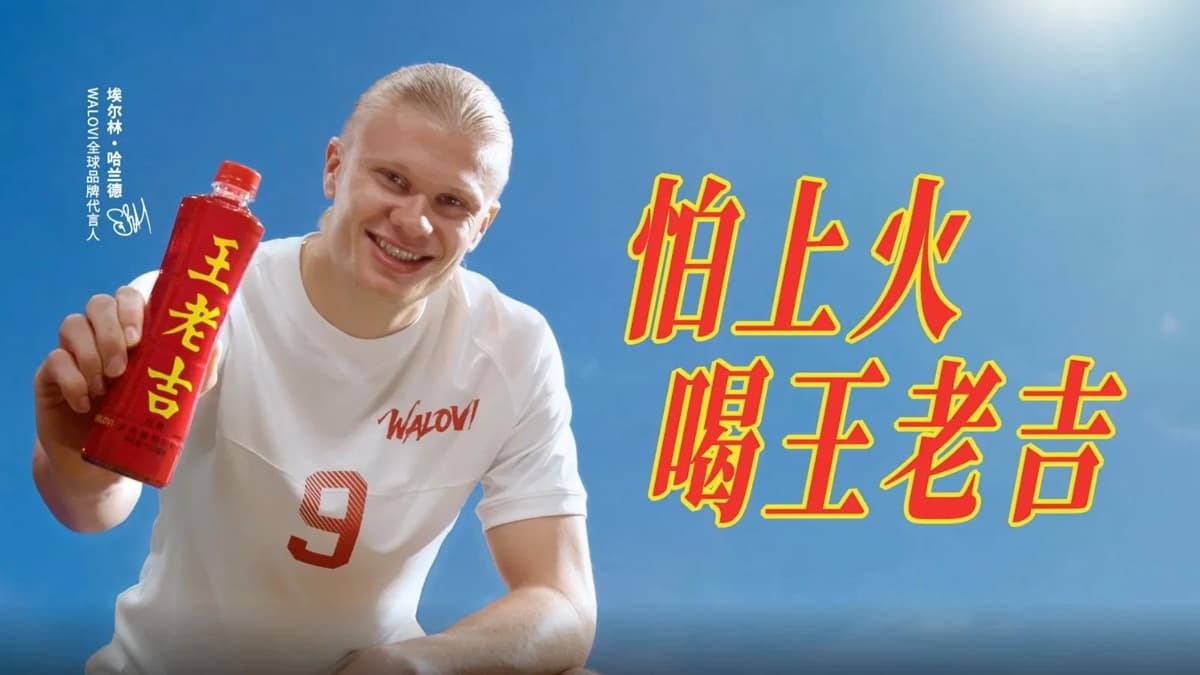
Among young Chinese netizens, he has become a symbol of ‘abstract’ energy – a term used to describe something surreal, bewildering or difficult to explain. His popularity has subsequently attracted commercial interest in China, where he is a brand ambassador for the herbal tea brand Wanglaoji and represents the Norwegian Seafood Council in promoting Norwegian exports of salmon and other seafood.
As the Global Times, the official English-language newspaper, explains, his recent campaigns for this typical Norwegian product have been a huge success with consumers, as has his decision to become the face of Walovi by Wang Lao Ji, the international brand of Chinese herbal teas.
The sight of a football superstar – with a market value of 200 million euros according to Transfermarkt – speaking Mandarin with conviction and appearing in an advert for Chinese drinks created an immediate comic contrast. The campaign’s jingle, built around a repetitive “ha-ha-ha” rhythm, plays on the initials of Haaland’s surname and the Chinese verb for ‘to drink’, providing viewers with an easy hook. Many viewers have said the tune sticks in their heads, joking that they found themselves humming it whilst walking or eating.
After all, the commercial and business sector is where Beijing has already secured success at this year’s FIFA World Cup, becoming an unmistakable presence. In stadiums across the United States, Canada and Mexico, Chinese brands such as Hisense, Lenovo and Mengniu are highly visible, extending their influence far beyond sponsorship. The first two have set up fan zones at the competition venues to attract supporters.
Furthermore, Lenovo, FIFA’s official technology partner, has gone a step further by integrating its systems into the tournament’s technical infrastructure: its Football AI Pro platform, in fact, provides all 48 teams with advanced match analysis, placing Chinese technology at the heart of every match.
This contrast between absence on the pitch and prominence off it captures an even broader reality.
Despite President Xi Jinping’s ambition to transform China into a footballing powerhouse, with the aim of hosting and winning the tournament, the national team has not qualified for over 20 years. Structural weaknesses – political interference, corruption, financial instability and poor grassroots development – continue to undermine performance.
Yet China’s influence in football is expanding through alternative channels, and this World Cup demonstrates how it can be projected not only through sporting success, but also through commercial clout, technological integration and cultural exposure.
One prime example emerges from the Loy Institute’s 2026 survey, which found that younger Australians aged between 18 and 29 hold more positive views of China than the wider population. Seven out of ten view China as an economic partner and are less likely to perceive it as a security threat.
They are also slightly more inclined to trust Beijing to act responsibly on the global stage, with 32 per cent holding this view compared to 28 per cent of all Australians. The general sentiment remains cautious, but the more favourable view among younger people is marked and represents a significant finding.
Consent and publicity alone do not dispel concerns about governance, security or values, and appeals to consumerism may open doors but do not resolve deeper tensions. However, the World Cup provides a useful lens through which to understand this evolution.
The pervasive commercial and technological presence of Chinese companies points to a strategy capable of adapting to the market and (also) to sporting performance. By embedding their brands and systems into shared global experiences – particularly one with the global reach of football – Chinese companies are establishing a presence in the daily lives of a global audience. Through sponsorship, infrastructure and fan engagement, these companies (and the country more broadly) are building familiarity, trust and, potentially, an ‘emotional connection’.