








AI revolution in trade, a two-speed affair, with the Pacific lagging behind Asia
New technologies promise to increase trade and productivity, but also risk exacerbating economic disparities, this according to a report by the United Nations and the Asian Development Bank. The study highlights the growing gap between East Asia's digital powers and other countries in the region, which lack digital infrastructure and skills.
Bangkok (AsiaNews) – Artificial intelligence (AI) promises to revolutionise international trade, speed up customs procedures, reduce costs, and make border controls more efficient.
In the Asia-Pacific region, this transformation risks, however, accentuating an already existing divide between advanced economies and more fragile countries, this according to the Asia-Pacific Trade Facilitation Report 2026, published by the United Nations Economic and Social Commission for Asia and the Pacific (ESCAP) and the Asian Development Bank (ADB).
According to the report, AI is increasingly pervasive in commercial processes, used to check documents, detect fraud and smuggling, classify goods, and expedite customs clearance procedures.
In some cases, AI-based systems have reduced the time required to check commercial and health certificates from 20 to two minutes, while some automatic recognition tools already process millions of documents with high levels of accuracy.
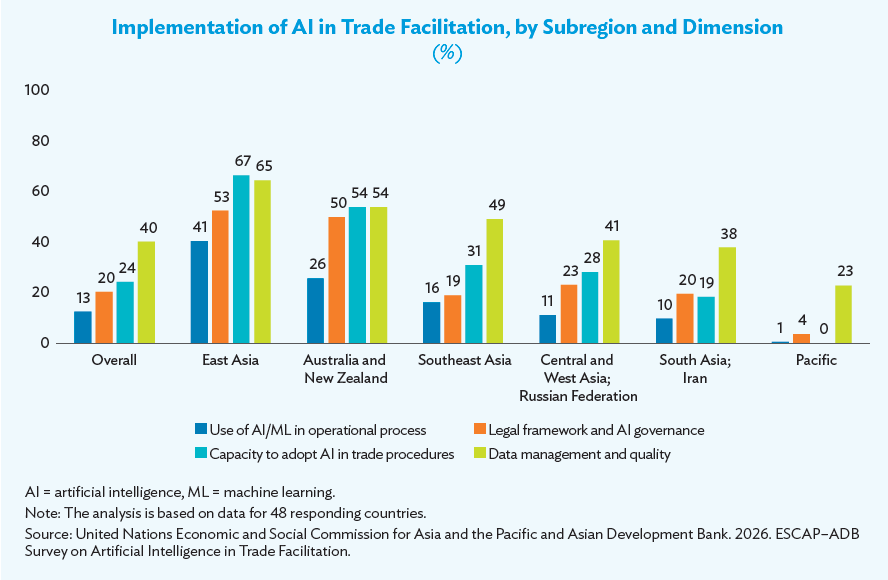
However, the spread of these technologies is proceeding at very different speeds. The survey, conducted in 48 countries, shows that the average level of AI use in trade procedures remains below 15 per cent and exhibits significant regional disparities.
East Asia clearly tops the ranking, followed by Australia and New Zealand and Southeast Asia, while the Pacific Rim states lag far behind across all indicators.
In South Korea, for example, the customs agency handled 180 million cross-border e-commerce transactions in 2024 (nearly three times the volume of 2021), and its AI system analyses each high-risk shipment in less than a minute, compared to the full hour required until a few years ago.
In the Pacific Islands, however, 55 per cent of trade facilitation measures have not yet been implemented, and a single trade transaction can still require up to 36 original documents and 240 copies.
While the adoption of AI in trade facilitation remains below 15 per cent across the region, the emerging picture is one of a two-speed Asia.
On one side are economies like China, Japan, South Korea, and Singapore, which have advanced digital infrastructure, large amounts of data, and specialised personnel. On the other, are small island states and low-income countries that are still struggling to complete the transition to basic digital trade procedures.
The report highlights that precisely those economies with the lowest levels of trade digitalisation are also the least prepared to adopt AI.
The gap is already visible in the implementation of digital trade facilitation measures. By 2025, the region's developed economies had achieved an implementation rate of 78 per cent, while the least developed countries had reached 48 per cent and the small island states, 41 per cent.
In China, for example, the authorities have developed TianXuan, a system based on neural networks and AI trained on years of customs data.
Launched in 2017 with just 13 risk indicators, it now uses over 100 to identify potential tax fraud, drug trafficking, intellectual property violations, product safety issues, and transportation risks.
The system is now operational in more than 250 customs offices across the country and, in the first eleven months of 2024, performed over 4 per cent of all inspections, achieving better results than manual checks.
It is supported by a massive IT infrastructure that collects over 260 billion data points from various sources, a level of development unmatched in the small Pacific Island states.
Since 2017, the Customs Border Targeting Center in South Korea has also been analysing customs declarations in real time.
Today, cargo viewed as risky is identified in less than a minute, while shipments deemed safe can be cleared automatically without further documentary checks.
Japan, meanwhile, has developed the SMART Customs programme, which has automated hundreds of administrative procedures and uses X-ray image analysis systems to inspect international mail.
According to estimates, the widespread use of AI could boost global trade by up to 37 per cent by 2040. But experts at ESCAP warn that new technologies risk amplifying existing imbalances.
The benefits of AI tend to be concentrated in high-income economies and large companies, which have better infrastructure, greater investment capacity, and access to quality data.
Sectors using AI show an average 31 per cent higher export levels, and companies that hire workers with advanced skills see total sales increases of nearly 20 per cent.
For companies operating in international markets, the adoption of AI increases foreign sales by an additional 26 per cent compared to exporters without it.
Conversely, poorer countries risk being excluded from the benefits of the new technological revolution.
The main factors are the lack of specialised skills (even where digital tools exist, the lack of specialised human capital blocks their use), the high costs of digital infrastructure, and weak data management systems.
The gender gap in digital skills also risks multiplying existing inequalities. If women remain underrepresented in technology sectors and in access to digital training, AI adoption will be even more unequal, both between and within countries.
For this reason, some leading countries in the development of new technologies are seeking to export a series of “best practices” to help the region's most fragile economies avoid being left out of the technological revolution.
Singapore and North Korea have entered into a bilateral agreement on the application of AI and are promoting the adoption of common ethical standards (for example, as outlined in the ASEAN Guide on AI Governance).
They also actively support the United Nations treaties on digital and paperless trade, offering technical assistance, resources, and guidelines for developing digital skills.
The report also warns of the risks associated with the indiscriminate use of AI. Generative systems can produce incorrect information, incorrect classifications, or biased assessments, especially if trained on incomplete data.
Average rates of inconsistent responses hover around 5 per cent, rising to 9.8 per cent in financial and trade applications.
In sensitive sectors such as customs, even seemingly minor errors can result in delays, tax losses, and trade disputes, which is why the authors emphasise the need to maintain human control in decision-making processes.

.png)
30/05/2022 13:39
04/10/2023 18:52
10/01/2007










