





-65612.html&is_video=&description=Xi+in+Pyongyang+reiterates+%27historic+alliance%27+%28and+no+longer+mentions+nuclear+issues%29)


Xi in Pyongyang reiterates 'historic alliance' (and no longer mentions nuclear issues)
The two-day visit came after the reopening of rail and air links between the two countries, interrupted by the COVID-19 pandemic. China remains North Korea's main economic partner, but now faces Russia’s competition, strengthened by agreements tied to the war in Ukraine. Unlike 2019, the Chinese leader no longer made any reference to the denuclearisation of the Korean Peninsula.
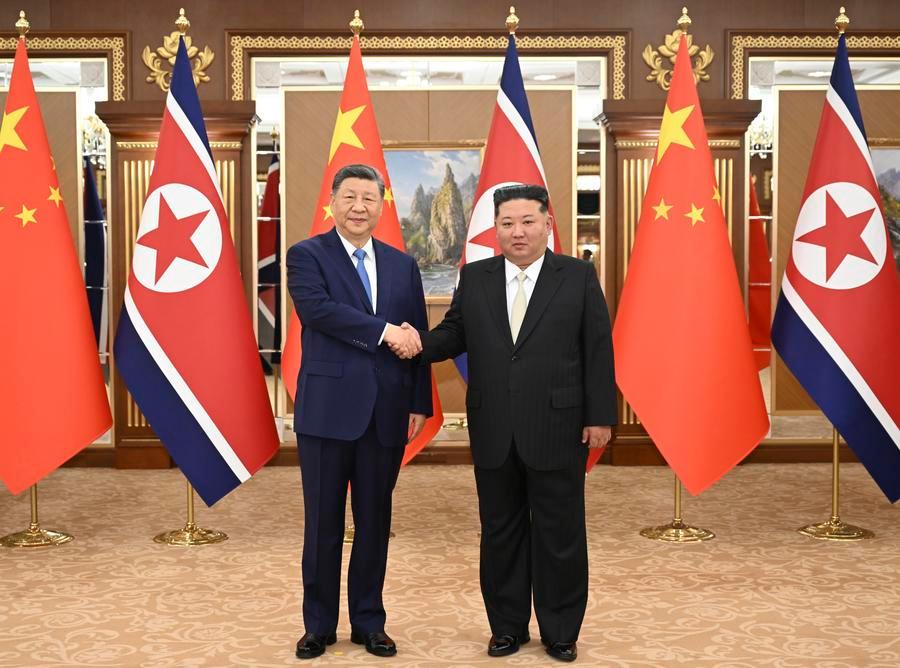
Pyongyang (AsiaNews/Agencies) – Chinese President Xi Jinping's visit to Pyongyang, where he met with North Korean leader Kim Yong-un, ended today with the obvious statement of both countries' agreement to boost mutual relations.
Accompanied by his wife, Peng Liyuan, and senior officials, Xi Jinping made his first official visit to North Korea since 2019, his first trip abroad since early 2026.
The Chinese leader stated that the goal of the visit was to elevate bilateral relations to a new level, coming soon after major summits in Beijing, including those with US President Donald Trump and Russian President Vladimir Putin.
Pictures released by state media showed Xi and Kim smiling amid red carpets, military honours, and large cheering crowds. The two leaders agreed to further consolidate the friendship and cooperation between China and North Korea.
Xi stressed the need to intensify diplomatic exchanges, law enforcement and military cooperation, as well as expand economic ties. He also highlighted the importance of the recent reopening of rail, air, and border links between the two countries, halted for years due to the COVID-19 pandemic.
China remains North Korea's main economic partner and accounts for almost all of its foreign trade, and the resumption of direct air travel between Beijing and Pyongyang is seen as a tangible sign of strengthening relations.
A significant aspect of the summit concerns the North Korean nuclear issue. Official statements made no reference to Pyongyang's nuclear programme, despite the country being under international sanctions for its development of nuclear weapons.
Some see this silence as an implicit sign of China's acceptance of North Korea's nuclear status. It marks a departure from Xi's last visit to Pyongyang in 2019, when he declared that China would work toward the denuclearisation of the Korean Peninsula.
Kim Jong-un has repeatedly stated that he does not intend to give up his nuclear arsenal, while his sister has called the programme “a line of no retreat”.
In return, observers note, Pyongyang reiterated its support for the "One China" principle, supporting Beijing's position on the Taiwan issue.
Observers were generally struck by the context in which the visit took place. In its reports, for example, Reuters highlighted the growing number of private cars on the road in Pyongyang, along with a construction boom and an increase in new services and restaurants.
These reports are said to be the economic benefits brought to North Korea by the increasingly close relationship between Pyongyang and Moscow, which has purchased North Korean weapons and deployed North Korean soldiers in the war in Ukraine.
Added to this is Pyongyang's gradual shift away from its rhetoric of isolation, with new relations also with countries like Belarus and Vietnam, which AsiaNews reported a few weeks ago.
In this sense, therefore, Xi's visit can be interpreted as a step by Beijing to avoid losing ground with its historic ally, in a game that is becoming much more complex than it was a few years ago.

.png)










