Tehran (AsiaNews) – While the world’s attention is focused on the Strait of Hormuz, blocked once again by the escalation between Iran and the United States that is threatening the fragile truce, others, largely ignored key strategic infrastructures have been hit as well. One is a bridge in a remote area of the Islamic Republic.
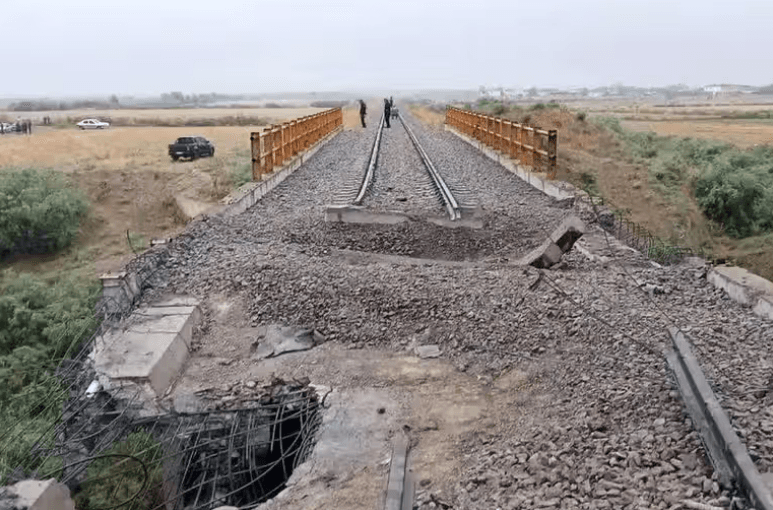
Although the US has not yet officially confirmed the raid, the bridge was struck a couple of days ago, while Iran was celebrating the funeral of Grand Ayatollah Ali Khamenei, killed on the first day of the conflict in late February.
The structure is strategically important connecting Iran to China, as well as Russia, this according to a detailed report by Iran International. According to the dissident news platform founded by Iranian exiles opposed to the Islamic Republic, the US decision to hit these targets is a sign of an “expanding” war.
The attack on the bridge puts the spotlight on a much lesser-known front in an increasingly broad conflict involving transportation routes connecting Iran to Central Asia, all the way to Russia and China.
Iranian state media and the Islamic Revolutionary Guard Corps (Pasdaran) report that US cruise missiles hit the Aq Tekeh Khan railway bridge near Aqqala, Golestan province, last Wednesday morning, damaging the Gorgan-Incheh Borun railway line.
The facility is part of the country's northern rail connectivity with Turkmenistan and the continent's broader networks, making it important for military logistics, civilian trade, sanctions busting, and alternative transit routes.
If confirmed, the raid shows that transportation hubs are becoming “strategic assets”, where pressure on dual-use infrastructure can disrupt connectivity without focusing solely on conventional military sites.
The bridge's importance
The Aq Tekeh Khan Bridge is located on the Gorgan-Incheh Borun Railway, a key segment connecting Iran's interior to its northeastern border with Turkmenistan.
Incheh Borun serves as a major railway crossing and dry port in Golestan Province, connected to the Iranian national railway network to the south and to the Kazakhstan-Turkmenistan-Iran corridor, inaugurated in 2014, to the north.
The road network extends from Kazakhstan through Turkmenistan to the Islamic Republic, providing a land link between Iran and Central Asia, extending to Russia, China, and broader Eurasian markets.
It also complements the International North-South Transport Corridor (INST) and overlaps with the ambitions of China's Belt and Road Initiative, while offering alternatives to vulnerable maritime routes.
For Tehran, this northern rail artery is strategically valuable because it expands access to the resource-rich states of Central Asia and supports transit flows less exposed to the Gulf choke points, from the Strait of Hormuz to the equally strategic Bab el-Mandeb Strait, which connects the Gulf of Aden to the Red Sea.
Freight trains from China have also moved along related corridors, underscoring the route's role in broader East-West Eurasian trade.
Infrastructure and sanctions
Damage to the Aq Tekeh Khan Bridge and associated rail services could limit Tehran's ability to move cargo, fuel, equipment, and strategic materials along its northern corridor.
Northern rail connectivity becomes particularly important when southern ports or the Strait of Hormuz face military or political pressure.
Under such conditions, Iran's ability to maintain alternative land routes through Central Asia, the Caspian region, and Russia becomes part of its strategic planning.
The Islamic Republic has spent years developing land corridors with Central Asia, Russia, China, and the Caspian region to reduce its dependence on maritime routes exposed to sanctions, surveillance, and possible interdiction.
The Kazakhstan-Turkmenistan-Iran railway and the routes connected to the INSTC are key to this strategy, enabling transit revenues, regional trade, and access to markets where sanctions enforcement may be less direct.
Attacks on such infrastructure could therefore be intended to erode Iran’s ability to resist Western sanctions by increasing operational risks for partners and discouraging the use of the corridors during heightened periods of conflict.
Regional consequences
Finally, the targeted attack on the Aq Tekeh Khan Bridge has potential implications for Turkmenistan, Kazakhstan, and other Central Asian states.
These countries have invested in diversified transit routes through Iranian territory to reach Gulf ports and global markets, thus reducing their dependence on corridors controlled by Russia or China.
If the routes in the Islamic Republic are now considered vulnerable during the conflict, governments and traders may reevaluate their reliability.
For China, the sudden interruption of corridors connected to Iran adds further uncertainty to supply chains on the long-distance routes linking East Asia, Central Asia, and the Middle East.
The same applies to Russia, which has recently strengthened logistical ties with Tehran. Analysts believe that damage to Iranian infrastructure and transport routes could complicate access routes to the south.
The US raid demonstrates how "infrastructure has become part of modern strategic competition,” writes Iran International, reinforcing the "challenge of protecting trade networks built to withstand sanctions and pressure on maritime access."
It also shows that the politics of trade corridors, from the Silk Road (BRI) to the INSTC, are increasingly “shaped not only by commerce but also by military risks.
“Whether this leads to hardened infrastructure, shifts in regional trade planning or renewed pressure for de-escalation remains uncertain, but the bridge’s symbolic and practical importance now extends well beyond Golestan province.”





.webp&w=3840&q=75)