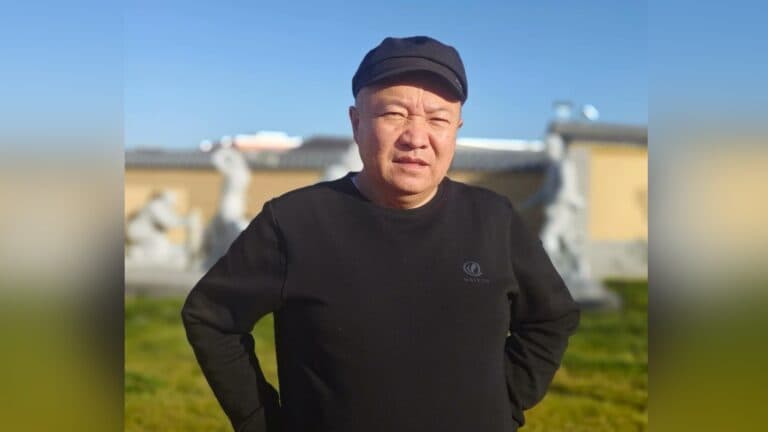
Beijing (AsiaNews) – Zhengis Reskhan, a well-known Kazakh writer and member of the China Writers' Association, has been missing for over two months in Altai and Hami, Xinjiang, northwestern China, this according to ChinaAid.
The advocacy group reported that the writer’s eldest son, Zhengis Nartay, a Christian living in Kazakhstan, issued a public plea last Sunday, stating that his father was taken by Chinese police in mid-March and has not been heard from ever since.
Zhengis Nartay urged the international community and human rights groups to follow the case and raise awareness regarding his father’s fate.
Zhengis Reskhan, 57, is considered a leading figure in Xinjiang's literary circles. His positions include editor-in-chief of a Kazakh-language literary magazine in Hami City, associate research librarian at the Barkol County Cultural Centre, and former president of the Hami Regional Writers' Association.
Over decades of literary activity, Reskhan has published 13 novels, many of which have been translated into Chinese and published in China. For this work, he has also received the highest literary award in the western Chinese region, the Tianshan Literary Prize.
“It has been more than two months since my father was forcibly taken away, and we still have no official information about where he is or what condition he is in,” Nartay said in an interview.
According to him, starting in late December last year, Chinese authorities started summoning Reskhan repeatedly for brief questioning. Eventually, the writer was forcibly detained on 19 March, after which all contact with the outside world ceased.
In his appeal, Nartay says that the family went to the Barkol County Public Security Bureau and the local prosecutor's office to inquire about Reskhan's situation. However, it has not received any formal legal paper, notice of detention, or a clear answer regarding their relative's fate.
In recent years, the treatment of ethnic minority intellectuals in Xinjiang has attracted growing attention from the international community and human rights organisations.
Nartay noted that the authorities took his father's passport, while his social media accounts and literary publications have faced varying degrees of restrictions.
“Even travel within China was strictly monitored and restricted,” Nartay said. “Whenever my father stepped outside the Hami region of Xinjiang, his phone would immediately be flooded with calls from police, community officials, and state security departments asking why he had left Hami and when he would return.”
Nartay said he left China in 2017 to study in Kazakhstan, after which communication with his parents became increasingly difficult.
“After I repeatedly tried to communicate with them, their replies became very mechanical,” he explained. “They would only repeatedly say, ‘The Party, the country, and we ourselves are all doing very well. Don’t worry about us. Live well and keep living well.’”
As a member of an ethnic Kazakh community that spans China and Kazakhstan, Reskhan attended the Fourth World Congress of Kazakhs in Astana in 2011, where he promoted cultural exchanges between the two countries.
At present, international institutions, including UN human rights bodies and the Kazakh Ministry of Foreign Affairs, have declined to comment officially on the matter.
Nartay concluded by saying he has sought help from Kazakh President Kassym-Jomart Tokayev and Chinese state leaders.
He also stated that he is willing to speak further with international media in the hope of bringing greater transparency to his father's case and shed light on his fate.