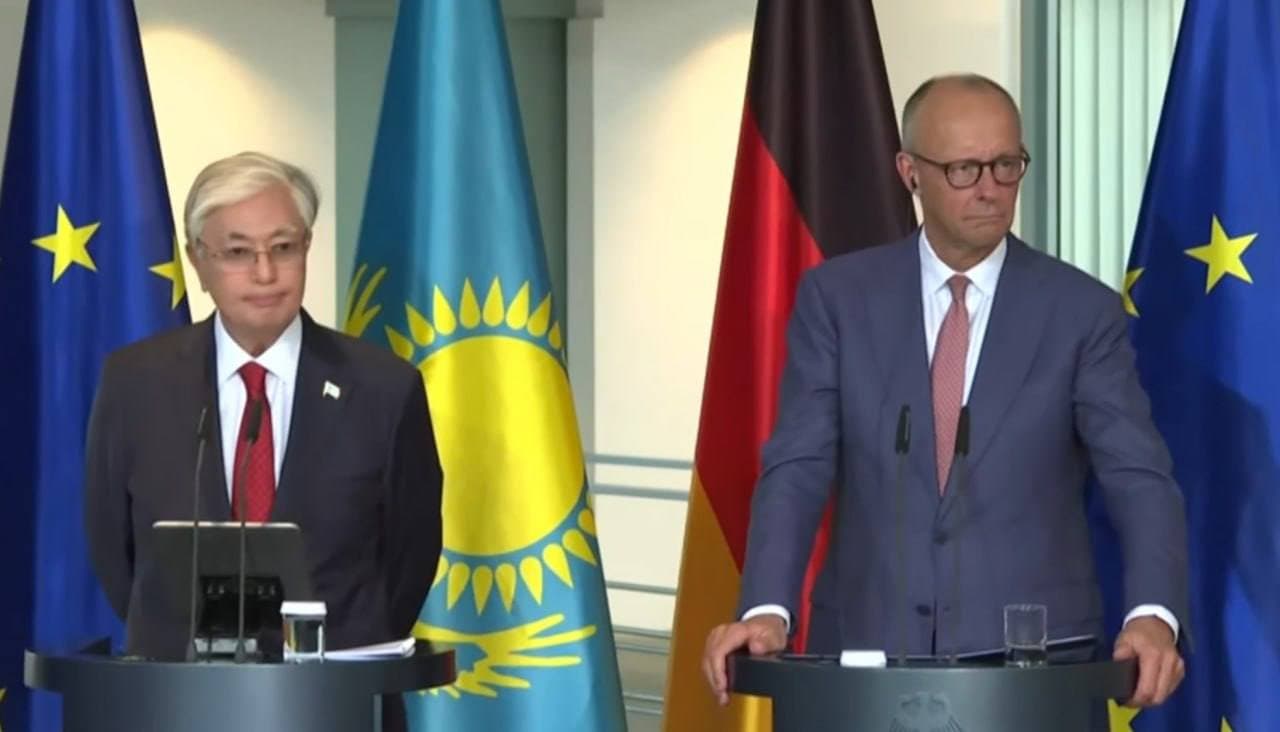
Astana (AsiaNews) – During a recent visit to Germany, Kazakh President Kasym-Žomart Tokaev made a couple of remarks that left some perplexed and others downright outraged, particularly due to his effusive praise of Vladimir Putin.
At a joint press conference with German Chancellor Friedrich Merz, whilst responding to a question from an ARD journalist about his proposal to “freeze the conflict in Ukraine” – a suggestion he had previously made in the presence of the Russian president in Omsk – Tokaev expressed his “gratitude” to Putin for responding “with great understanding” to his position on Ukraine, emphasising his “excellent relationship” with the Russian leader and describing Putin as “an exceptional statesman”.
Furthermore, according to Tokaev, Putin is the most acceptable political figure – “however strange that may seem to a German audience” – for Central Asia, including Kazakhstan. Tokaev added that he knows Putin well and believes he possesses the qualities necessary to lead a great state with a complex history and a unique understanding of the strategic challenges it faces.
At the same time, the Kazakh president recalled that his country, from the very beginning, had declared its commitment to the United Nations Charter, emphasising the principle of territorial integrity, which naturally also applies to Ukraine. Tokaev emphasised Kazakhstan’s respect for the Ukrainian people, their history, culture, traditions and language.
He reiterated that he had never claimed the war could be stopped immediately: under the current circumstances, he considers this unrealistic. His proposal, according to Tokayev, is to freeze military operations on Ukrainian territory, after which the parties could turn to diplomacy and negotiations. Finally, Tokayev described both Russia and Ukraine as “good friends” of Kazakhstan.
Some critics have accused the Kazakh president of trying to “sit on the fence”; others have pointed out that, however conciliatory Tokaev’s rhetoric towards the Kremlin may be, Kazakhstan under his leadership is actively developing independent relations with Germany and the European Union, which in turn provides extensive support to Ukraine.
Some commentators have expressed disappointment with Tokayev, believing that his statements in Berlin have weakened the political impact of his previous public appeal for a truce in the conflict, made in the presence of Putin.
According to the journalist and political scientist Merkhat Sharipzhanov, Tokayev, like his predecessor Nursultan Nazarbayev, is continuing the so-called “multidimensional foreign policy”.
The essence of this policy lies in cooperating with and developing partnerships with various centres of power simultaneously: the European Union and the United States, China, Russia, Japan, South Korea, the wealthy Persian Gulf states and Turkey, which actively promotes cooperation within the Organisation of Turanian States.
The main aim of this policy is to prevent Kazakhstan from becoming overly dependent on any single external centre of influence: Russia remains one such centre, including in the security sphere.
In this context, Putin’s praise may have been directed not so much at the German public as at the Kremlin and the patriotic Russian public. The message might be phrased something like this: Kazakhstan is independently building relations with the West and other partners and intends to continue doing so, which does not mean it wishes to turn its back on Moscow entirely. In other words, for Kazakhstan, this may not so much be a contradiction as a classic balancing act.
When Tokayev set out his position in Omsk, calling for a freeze on the conflict in Ukraine, he also cautiously added that ‘we, too, are unclear about the nature of this conflict’.
The Kazakh president emphasised that he had received numerous signals from the leaders of other countries, thereby giving the impression of speaking on behalf of several countries – such as China, the EU, the United States or various international actors – simultaneously.
According to this interpretation, Tokayev may have acted as an informal channel of communication between one or more interested parties and the Kremlin; as well as defending Kazakhstan’s interests, the president – a diplomat with a long career – is also seeking to position himself as a major international mediator.