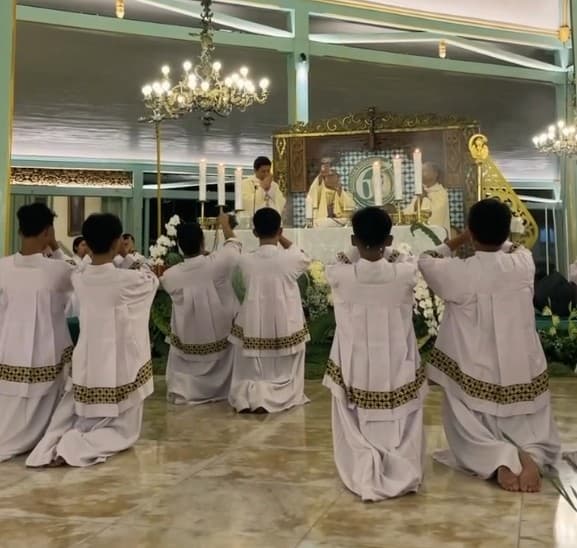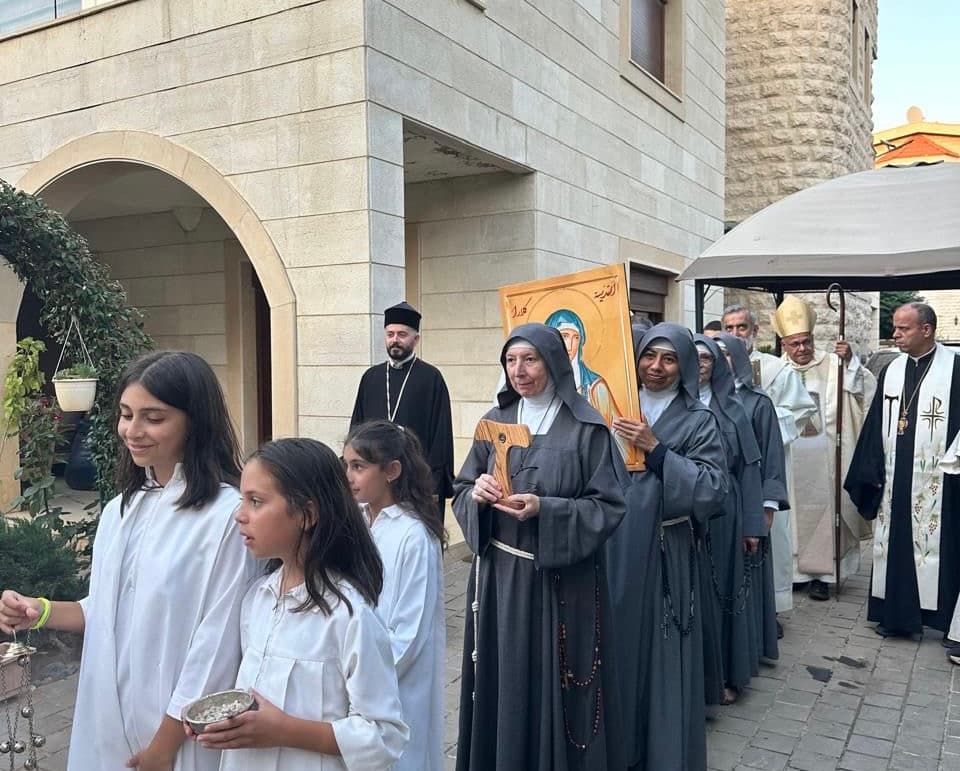
Beirut (AsiaNews) – For many in Rayak, in Lebanon's Bekaa Valley, it felt nothing short of a miracle: a sign of God's presence returning to a region often forgotten by the centres of power and increasingly affected by the spiritual emptiness of the contemporary world. On 11 August, the local Christian community celebrated the Feast of the Holy Church with the official inauguration of a new monastery of the Poor Clares, the cloistered Franciscan nuns.
The community was established by sisters from the monastery of Montone in Umbria, Italy, who chose to leave behind the familiarity of their homeland to live their vocation of prayer and contemplation in Lebanon, a land deeply wounded yet still rich in faith and hope.
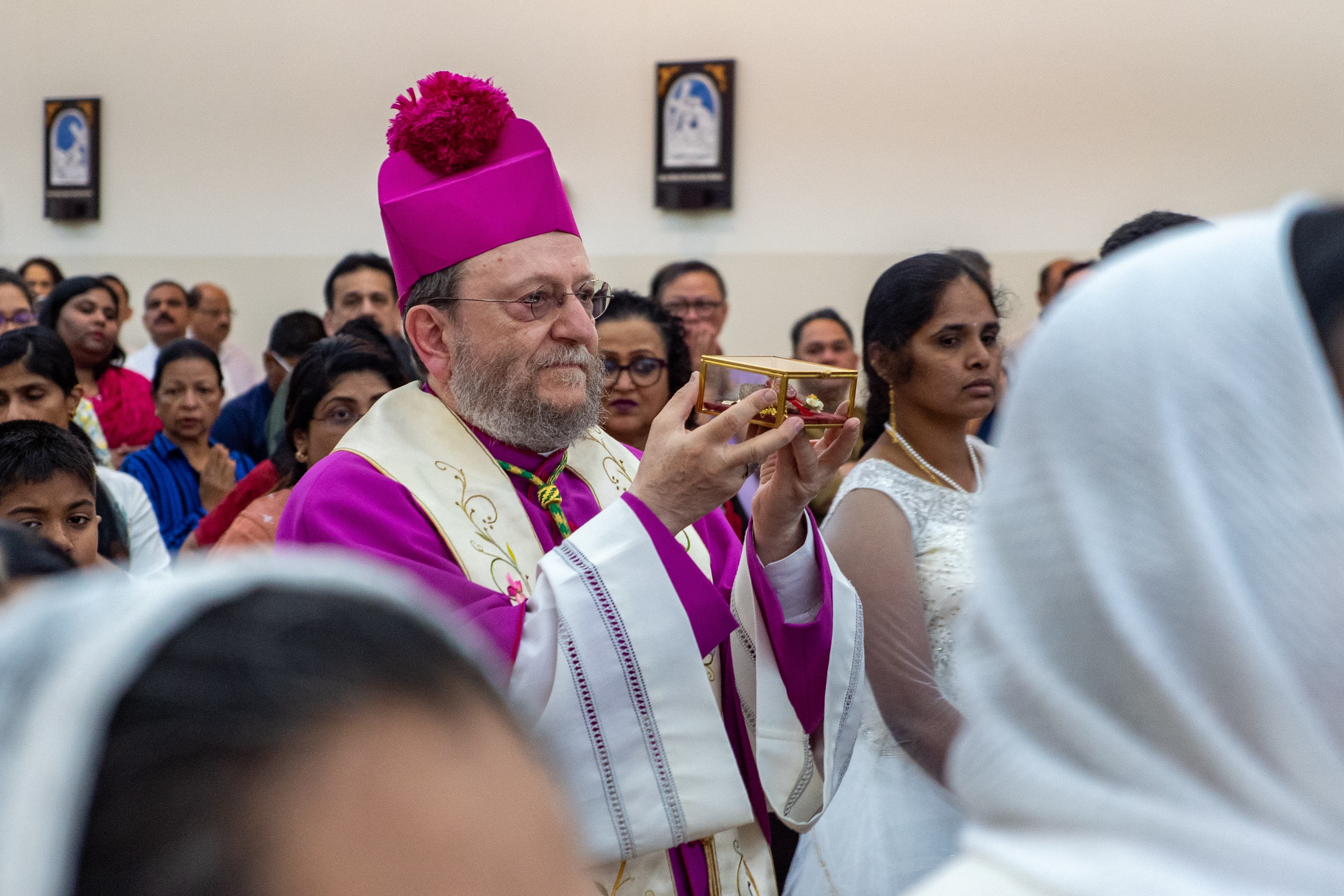
The ceremony was presided over by Monsignor César Essayan, Patriarchal Vicar for the Latins in Lebanon, who had called for this presence and led the day’s celebrations alongside a crowd that had flocked en masse to this predominantly Christian town in an area where the Shia population is constantly growing, partly as a result of the war.
“I didn’t mention it in my homily, but the nuns noted it down: people are talking about a miracle,” the Latin bishop of Lebanon tells AsiaNews. “It’s wonderful! But it’s not a miracle like any other. The fact that some Italian nuns have left their convent – and even sold it – to come and settle in a remote part of Lebanon means that the Lord has finally remembered them.”
This emotion also moved Sister Gloria, who speaks on behalf of the group: “Whilst everything is dying,” the 43-year-old nun of Italian origin tells AsiaNews, “whilst people have lost all hope, whilst young people just want to leave a country that seems to have no future, we,” she exclaims, “are buying a house!”
The settlement of the five nuns (Damiana, Gloria, Celina, Maria Lucia) from the Italian monastery, and of Maria Grazia, a nun from a monastery in Mexico City, is still underway: it will take a few more months to complete the formalities for clearing and refurbishing the building – currently occupied by several displaced families – and an adjacent plot of land, which is intended to ensure the community’s self-sufficiency. But the story of the new monastery has now begun.
“Rayak has chosen us”
Once known as an important railway station serving Damascus and Aleppo in particular – from where travellers boarded the legendary Orient Express – and also renowned for its military airbase, the town of Rayak was, for a time, very prosperous. The seismic shift in the economy and the closure by the French of a large factory contributed significantly to its decline. Today it is home to Christians, mostly Greek Catholics, as well as a steadily growing Shia population, continually swelled by numerous families displaced by the war.
This demographic shift has had an impact on the municipality’s demographic composition. Nevertheless, the municipality traditionally remains a sort of microcosm of Lebanon, with Maronite, Orthodox and Armenian minorities, each with its own church. The nearest town is Zahle (the capital of the Bekaa Valley, a dozen kilometres away). One curiosity remains from the era of the French Mandate: it is one of the few places in Lebanon where belote is still played, a popular card game involving four people divided into two pairs.
The whole of the Bekaa rejoiced at the news of the foundation, with the official ceremony taking place on 11 August. According to Sister Gloria, it took six exploratory trips before Rayak was chosen.
In the end, the town won the nuns’ favour thanks to the residents of its ‘Christian neighbourhood’, who went out of their way to find the building and land needed for the project. “We didn’t even know Rayak existed,” Sister Gloria tells AsiaNews. “It was the locals who, having learnt that some nuns wanted to settle in the area, came looking for us! This gesture,” she continues, “seemed to us a clear sign from the Lord. Then came the (arduous) task of learning Arabic!”
The foundation is the result of a process of discernment lasting around ten years, she adds. The initial impetus came from Lebanon. The founding of this monastery responded to the local Church’s desire to see the Poor Clares – who currently already have a monastery in Yarzé, a residential area on the outskirts of Beirut – settle also in a less affluent environment, where they could serve as a sign for vocations.
In the footsteps of the Trappists of Tibhirine
For the Poor Clares themselves, quite apart from Lebanon, it was the total self-giving of the Trappists of Tibhirine – the Algerian community whose members were abducted and killed during the civil war (1994) and later proclaimed martyrs by Pope Francis – that inspired the desire for total self-giving.
“This story,” admits Sister Gloria, “moved us deeply, above all because it was an entire community, and not just one person, that offered itself on the altar.” The invitation to work in a rural setting in Lebanon – an environment that had initially left them hesitant – was accepted following the 2021 appointment of a friend of the community, the Belgian-born Cardinal Dominique Mathieu, as Archbishop of Tehran-Isfahan in Iran.
“Fully aware of the difficulty, he accepted on faith,” comments Sister Gloria. “Her ‘yes’, her courage and her trust in the Lord deeply moved us, and we asked ourselves: ‘What about us?’. From that moment on,” she emphasises, “we seriously considered the possibility of coming here and, after much prayer, we decided to embark on this adventure.”
The Islamic-Christian dimension of the foundation is evident. All the more so as the Bekaa Valley still bears the scars of the violence which, during the years of the Lebanese civil war and the Syrian dictatorship, claimed the lives – ten years apart – of two priests: the Jesuit Nicolas Kluiters – brutally murdered in 1985 near the Christian village of Barqa, whose cause for beatification is currently under consideration – and the postulant Ghassibé Keyrouz, whom Fr Kluiters had taken under his wing, killed in the midst of the deadly wave of sectarian massacres in 1975, whilst on his way to Nabha to celebrate Christmas with his family.
In any case, the sisters know that whilst the echoes of the civil war are fading, those of war tout court are very much present, with the accompanying bombings, destruction and their economic and social consequences: numerous families have fled from a southern Lebanon laid to waste; a silent exodus to the city or abroad of young graduates from all walks of life; an exodus – sometimes unjustified – of the Christian upper and middle classes, fleeing the situation in the ‘invaded’ rural areas towards religiously homogeneous urban centres.
Forgiveness, the key to peace
Despite everything, “within the mosaic of Christian communities living on the outskirts of the country, the founding of a convent is a great sign of hope”, assures the historian Névine Hage-Chahine, who lives in Zahlé.
“It is a spark, a fragile flame,” she continues, “that flickers in the night, but a flame nonetheless. This flame will kindle the fire of prayer. A lady said to me: ‘But do you realise, we won’t be able to spend time with them!’ And yet that is precisely the point: what is essential,” she continues, quoting a famous story by the aviator and writer Antoine de Saint-Exupéry, “is invisible to the eye.”
Of course, apart from when they go shopping, the people of Rayak will not see ‘their’ nuns, who have chosen the cloistered life. No ‘sobhiyé’ with the Poor Clares. No mornings spent chatting over a coffee. However, if they listen carefully, they may hear their songs and, perhaps, help them on days when it snows or is bitterly cold. These are vocations.”
Like so many Italian girls, Sister Gloria recounts having attended university, gone out with friends and experienced human love… But at the age of 24, at the end of an inner journey whose secrets are known only to God, she says she finally found her ‘home’ behind the cloister, in a radical offering to Christ that she herself had once deemed ‘exaggerated’.
“What does the Lord of history tell you about the world, Sister Gloria? Do you ever find yourself worried?” we ask her finally, before saying goodbye. Her reply makes it clear that the Poor Clares do not live detached from current events.
With their gaze fixed on the Pope’s words, their ceaseless prayer is that the logic of forgiveness—at the heart of the Lord’s Prayer—may prevail over the logic of force. That it may never be believed that war is inevitable. And that faith and hope in a peaceful resolution of conflicts may always be preserved.
“Yes,” concludes Sister Gloria, “sometimes I do find myself worried. We all do, from time to time… What worries me most is that none of those who decide the world’s fate can glimpse or proclaim the only solution to all conflicts, both those currently underway and those yet to come: forgiveness!”