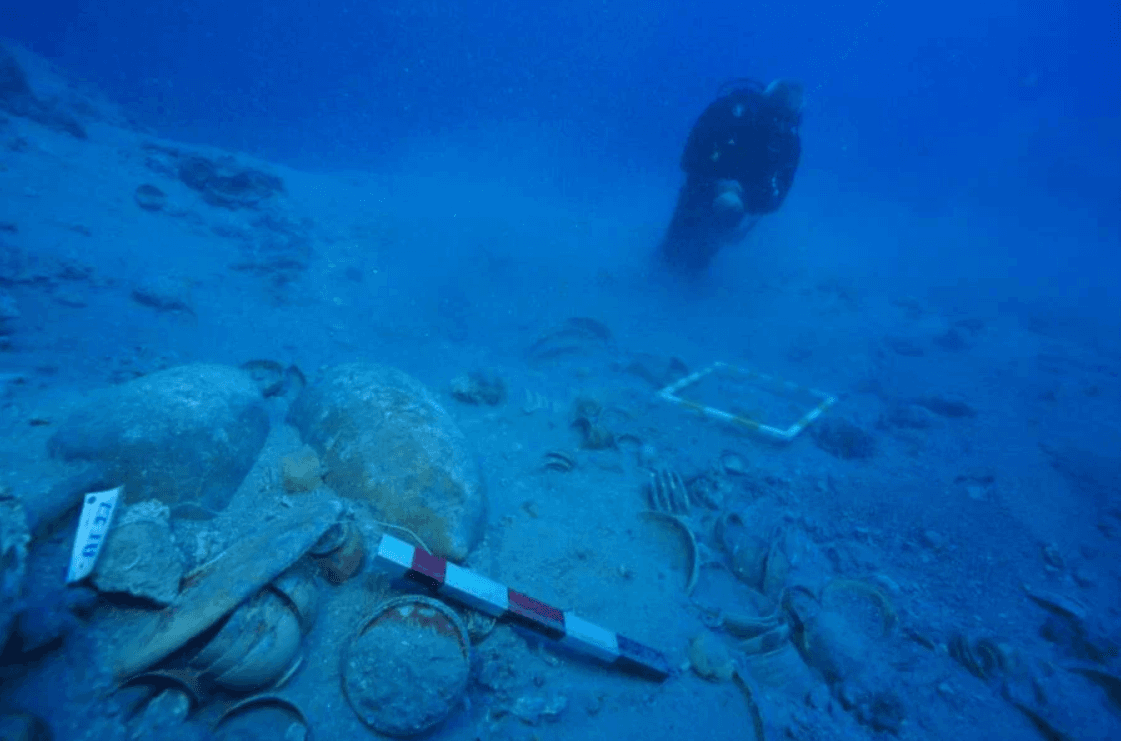
Off the coast of Adrasan (a coastal town overlooking the Gulf of Antalya, along the coast of ancient Lycia, a historic region of south-western Anatolia), underwater archaeologists have unearthed thousands of pieces of tableware dating back 2,100 years. This discovery sheds light on trade, cuisine and the culture of the Hellenistic-Roman Mediterranean. The cargo probably originated from the coast of Anatolia and was perhaps bound for Rome.
The wreck is that of a merchant ship which probably sank around the middle of the 1st century BC. Excavations began in 2025 and are yielding an exceptionally rich cargo: ceramic tableware in 122 different shapes and sizes, along with amphorae (and coins) from various centres across the Aegean world.
The main pottery appears to originate from the region of Antioch and, in particular, from the coast of Arsuz – ancient Rhosus – south-west of İskenderun (ancient Alexandretta), on the Mediterranean coast of southern Turkey.
The cargo ship had already been located previously, and initial investigations had been carried out in 2022. In 2023, Hakan Öniz and Emre Okan, of Akdeniz University in Antalya, published a study specifically dedicated to the wreck in the Journal of Maritime Archaeology.
But the underwater archaeologists’ recovery campaigns did not stop there: in 2025, 6,511 intact ceramic artefacts were brought ashore; thousands of fragments were taken to laboratories to be studied and, where possible, restored. Robots capable of operating at great depths are also being used in the various campaigns.
As recently as 28 September, the Ministry of Culture and Tourism in Ankara released the news, which was immediately picked up by the Turkish news agency Anadolu and a number of international media outlets.
The discovery provides us with exceptional documentation of an aspect of ancient life that normally reaches us in a very fragmentary form: how a table was laid, which vessels were used, which objects were considered refined, and which goods could travel hundreds of kilometres to reach a distant market.
Among the artefacts identified were plates for serving fish, soup bowls, containers for dried fruit and trays of various shapes and sizes. The wide variety of tableware suggests a dining table where different courses and dishes had their own specific vessels and where the presentation of the food was also of great importance. These are the objects through which a society reveals its food culture.
The pottery belongs to the category that specialists refer to as Eastern Sigillata A (ESA), a class of fine tableware produced in the eastern Mediterranean, particularly in the region of northern Syria and Cilicia, from the end of the 2nd century BC and in use until the 1st century AD. This pottery is characterised by a generally light-coloured body and a thin, glossy red glaze applied to the surface.
The coasts of Anatolia, Syria and Cilicia were not a backward periphery compared to the major centres of the Mediterranean. On the contrary, they were an area where Greek and Eastern cultures, local traditions, specialised craftsmanship and trade routes had been intersecting for centuries. The cities that arose or developed during the Hellenistic period formed the nodes of a network linking the Levant to the Aegean, Greece and Italy. In short, the Adrasan wreck helps us to better understand one of the economic centres of the Roman and Hellenistic worlds.
The coins found in the shipwreck also help to clarify the context. Some, dating from the 1st century BC and traceable to the Antioch area, help to place the sinking chronologically. Archaeologists hypothesise that the ship had set sail from Arsuz and was heading westwards, probably towards the Italian markets and perhaps Rome, when a storm drove it onto shallow waters, causing it to sink.
What makes the discovery even more fascinating is the name Rhosus. The ancient city, identified with modern-day Arsuz, is in fact also mentioned by Marcus Tullius Cicero. In 50 BC, in letters addressed to Titus Pomponius Atticus, the great Roman orator speaks of vases from Rhosus that he had purchased and which were to be presented as a gift to his friend. Literary sources thus show that the pottery produced in Rhosus was known throughout the Roman world and that it may have been sought after by members of the elite. A striking detail: whilst Cicero was writing, the ship laden with pottery produced on the coast of Cilicia might well have been en route to Rome.
Of course, archaeology calls for great caution. It is not possible to state that the plates recovered at Adrasan are the ones ordered by Cicero for Atticus. But the comparison between the literary document and the archaeological find is nonetheless of extraordinary interest: Cicero’s letter demonstrates that those ceramics were held in high regard in the Roman world. And the shipwreck shows us in concrete terms how they were transported.
One aspect of underwater archaeology is worth emphasising: whilst on land an object often undergoes a complex history (a plate may end up in a rubbish tip, a bowl may find its way into a home other than its original one, an amphora intended for one use may be repurposed for a different purpose), on the seabed, by contrast, a shipwreck can freeze a situation in time. The cargo remains exactly where it was placed before the tragedy, as if in a sort of ‘time capsule’.
Something similar happened at Adrasan. The cargo had been carefully arranged in wooden crates. Clay had been placed amongst the artefacts, probably to prevent the pottery from knocking against one another and breaking during transport. That packing technique helped to preserve the plates and bowls for over two thousand years. The result is a snapshot of ancient trade.
For centuries, the Anatolian coastline had been one of the great meeting places of Hellenism. Antioch, Rhosus and the other centres in the region belonged to a world in which language, culture, craft techniques and trade constantly crossed political boundaries.
The subsequent Roman expansion did not create this network from scratch: to a large extent, it inherited it, transformed it and expanded it. And so, from the seabed, it is not merely ancient pottery that resurfaces today. What resurfaces is a unified Mediterranean: that of ships and merchants, of the Hellenistic cities of Anatolia, of Roman cities and banquets, of workshops and harbours. A Mediterranean in which even a bowl could cross the sea to tell, two thousand years later, the story of a civilisation.