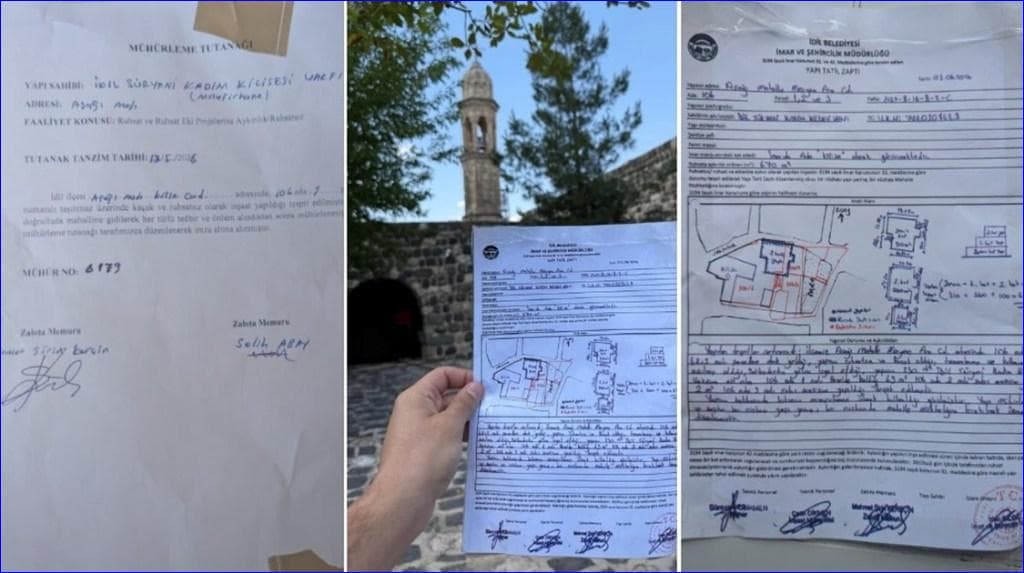
Istanbul (AsiaNews) – Homes expropriated, properties and buildings demolished before a court ruling on the legality of the measure, and families being denied recognition of their ancestral family name linked to their Assyrian-Chaldean ethnicity. The situation of Christians in Turkey has recently seen worrying incidents of religiously motivated abuse and persecution, often perpetrated with the endorsement of local (and central authorities). The most recent incidents date back to last week in the province of Şırnak, in the south-east of the country, and also involve the mayor of Azekh (better known as Idil, the capital of the district of the same name).
Demolished properties
Four of the Christian citizens affected by the measures have already taken legal action to challenge them. However, their buildings were demolished before the court could rule on the objections raised. Measures were also taken against a guesthouse belonging to the Syriac Orthodox Church of the Virgin Mary. The families involved regard these actions as an attempt to “intimidate” the Assyrian-Chaldean community and to weaken its ties with its homeland, as some of the demolished properties belonged to families who had emigrated to Europe.
Lawyer Melke Karagöl, whose family has also been affected by the demolition orders, has criticised the municipal administration’s actions. The demolished buildings, he explains, belonged to “four residents” aged between 20 and 25. “Three days before the demolition, we lodged an appeal with the court. The houses,” the lawyer explained to the MA news agency, “were demolished even before a decision had been made.” The legal proceedings are still ongoing, but the local council has created a fait accompli without waiting for the judgement.
In addition to the demolition orders, the council has also sealed off residential and commercial buildings owned by Christians and imposed administrative fines. Karagöl is particularly critical of the measures taken against the Orthodox Church’s guesthouse, the demolition of which was approved by the council, as in the other cases. For the lawyer, this is a “deliberate policy” aimed at targeting the Assyrian community. “They want,” he accuses, “the Assyrians living in Europe to lose all ties with this region completely. That is their objective.”
AKP mayor in the firing line
The Christians’ anger is directed squarely at Idil’s mayor, Türkan Kayir, the very person who is issuing and signing the demolition orders for homes and commercial premises belonging to members of the Assyrian community.
Kayir, who also belongs to the Assyrian-Chaldean minority and was elected mayor in 2024 as a candidate for the pro-democratic DEM movement (the Party for Equality and Democracy of the Peoples), took office amid high expectations. The general view, in fact, was that she would serve the Assyrian, Kurdish [who form the majority in the area] and other ethnic groups in the town impartially. However, the Assyrian Federation of Idil claims that Ekrem Simsek, a member of the Azech town council, has begun to influence her official decisions. The Federation has accused Simsek of exerting undue influence over the mayor, exploiting municipal authority to pursue personal interests and carry out acts of retaliation against Christians.
Furthermore, Mayor Kayir was expelled from the Christian organisations of which she was a member and from the DEM party, remaining independent for some time before joining President Recep Tayyip Erdogan’s ruling AKP (Justice and Development Party) on 14 August. The decision to join the AKP, moreover, is a move made by numerous mayors, including those of major cities in Turkey, as was recently the case with the mayor of Izmir, a city considered a stronghold of the opposition. Amidst arrests and defections, the AKP has managed to win over dozens (if not hundreds) of towns and municipalities that had previously voted for opposition candidates or Erdogan’s rivals at the polls, as in the case of Istanbul’s mayor, Ekrem Imamoglu, who was arrested in March 2025 on (spurious) charges of corruption.
The Assyrian International Federation of Idil (Azech) has described the change in political allegiance as “extremely significant” in relation to the demolitions, arguing that the mayor believes his new political affiliation would guarantee him protection for his actions. Meanwhile, the issue has also reached Parliament: DEM MPs Newroz Uysal Aslan, Mehmet Zeki Irmez, Aysegül Dogan and George Aslan have submitted written questions to the relevant ministries, seeking clarification on the legal basis for measures, sanctions and demolition orders concerning Christian properties. They also raised objections regarding the actions of the AKP-led municipal administration, which proceeded with the demolition of buildings even before the judicial review of the measures in question had been concluded.
The War of Surnames
Beyond the immediate dispute over property, the Assyrian Federation has framed the demolitions within a context of violence, killings, unsolved murders and forced displacement that have long afflicted the Assyrian Christian community in the area. Furthermore, emigration and population displacement have contributed to the depopulation of the community of Azech, formerly known as Beth Zabday, situated in the south-eastern province of Şırnak; the population is now predominantly Kurdish, whereas in the past it was predominantly Assyrian-Chaldean.
Also in south-eastern Turkey, in a town a few dozen kilometres from Idil, a case has emerged that is fuelling concerns and fears about the future of Christians: the Second Civil Court of First Instance in Midyat has ruled that members of an Assyrian family from Tur Abdin cannot officially change their Turkish surname to their original one. The family is from the village of Anhel (Yemisli), in the Tur Abdin region. During a second hearing, held last month, the judges granted Sikare Erçin’s request to change her name to “Karin”, but rejected the applications to change the surnames of Gabriela Erçin, Manuela Erçin, Mariya Erçin and Sikare Erçin from “Erçin” to “Hanne”.
The Turkish law on surnames currently in force stipulates that every citizen must adopt a surname of “Turkish ethnicity”. However, the family’s lawyer argued that “Hanne” is not a surname of foreign ethnic origin or nationality, but is deeply rooted in the ancestry, memory and tradition of the Assyrian family. During the court proceedings, the family’s lawyers pointed out that the rulings of the European Court of Human Rights and the Turkish Constitutional Court, as well as established legal practice, should form the main basis for the decision. In the past, similar legal battles concerning Assyrian identity and surnames have already encountered similar obstacles and opposition from the judiciary.