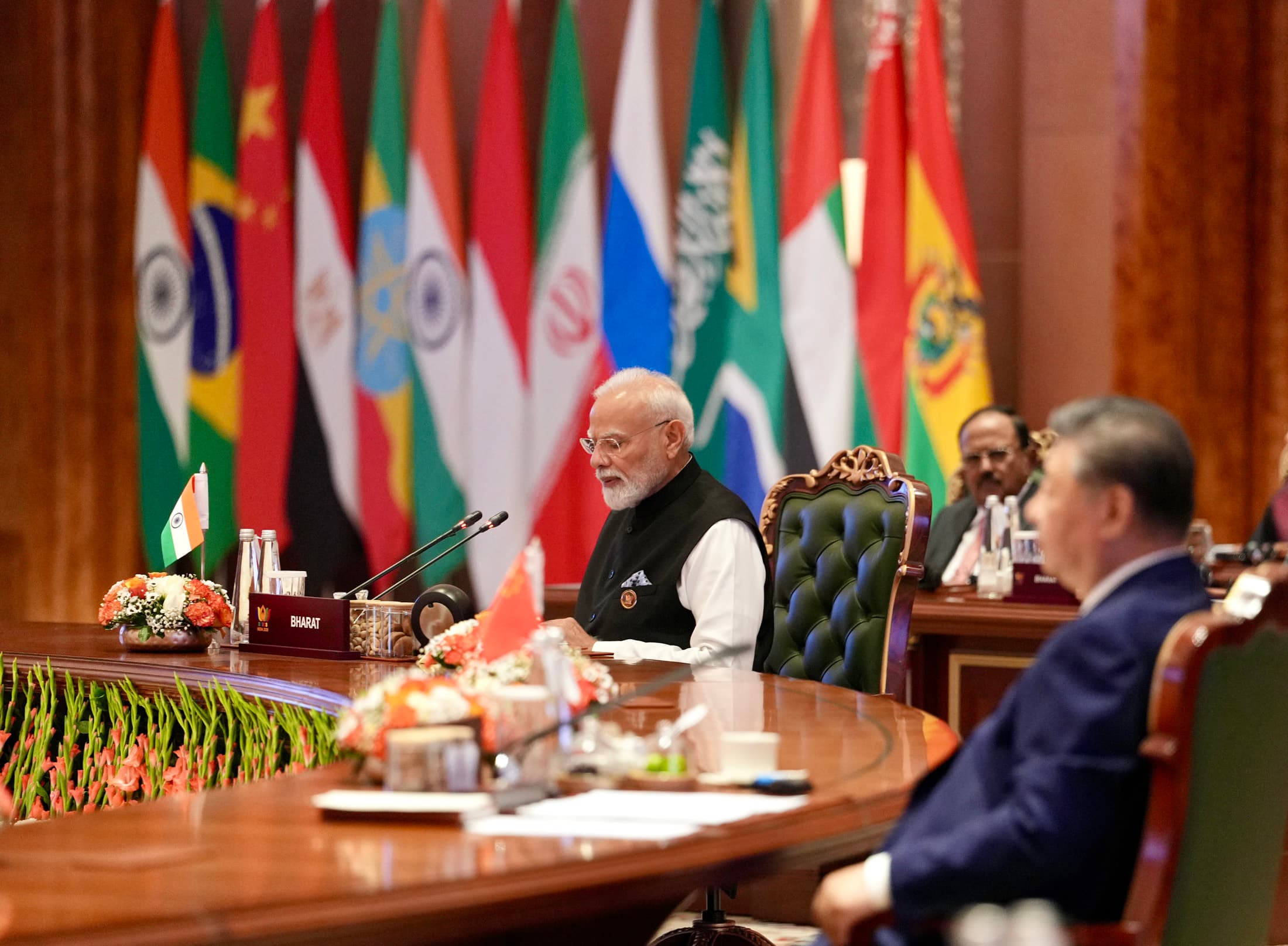
New Delhi (AsiaNews) – Eleven countries, often rivals, sat around a massive circular table: Chinese President Xi Jinping back in India for the first time in seven years, Russian President Vladimir Putin and Iranian President Masoud Pezeshkian seated just a short distance from the Crown Prince of Abu Dhabi.
The images circulating after the 18th BRICS summit, which ended in New Delhi yesterday, seem to tell the story of the emergence of a new global power centre.
Indian Prime Minister Narendra Modi spoke of the need for the group's members to increasingly become "rule shapers", capable, that is, of setting the rules of the international order, rather than rules takers.
Yet, the seeming unity among BRICS countries appears more like a piece of grand standing – and one not particularly well orchestrated, considering Xi Jinping skipped the closing dinner hosted by the Indian Prime Minister – rather than the establishment of an alternative pole capable of coherently challenging the US-led order.
From an economic acronym to a platform for communicating with the West
It is worth noting how the group originated. The acronym BRIC was coined in 2001 to designate four major emerging economies (Brazil, Russia, India, and China) that held their first ministerial meeting on the sidelines of the UN General Assembly in 2006 and their first leaders' summit in 2009, in response to the global financial crisis of the previous year.
The group was thus founded on a primarily economic basis, making the bloc distinct from the outset from others such as NATO, the Shanghai Cooperation Organisation, or the Quad, which were formed around shared security concerns.
On paper, the group has a political and security “pillar”, but in practice, there is no supporting structure, no binding commitments or mutual defence mechanisms.
What is left, therefore, according to various analysts and observers, is essentially a platform for signalling dissatisfaction to Washington and the West, shared dissatisfaction: when a member can negotiate bilaterally with the United States, it does so quietly; when it cannot or will not, it brings the issue to a forum like BRICS and crafts a contentious statement there.
Consequently, these announcements end up being purely rhetorical, as they are not backed by binding obligations or mechanisms capable of enforcing their implementation. This is because relations between member countries are, in reality, frayed, if not openly conflictual.
India and China, for example, clashed militarily in 2020 along their disputed Himalayan border. While tensions have eased since then, the border issue remains unresolved, mistrust prevails, and friction persists, exemplified, notably, by Xi Jinping’s absence from the summit’s closing gala dinner.
Similarly, the final declaration acknowledges the strategic role of critical minerals in low-emission technologies and energy security, calling for supply chains that are “reliable, responsible, diversified, and resilient”.
In his address, Modi spoke out against the use of critical minerals as tools of leverage. This is because China dominates global rare-earth processing and has recently used export controls as leverage in its trade relations.
India, which is seeking to diversify its supplies and forge agreements with other countries, has a tangible interest in reducing this dependency.
The conflict between Iran and the United Arab Emirates (UAE) is another sore point. Tehran has not spared UAE territory from missile strikes during the war that continues to engulf much of the Middle East.
Once again, the BRICS do not appear as a bloc of allies, but at most as a forum where adversarial parties can try to manage the consequences of conflicts that are barely called by their true names.
Many words, few commitments
The 140-point New Delhi Declaration was unanimously adopted.
On one hand, this is a significant achievement, given that two previous meetings of BRICS foreign ministers earlier this year failed to produce a joint statement due to internal divisions.
On the other hand, the language is so vague that it binds no one; indeed, it explicitly acknowledges that member countries maintain their own "national positions" regarding ongoing armed conflicts.
Regarding the war in the Middle East, the text merely calls for "maximum restraint" and condemns “attacks on civilian infrastructure and peaceful nuclear facilities” without ever assigning responsibility to any specific party.
It reaffirms support for a two-state solution between Palestine and Israel and opposes the forced displacement of Palestinians, yet carefully frames everything within existing UN resolutions, avoiding any stance that might upset any of the members present at the table.
On trade, the document expresses concern over the "indiscriminate" rise in tariffs and condemns unilateral sanctions, yet never explicitly names the United States. This omission reflects a fear, shared by several member countries, of incurring Washington’s wrath, with whom relations remain, in reality, ambivalent.
India seeks to cooperate with the United States, regardless of administration. China wants a mutually beneficial economic relationship, and Xi is set to visit the United States for a summit with Trump on 24 September, according to the US president.
Although Russia has more valid reasons to break with a US-led international order, Moscow has hosted Trump’s envoys over the past month, and it is hard to imagine Russia supporting a Chinese-led global order, in which it plays a subordinate role.
Little credibility
In this regard, the failure to mention Russia’s war in Ukraine is particularly significant, marking a clear departure from previous BRICS statements that at least cited possible efforts at mediation.
According to a Kremlin spokesman, during bilateral talks with Putin on the sidelines of the summit, both Modi and Xi expressed readiness to offer their good offices to help find a solution to the conflict in Ukraine.
The day before, Modi and Putin had met separately exchanging views on regional and global issues, including conflicts in the Middle East and the Black Sea region (a diplomatic term New Delhi tends to use to refer to the war in Ukraine without explicitly naming it).
The failure to mention the conflict once again highlights the irreconcilable divisions between New Delhi and Beijing, despite statements made for the media.
The rest of the document follows the same pattern: it calls for reforming the International Monetary Fund and the World Bank to reflect the weight of emerging economies, for a "comprehensive" reform of the UN Security Council, for support of a "non-discriminatory, open, fair, inclusive, predictable and rules-based” multilateral trading system, and for stronger industrial cooperation.
These formulas recur, almost identical, from one summit to the next; and none of these statements are accompanied by deadlines, verification mechanisms, or concrete consequences for non-compliance.
Even on the issue of "de-dollarisation”, the summit opted for a cautious approach. The final declaration supports the use of local currencies and the interoperability of payment systems but proposes neither a common BRICS currency nor a unified payment system. Indeed, precisely to avoid once again exposing itself to the threat of US tariffs, New Delhi emphasises the concept of currency “diversification” rather than the replacement of the dollar within the international system.
It is thus hard to label a group an “alternative pole” when it softens the language of its own communiqué so as not to antagonise the very power it is theoretically supposed to oppose.