

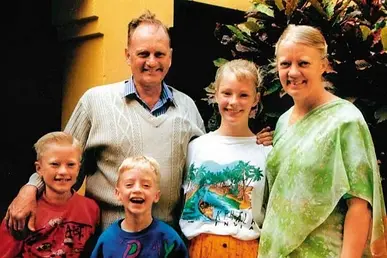
Bhubaneswar (AsiaNews) - The Orissa government has rejected the application for early release submitted by Ravindra Kumar Pal, alias Dara Singh, who was sentenced to life imprisonment for the murder of Australian missionary Graham Stuart Staines and his two sons, Philip and Timothy, in January 1999.
The decision was taken by the state’s Sentence Review Board and follows repeated calls from the Indian Supreme Court, which had asked the authorities to rule on the application for remission of sentence.
Singh, who has spent more than 26 years in prison, had submitted the application, citing the guidelines on early release adopted by the state in 2022.
The case had remained pending for a long time without a final decision, until the Supreme Court intervened.
On 19 August, the judges had ordered the Sentence Review Board to rule on the matter and, on 8 September, had once again expressed strong displeasure at the delay, threatening to summon state officials if the issue was not resolved.
The Board’s decision, taken at a special meeting on 31 August, was also motivated by the potential implications for security and public order.
According to the minutes examined by the Indian press, the authorities in Kendujhar had reported that on 15 August, around 200–250 people linked to the so-called Dara Sena (an informal organisation centred on Singh, whose name means ‘Dara’s army’) had gathered outside the prison where the man is being held, chanting provocative slogans.
The Board considered that his release could have “repercussions on society” and provoke sectarian tensions.
The decision must now be communicated to the Supreme Court, which is expected to review the case again tomorrow, 17 September. The rejection of the application therefore does not bring the legal proceedings regarding the remission of the sentence to a close.
The incident dates back to the night of 22–23 January 1999, when Graham Staines and his two sons were sleeping in a vehicle parked in Manoharpur, in the district of Keonjhar (now Kendujhar).
A group of men set fire to the vehicle, preventing the victims from escaping: all three were burnt to death. Staines, an Australian missionary, had been working for years amongst tribal communities, including providing care for people affected by leprosy.
The Supreme Court detailed the missionary’s work and the circumstances of the attack in its 2011 judgement.
His sons, Philip and Timothy, were 10 and 6 years old respectively when they were killed.
A court sentenced Dara Singh to death in 2003. In 2005, the Orissa High Court upheld his conviction but commuted the death sentence to life imprisonment.
In January 2011, the Supreme Court upheld the life sentence.
In the 2011 judgement, the Court attributed the attack in part to a desire to ‘teach Staines a lesson’ for his religious activities, which involved preaching Christianity amongst tribal communities.
The verdict also addressed the relationship between religious freedom, conversions and the secular nature of the state, reaffirming that constitutional protection of religious freedom cannot depend on religious affiliation.
The tragedy also had an unexpected consequence in the response of Staines’s widow, Gladys, who decided to remain in India following the murder of her husband and children and, over the years, became a figure associated with forgiveness and reconciliation.
Her choice helped to make the case not merely a legal story, but also a point of reference in the debate on the Christian response to violence.
However, the case of Dara Singh does not end with the murder of the Staines family.
Singh also received two further life sentences for two other murders committed in the district of Mayurbhanj: that of the Catholic priest Arul Doss, killed in the church at Jambani, and that of the trader SK Rahman.
These previous convictions were also taken into account by the Orissa authorities when assessing the request for early release.
The request for remission had already been rejected on several occasions between 2016 and 2023.
In March 2025, the authorities in Kendujhar district had, however, expressed a favourable opinion regarding a possible release, subject, however, to conditions designed to preserve public order and social harmony.
Subsequently, the Board had postponed the decision several times, requesting further assessments from the local authorities and those in Singh’s home district in Uttar Pradesh.













