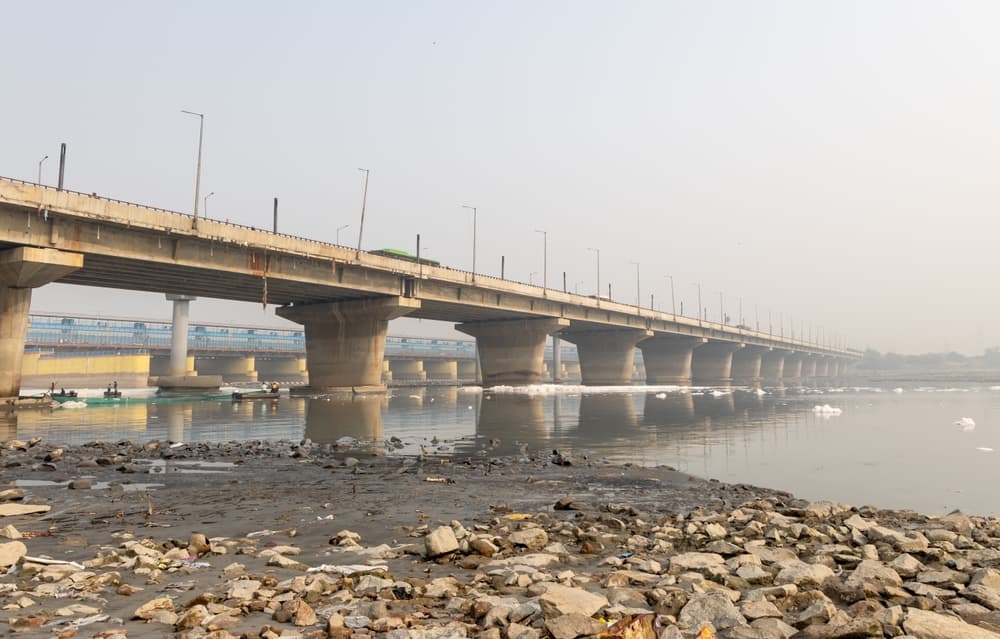
New Delhi (AsiaNews) – After an eight-year impasse, six Indian states signed an agreement on Tuesday to move forward with the Kishau Dam, a multipurpose project to be built on the Tons River, a tributary of the Yamuna, along the border between Himachal Pradesh and Uttarakhand.
The project, with an estimated value of over 165 billion rupees (more than US$ 1.87 billion), is expected to supply water to various sectors and generate hydroelectric power. However, environmentalists and scientists are demanding that updated studies on the project's impact be made public before work begins, particularly in light of the Himalayas' seismic instability.
The chief ministers of Himachal Pradesh, Uttarakhand, Uttar Pradesh, Haryana, Rajasthan, and Delhi signed the memorandum of understanding in the presence of Union Home Affairs Minister Amit Shah and Minister of Water Resources C R Patil.
According to the central government, New Delhi will bear approximately 90 per cent of the financial burden for the water component, while the remaining 10 per cent will be shared among the states in accordance with agreements regarding the management of the Yamuna River, currently one of India's most polluted rivers.
The project must now undergo final approval by the central government.
According to the latest data released by authorities, the Kishau Multipurpose Project is expected to enable the irrigation of approximately 97,000 hectares of land and generate 1,476 million units of hydroelectric power. The generation capacity cited in the most recent documents is 422 megawatts.
The dam is part of a broader plan to increase water storage capacity in the upper Yamuna basin, in accordance with a 1994 agreement on the allocation of the river's water among the states surrounding the basin.
The Kishau Dam is intended to allow for water storage during periods of high availability, which would then be distributed to the beneficiary states.
However, the need to reach an agreement among the states delayed the project for years.
The main obstacle was the cost that would fall upon Himachal Pradesh, the state where a significant portion of the project would be built and which would also have to bear the social and environmental costs associated with the dam's construction.
The state government had specifically objected to the requirement to invest in a project where the primary benefits regarding water supply would go to downstream states.
The turning point came last June, when the central government announced it would cover 90 per cent of the costs associated with the water component.
The agreement also stipulates that Delhi and Rajasthan would shoulder Himachal Pradesh’s share of the project costs, 75 per cent and 25 per cent respectively, in exchange for their share of the water.
As for the energy component, the beneficiary states are expected to cover approximately 20 billion rupees (US$ 210 billion) in costs that would otherwise fall on Himachal Pradesh.
A 2020 feasibility study anticipated the submersion of about 2,950 hectares of land, affecting roughly 5,500 people across 17 villages in Himachal Pradesh and Uttarakhand.
Field research also highlighted potential impacts on agriculture, livestock, forests, fisheries, and economic activities in the Tons Valley, as the submerged areas include fertile land capable of yielding three to four harvests a year.
Environmentalists are concerned about the project's location in one of India’s most geologically sensitive areas.
Himanshu Thakkar, a water resources expert with the South Asia Network on Dams, Rivers and People, described the project as risky precisely because of the Himalayan region's high seismic activity.
According to Thakkar, building a dam of this size in an unstable area could amplify earthquake-related risks, while the increase in extreme weather events linked to climate change introduces further uncertainties.
Furthermore, discrepancies remain regarding the project's technical data. A document from the Ministry of Environment’s appraisal committee, dated January 2026, indicates a generation capacity of 422 megawatts (MW), utilising four 105.5 MW turbines.
Earlier documents, including those available on the Himachal Pradesh Power Corporation website in 2018 and a 2022 committee agenda, indicated a capacity of 660 MW, comprising four 165 MW units.
This discrepancy is not explained in the more recent documents. Classifications of the land subject to submersion also differ between the older sources and those from 2026.
Signing the agreement will not immediately lead to the start of construction. Several steps must be completed before the project is realised, including central government approval, the transfer of forest land, environmental clearances, and a detailed resettlement plan for the affected communities. No timeline has currently been specified for the completion of these procedures.