Karachi (AsiaNews) – Twenty-four years on from the killing of seven staff members during an armed attack on the offices of the Institute for Peace and Justice in Karachi, the Rampa Plaza tragedy remains a painful memory for Pakistan’s Christian community and for all those who fight for human rights, peace and social justice.
On 25 September 2002, armed assailants stormed the headquarters of the humanitarian organisation, subdued the staff inside and shot them at point-blank range in what amounted to a full-scale execution. Six victims died instantly, whilst one died in hospital a week later as a result of the extremely serious injuries sustained. Another staff member, Robin Sharif, although also seriously injured in the attack, managed to survive.
The seven victims were Iqbal Allah Rakha, Benjamin Sadiq/Talib, Kamran Anjum, John Munir, Aslam Martin, Mushtaq Roshan and Edwin Foster.
The Institute for Peace and Justice was linked to the Catholic Diocese of Karachi and worked to protect human rights, workers’ dignity and social justice. For many years, the organisation was led by Fr Arnold Heredia, a Catholic priest who, because of his commitment, suffered imprisonment and many other hardships, eventually being forced to leave Pakistan.
The institute also published the monthly magazine Jafakish, which gave a voice to the concerns of workers and disadvantaged communities, raising awareness of issues relating to social and economic justice. According to Fr. Khalid Rashid Asi, the Rampa Plaza tragedy continues to raise crucial questions about the protection of those working for peace and human rights and the need to establish who is responsible for the attacks suffered.
The murders – carried out by a commando unit linked to fundamentalist movements – took place just a few months after the death of the institute’s president, Edwin Naun, who also died in circumstances described as mysterious. The two incidents fuelled concerns within the organisation and throughout the entire Christian community. However, almost five lustri on, questions remain about the attack, whilst the call – so far in vain – to identify the perpetrators and bring them to justice remains an integral part of the remembrance of the victims.
Today, 25 September, a special prayer service was held at the Church of the Holy Rosary in Madina Town, Faisalabad, to commemorate the seven victims. The ceremony was not only an occasion to remember those who lost their lives, but also a moment to renew the commitment to peace, justice and human dignity. Fr Khalid Rashid Asi stated that the sacrifice of the seven workers must not be forgotten. “Their lives,” he emphasised, “represent a constant call to reject violence and injustice and to pursue dialogue, respect for the law and peaceful coexistence.”
For Pakistan’s Christian community, the anniversary also carries a broader significance. Churches and Christian organisations have repeatedly emphasised the importance of safeguarding human dignity and ensuring justice for the victims of violence, particularly when attacks target people working to support vulnerable communities. The victims of the Rampa Plaza tragedy were not killed in the course of an armed conflict; they were staff members of an organisation dedicated to human rights and social justice. Their deaths remain a stark reminder of the risks faced by civil society activists and human rights defenders in Pakistan.
Remembering the seven victims also highlights the broader need for accountability. For families and communities affected by violence, justice is not merely a legal matter, but an essential part of the journey towards healing and reconciliation. As the Christian community remembers and honours its ‘martyrs’, their legacy continues to point the way towards a society in which differences are addressed through dialogue rather than violence. The Rampa Plaza tragedy remains a painful chapter in Pakistan’s history. However, the annual commemoration offers an opportunity to reaffirm a different vision: one in which peace takes the place of hatred, the rule of law replaces violence, and justice and human dignity are guaranteed for all.
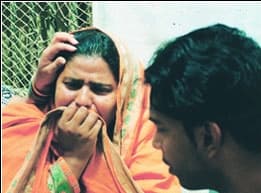
(Pictured: a relative of one of the victims in the hours following the attack)