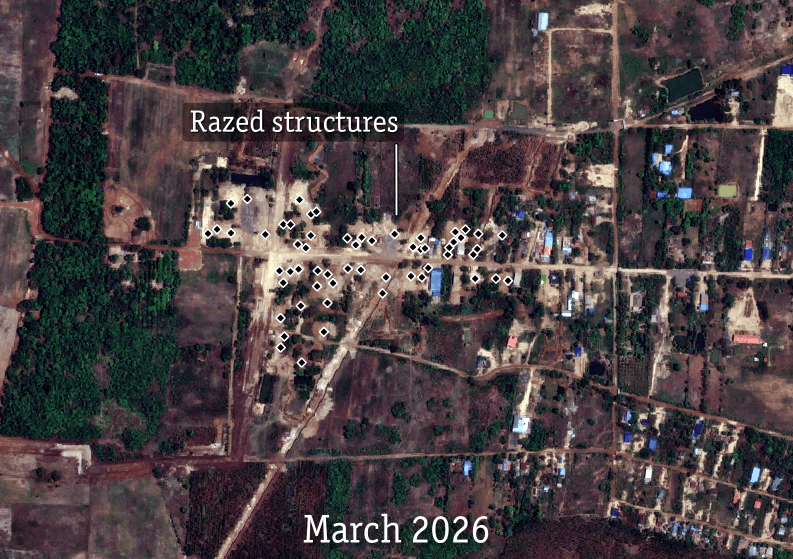
Phnom Penh (AsiaNews) – A leading Cambodian human rights group has released satellite images showing hundreds of homes and public buildings, including health centres, that have been razed in three Cambodian villages occupied for months by Thai troops.
The revelation comes as more than 20,000 Cambodians remain unable to go home and Phnom Penh steps up pressure on Thailand to resume stalled talks and joint border inspections.
The images, publicly available from the European Space Agency's Sentinel-2 satellites, show side-by-side comparisons of the villages in April last year, before Thai forces took them, and again in March this year.
The Cambodian League for the Promotion and defence of Human Rights (LICADHO), one of the country's oldest and largest rights groups, says about 627 homes were destroyed after the two sides agreed on an uneasy truce in December.
"The destruction of civilian property by occupying powers, unless absolutely necessary for military operations, is prohibited by Article 53 of the Fourth Geneva Convention," says LICADHO.
"International human rights law also protects the right to adequate housing, and prohibits the arbitrary destruction of civilian houses and forced evictions regardless of land tenure or ownership status.
"Civilian homes must not become targets or collateral damage in a border dispute, and remedy for the destruction of property must be considered."
Thailand has not yet formally responded to the publication of the satellite images or comments by senior Cambodian government officials.
But Bangkok routinely insists it has not targeted civilian infrastructure and previously pushed back against criticism by human rights groups over the border displacement.
The UN Special Rapporteur on the situation of human rights in Cambodia, Tom Andrews, toured the border area and met senior Cambodian government officials, as well as refugees, on a 12-day mission that ended on July 31.
"It is a matter of international law that those displaced by armed conflict have the right to return to their homes," he told a news conference in Phnom Penh at the end of his tour, adding the December ceasefire stipulated the right of return.
"It is imperative that Thailand and Cambodia work together to expedite the return of displaced civilians. They need, and deserve, to go home."
As of August 6, 20,281 Cambodians, including 10,331 women and 6,066 children, are stuck in refugee camps, unable to return to their homes and farms, according to the Ministry of the Interior.
The displacement has affected public services in border provinces, closing schools, health centres and other facilities.
The publication of the satellite images comes as Cambodia steps up diplomatic efforts over its border dispute with Thailand, urging the Cambodia-Thailand Joint Boundary Commission (JBC) to resume boundary demarcation while ASEAN observers expand inspections along the frontier.
"This is not going away any time soon," a Phnom Penh-based diplomat from an ASEAN country told AsiaNews. "The two sides appear no closer to resolution – or even starting to talk seriously,” they added. "The problem is, the longer this goes on – and the longer Thai soldiers are in those villages – the less likely it is the IDPs (Internally Displaced Persons) will ever go home.”
Cambodian government spokesman Pen Bona said on 6 August that the resumption of JBC field surveys is essential to enable the thousands of refugees to return home.
“This situation underscores the need for the Cambodia-Thailand Joint Boundary Commission to begin joint boundary demarcation as soon as possible, ... so that innocent Cambodian civilians can return to their homes freely, safely and with dignity, in accordance with international law,” Bona said.
Cambodian Information Minister Neth Pheaktra, in a 6 August social media post, said the ceasefire agreement committed both governments not only to ending armed hostilities but also to ensuring that civilians could go home.
"True peace cannot be measured merely by the silence of the guns,” he wrote.
“It must be measured by the day when more than 20,000 displaced Cambodian civilians can finally return to their homes and land safely, voluntarily, and with dignity.
"Until that happens, the commitments embodied in the Joint Statement of December 27 remain unfulfilled."