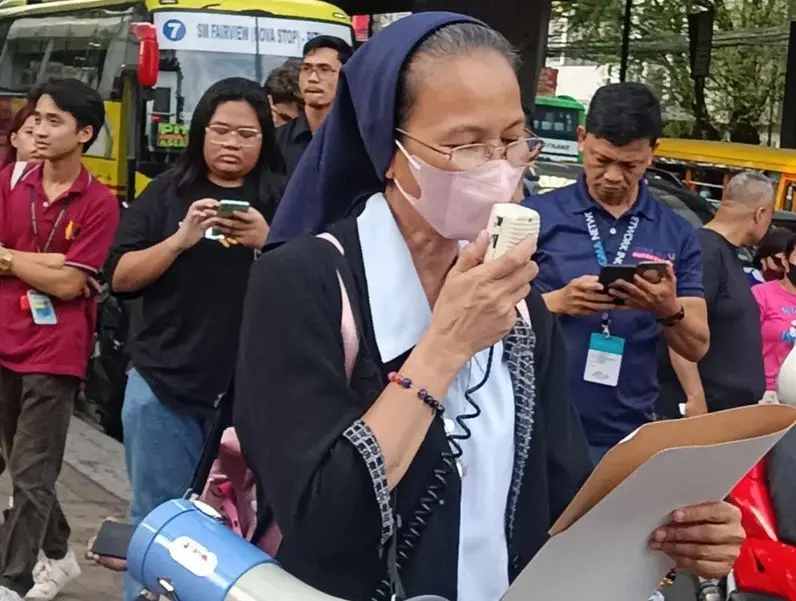
Manila (AsiaNews) – For the past 38 years, Sister Maria Liza Ruedas, a Filipino nun, has been dedicated to voter education to ensure a fair, honest and transparent election.
A member of the Daughters of Charity, the nun has been active in her mission amongst students, farmers and indigenous communities, demonstrating throughout this time a commendable commitment to building a better nation that aspires to justice, peace and development.
The aim of voter education, in fact, is to help people understand that the country needs honest, transparent and ethical candidates and representatives, capable of governing with compassion, competence and commitment.
People thus have the opportunity to learn about their socio-political rights and responsibilities in a context as particular as the Philippines, where electoral fraud, violence and family feuds often occur during voting, including political murders.
“When I am in the National Capital Region, particularly in Manila, I work with partners to set up a group of expert speakers,” she explained to AsiaNews. “Building a path towards good governance, truth and transparency,” she continued, “begins with the right of voters to choose capable people for elected office.”
The programme is aimed at the institutions of the Daughters of Charity, schools and lay partners of the mission, which extends well beyond the capital’s borders thanks to the collaboration of her fellow sisters. “We have modules adapted by the Conference of Major Superiors of the Philippines (AMRSP), the Ecumenical Group, Simbayanihan and other partners,” adds the nun, who, alongside her own programme, has integrated her modules with those of sector-specific organisations. The parishes in Manila also regularly host organisations and institutions from other parts of the archipelago.
Voter education continues at irregular intervals in various parts of the Philippines, the most significant predominantly Catholic country on the Asian continent with its 86 million faithful.
Its mission, she explains, is to shape voters’ consciences and to give people the tools to assert their rights in the face of life’s challenges and corruption. “To raise awareness and encourage participation in political change, empowering the Filipino people and young people. In particular,” continues Sister Ruedas, “voters are finding democratic ways and spaces to participate in electoral reform.”
Discussions range from selecting suitable candidates to combating forms of electoral fraud – particularly those involving vote-buying – and identifying candidates who arouse suspicion.
“It is very demanding yet stimulating, especially when we go out into the field. The poorest people and those in the outskirts,” she explains, “are always the victims of political manoeuvring and exploitation by traditional politicians.”
It is difficult when one has to repeatedly uncover and expose the usual practices, such as vote-buying, the unreliability of the automated electoral system, political dynasties and patronage systems.
“I believe this issue,” she stated, “must be taken seriously not only during election periods, but at other times as well. Good governance and leadership must be taken seriously in schools, in the curriculum and within communities’.
In this regard, the nun adds that ‘many hope for a people and a society that are upright, honest and empowered. It is a lifelong process; until we learn to live for and defend the common good of our country – not just for the few, but in the service of our people’.
“We aspire,” she says, “for every Filipino voter to rediscover their rights, duties and even their privileges,” adding that voting is a sacred act and political engagement is a true charitable contribution to political change. Efforts to make an informed decision at the ballot box must make a difference in the lives of individuals and society. However, behaviours and attitudes are difficult to change. “It requires,” she emphasised, “awareness, active participation and commitment to the Philippine electoral system.”
People’s response to voter education varies: some are enthusiastic, others not so interested, the nun explained, adding that it is the younger students who demonstrate a willingness to learn and a high level of receptiveness.
One of the key points of her campaign in favour of voter education has been the need for people to be aware of the scourge of vote-buying – a phenomenon that is as lucrative as it is tempting and widespread.
In her work on voter education, the nun ensures that people are aware of the attitudes and practices that foster patronage, vote-buying and deceptive campaign promises. “Our aim,” concludes Sister Rueds, “is to help voters make informed choices when electing the best candidates.”