

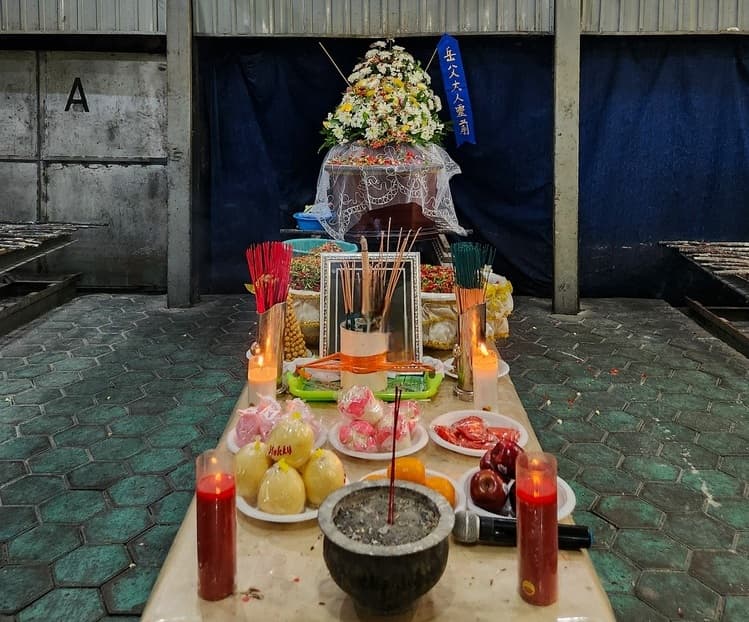
Singapore (AsiaNews) – In Singapore, demand is rising for pro bono funeral services – a free service often provided by an unseen network of charities, social workers and businesses. This is to ensure a dignified farewell for an increasing number of elderly people who die alone, almost always without the slightest family support. Among the systemic causes are an ageing population and a significant reduction in the size of households.
An investigation by Channel News Asia paints a picture of a phenomenon that is as alarming as it is surprising. In 2024 alone, Singapore recorded 87,000 residents – aged 65 or over – living alone; added to this figure is the statistical uncertainty regarding how many people die alone in the city-state.
Social workers say the number is rising, whilst in Singapore there is no legal obligation requiring a relative to cover funeral costs.
In fact, it is funeral directors who are most aware of this trend. It is by no means uncommon for people to die in their own homes, in complete solitude and isolation, without anyone noticing. Their bodies are usually discovered days after their death, often due to odours or fluids leaking from the home, which are detected by neighbours.
CNA spoke to those who provide funeral services for people living alone, guided by the mantra: ‘No one deserves to be forgotten’. One such organisation is the Cheng Hong Welfare Service Society, a charity dedicated to helping people without family support to organise the various aspects relating to the end of life, ensuring they receive a dignified send-off. The organisation has around 800 volunteers, including 40 who are specifically trained in end-of-life care.
The organisation reported that it had handled 330 cases of pro bono funeral arrangements in 2025; that is, more than triple the 106 cases recorded in 2021. Figures for 2026 are expected to be even higher. Some of these interventions are made possible by awareness-raising activities carried out particularly in low-income neighbourhoods, in addition to referrals received from hospitals, care homes and the police. The organisation spends around 3,000 Singapore dollars (2,300 US dollars) per case, funded almost entirely by donations and volunteers.
This means they are not limited to handling funeral arrangements. Once cases of isolation have been identified, volunteers accompany elderly people out for meals, or deliver groceries to them and check on their wellbeing. In other cases, funeral homes organise outings and social activities.
“When they socialise more, they look out for one another more often and, ultimately, when something happens or there’s an incident, it’s possible to intervene in time,” said the CEO of Direct Funeral Services.
Direct Funeral Services is another agency interviewed by CNA. Like others, it also provides free cremation for people living alone. It does this by chartering a boat to scatter the ashes of dozens of people at sea, whose remains have not been claimed. This agency handles over 120 pro bono cases a year.
Furthermore, in care homes and care facilities, staff are increasingly taking on responsibilities that traditionally fell to close relatives. The aim of the service provided by these staff is to encourage interaction, help residents feel connected and look after one another. As older people become increasingly vulnerable to conditions such as dementia, sensitive discussions about end-of-life wishes are initiated whilst they still have the mental capacity to make and communicate their own decisions.
Finally, with the relentless rise in the ageing population and the reduction in household size, the predominant challenge is to overcome the reluctance to speak openly about death. Indeed, death remains a taboo subject in many societies and cultures around the world. Therefore, the importance of planning ahead is emphasised, to spare loved ones from having to make difficult decisions, whilst ensuring that a person’s final wishes are respected.













