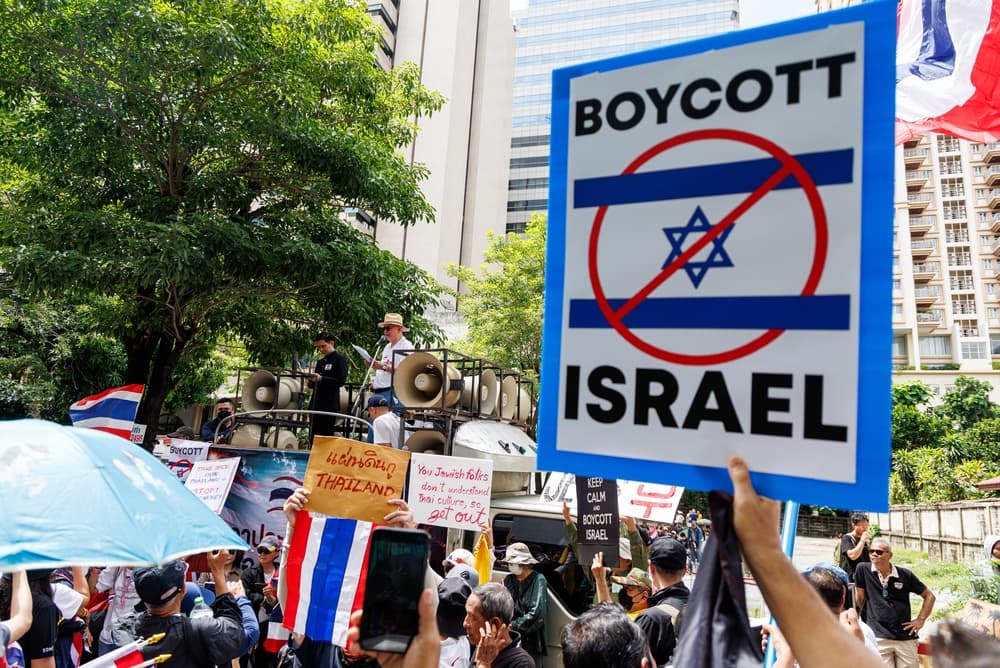
Bangkok (AsiaNews) – Hundreds of people recently gathered outside the Israeli embassy in Bangkok last week. Similar protests have taken place over Gaza in Muslim-majority Southeast Asian countries, but in Thailand, this was only part of the story.
The mobilisation has been building on Thai social media for weeks, culminating in the demonstration last Thursday, with calls for “foreign citizens to respect Thailand's laws and culture”.
By playing on resentment regarding the behaviour of some tourists, the movement is mainly fuelling Thai nationalism.
The protests
The rally was led by Sondhi Limthongkul, a 78-year-old former media tycoon and a key figure in the Yellow Shirts movement, a group that played a key role against Thaksin Shinawatra before the 2006 military coup.
Sondhi is back stoking Thai nationalism, recently targeting Cambodia, with whom Thailand clashed militarily last year, but now appears to have identified a new enemy: the Israeli presence in the country.
Between 300 and 400 people joined in protest to “Take Back Our Thailand” last week, this according to local sources,
In a letter delivered to Israeli Ambassador Alona Fisher-Kamm, protesters accused certain Israeli nationals of breaking the law, disturbing public order, and showing disrespect for local culture.
However, the text also included demands regarding land ownership and business activities.
Protesters called for an investigation into real estate holdings linked to foreigners, the use of Thai nationals as nominees to circumvent ownership restrictions, and the operations of Chabad centres, which are affiliated with the Orthodox Jewish Chabad-Lubavitch movement.
Thailand imposes strict limits on foreign land ownership; consequently, Thai citizens or companies are sometimes illegally used as nominees to bypass these rules.
Over the past two years, the authorities have stepped up inspections, particularly in tourist areas such as Phuket, Koh Samui, and Koh Pha-ngan, where the issue has raised political and economic concerns.
For instance, an investigation in May identified 32 companies on Koh Pha-ngan Island that were in violation of the law. Another operation examined 11,426 companies in Koh Samui and Koh Pha-ngan.
The presence of foreign capital in the real estate, restaurant, transport, and tourism sectors has become fertile ground for nationalist rhetoric calling for the country to “take back” control.
In the case of Israelis, this narrative has become intertwined with the rise in visitor numbers and the presence of a settled Israeli community in certain tourist destinations.
In the first eight months of 2026, more than 277,000 Israelis arrived in Thailand, a 7 per cent increase over the same period in 2025.
In 2025, Israeli visitors generated approximately US$ 1.2 billion in revenue, out of a total of around US$ 48 billion for Thailand’s tourist sector.
Overtourism as a trigger
Added to this are several recent incidents that have garnered significant media attention.
On Koh Samui Island, a dispute between Israeli tourists and the French owners of a zoo escalated into threats and confrontations after the park displayed a Palestinian flag and barred Israelis from entering.
However, tensions involving foreigners are not limited to Israelis. In July, a video showing an altercation on a Bangkok train between a Thai woman and a group of particularly rowdy Italian students went viral, sparking a wave of outrage. Eventually, the Italian embassy intervened, and the group released a video of apology.
The Thai government, led by Anutin Charnvirakul, has also introduced several new rules to streamline deportation procedures for those who violate the law, overstay their permitted time in the country, or fall into other categories defined by regulations, including illegal employment and business activities.
Why, then, did the protests focus specifically on Israelis?
An answer comes from a survey by Thailand’s National Institute of Development Administration (NIDA) whose results were released after the demonstration.
Conducted between 8 and 10 September among 1,410 adults in six areas of the country (Bangkok, Chachoengsao, Chonburi, Surat Thani, Phuket, and Mae Hong Son), the survey found that 76.38 per cent of respondents had heard media reports about alleged inappropriate behaviour or law violations by Israeli citizens, whereas only 5.11 per cent reported having had a direct experience.
Among the respondents, 77.49 per cent called for stricter law enforcement regarding Israelis, while 45.45 per cent argued that the government should reduce the length of stay permitted for Israelis.
About 38.49 per cent called for a more active role by the Israeli embassy in monitoring the conduct of its citizens.
Some 31.44 per cent cited the alleged use of Thai nationals as nominees to hold land on behalf of foreigners as a problem, while 29.04 per cent pointed to similar mechanisms regarding the control of businesses.
Furthermore, 23.54 per cent called for an assessment of the national security implications of the expansion of Israeli communities in certain parts of the country.
According to Thai analyst and journalist Pravit Rojanaphruk, the protests represent a convergence of various factors: xenophobia, economic stagnation, resentment toward certain foreign visitors, and opposition to Israeli policies in Palestine.
However, Rojanaphruk also highlights the spread of unfounded fears that some Israelis are attempting to put down roots in the country and gain increasing influence over Thai real estate and businesses.
Indeed, the term "grey Israeli" or "grey Jew" frequently appears in the protesters' narrative, modelled on the broader concept of "grey capital” used in Thailand to refer to foreign funds entering the country through opaque corporate structures.
While the issue of using nominees is real, the notion of a coordinated Israeli scheme to "conquer the Thai real estate market or establish a sort of permanent base in the country risks merely fuelling antisemitic stereotypes.
Rising Nationalism
Thailand’s nationalist narrative goes back to the Kingdom of Siam, the only Southeast Asian country never formally colonised by a European power, even though it was sandwiched between the British Empire to the west and French Indochina to the east.
The loss of territory to European colonial empires in the late 19th century has remained a significant facet of the country’s collective memory.
In the past year, tensions with Cambodia have revived political rhetoric centred on the defence of territory and sovereignty.
Fears that foreign capital, communities, and interests might alter the local balance of power are increasingly framed as issues of national sovereignty; indeed, the term "grey Chinese" has even surfaced in Thai public discourse.
The war waged by Israel in the Gaza Strip has also featured in the debate. Some protesters have carried signs calling for a boycott of Israel and opposing the Palestinian “genocide” in Gaza.
At the same time, local commentators have noted that no one mobilised over the dozens of Thai workers killed in the 7 October 2023 attacks, nor when an Iranian attack on the Thai vessel Mayuree Naree in the Strait of Hormuz claimed the lives of three Thai crew members.
The Israeli Embassy in Thailand is working to prevent the crisis from escalating. Ambassador Fisher-Kamm has met with the Thai foreign minister and proposed a set of dos and don'ts for Israeli visitors.
Deputy Chief of Mission Rami Teplitskiy stated that the embassy takes these reports seriously and that official guidelines regarding respect for Thai laws and culture will be issued to Israeli citizens.
The result, for now, is a diplomatic crisis that remains contained but risks causing problems for both countries.
Thailand relies heavily on tourism and has no interest in turning the issue into a conflict with Israel.
At the same time, however, the government must contend with nationalist feelings it directly nurtured during the war with Cambodia.
Now, some of the more radical nationalist groups increasingly view the presence of foreigners as a potential threat to the country’s national identity and sovereignty.