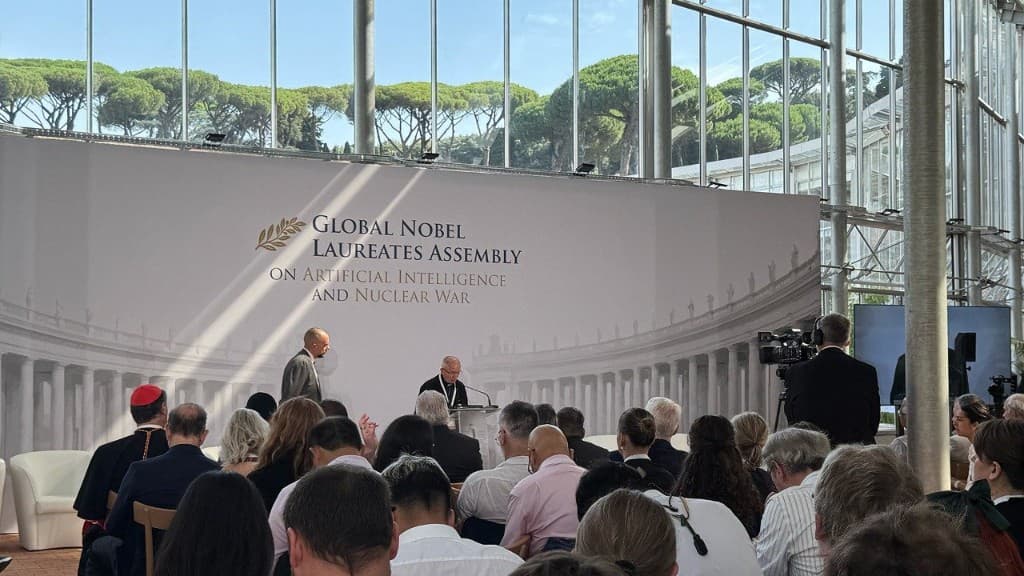
Rome (AsiaNews) – More than 200 prominent individuals – Nobel laureates, artificial intelligence (AI) experts, former heads of state and governments, and academics – met at the Borgo Laudato Sì in the papal gardens of Castel Gandolfo to address two of the major challenges of our time – AI and the threat of nuclear weapons – starting with the reflections offered by Leo XIV in his encyclical Magnifica Humanitas.
After three days of discussions, participants signed, at Rome's Capitoline Hill, a Declaration for an Unarmed and Disarming Peace in the Age of Artificial Intelligence, Nuclear and Autonomous Weapons, New Digital Protocols, and Emerging Models of Digital Development, calling for “a treaty prohibiting the reckless integration of artificial intelligence into nuclear command, control, and launch systems”.
The Domus Communis Foundation, an organisation chaired by Cardinal Silvano Maria Tomasi, created specifically to promote reflection on the ethics of AI, is behind the initiative together with authoritative international partners (the Nobel Laureate Assembly for the Prevention of Nuclear War, the Nobel Women's Initiative, the International Physicians for the Prevention of Nuclear War, Pugwash, the Yunus Centre, The Catholic University of America, the University of Chicago, Harvard Medical School, Brigham and Women's Hospital, the University of Notre Dame, the Bulletin of the Atomic Scientists, and Soka Gakkai).
The declaration signed today defines the current historical phase as "an unprecedented challenge," in which artificial intelligence offers enormous opportunities but also risks “mass job loss and sharpen economic competition between nuclear-armed states.”
The concentration of technologies in the hands of a few states and large corporations, the text warns, could also create profound asymmetries of power and accelerate economic, military, and social transformations.
The signatories denounce the parallel development of the nuclear arms race and "an equally dangerous AI race," reiterating Pope Leo XIV's call for "an unarmed and disarming peace" and the rejection of a security model based “on fear, domination, or the permanent threat of mutual destruction.”
One of the key points concerns the relationship between AI and nuclear deterrence.
“An automated system should never make the final decision to launch a nuclear weapon,” the Declaration reads. For this reason, “meaningful human control” must be guaranteed.
The declaration also proposes the recognition of a "digital commons" to foster data sharing and support global AI governance.
Finally, it reiterates the urgency of nuclear disarmament, calling for negotiations to achieve "the verifiable and irreversible elimination of nuclear weapons."
The final appeal is addressed to states to progressively reduce the role of these arsenals, noting that, “Our survival and the survival of future generations are at stake.”
During the proceedings, Nobel Peace Prize winner Juan Manuel Santos, a former president of Colombia, forcefully emphasised the need for effective governance.
Nobel Peace Prize winner Muhammad Yunus, a Bangladeshi economist who has played a crucial role in his country's delicate transition over the past two years, offered his thoughts on the epochal change underway, defining the present as a passage between the end of one civilisation and the beginning of a new one. He also highlighted the fundamental role of younger generations in building the future.
Other participants included Amnesty International Secretary General Agnès Callamard, AI security experts, specialists on the consequences of nuclear weapons, and Nobel Prize-winning Physics laureate David Gross.
The working sessions addressed topics such as the fragility of the human family in the nuclear age, the use of technology in the service of humanity, the ethical implications of AI, and the risks posed by the loss of human control over advanced systems.
One of the most important addresses came from Philippine journalist Maria Ressa, Nobel Peace Prize winner and cofounder of Rappler, who drew attention to the risks posed by AI for information and to the need to preserve the integrity of public debate.