Rome (AsiaNews) - Throughout his long ministry, marked by dialogue with the Church of Rome, Bartholomew I, the Ecumenical Patriarch of Constantinople, had already received two doctorates from pontifical universities, one in canon law andonein philosophy.
Yet, he has also made significant contributions to the theology of dialogue. For this reason, a few days before an international meeting in Assisi, where he will be a key participant, the Pontifical University of Saint Thomas Aquinas (also known as the Angelicum) has awarded him an honorary doctorate in theology.
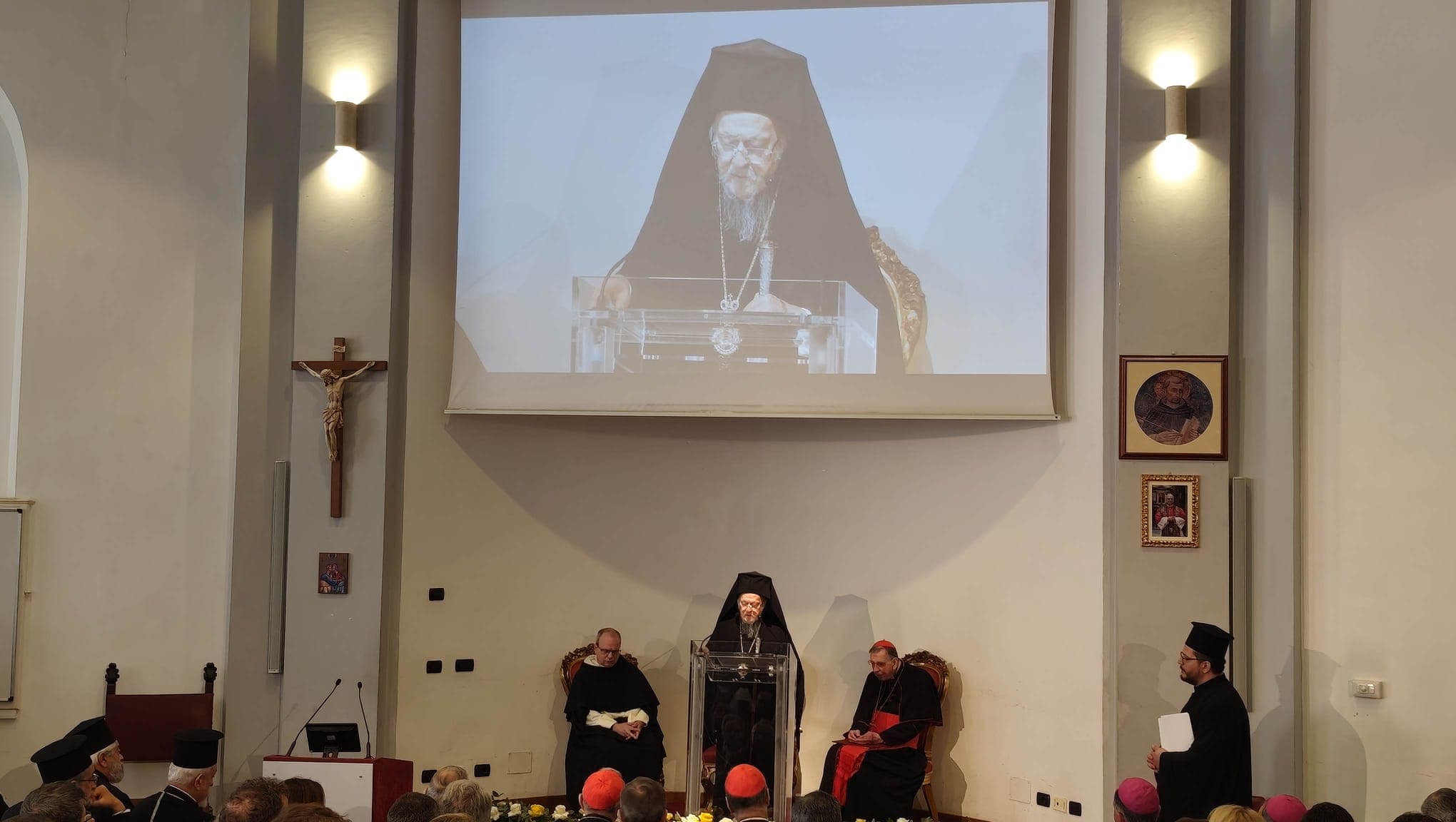
In a crowded hall, attended by university authorities, Vatican Secretary of State Cardinal Pietro Parolin, and the Prefect of the Dicastery for the Eastern Churches, Cardinal Claudio Gugerotti, the patriarch listened to the laudatio delivered by Cardinal Kurt Koch, Prefect of the Dicastery for Promoting Christian Unity.
Cardinal Koch briefly listed the key moments in the patriarch’s ministry, highlighting the milestones that shaped the evolution of theological thought regarding ecumenical relations between Catholics and Orthodox Christians.
The honorary doctorate was conferred “in recognition of your exceptional contribution to ecumenical thought, particularly in the field of relations between Catholics and Orthodox. Under your patriarchal ministry, relations between the sister Churches of Rome and Constantinople have, in fact, continued to flourish,” said the prefect of the dicastery that oversees ecumenical relations.
Over the course of his 35 years of ministry, which he just completed, since he was elected patriarch by the Holy Synod on 22 October 1991, "you have signed more joint declarations with popes than any other patriarch," Koch noted, citing those of 1995, 2002, and 2004 with John Paul II; the 2006 declaration with Benedict XVI; those from 2014 and 2016 with Francis; and the 2025 declaration with Leo XIV. Furthermore, "you were the first Orthodox patriarch to address a synod of bishops of the Catholic Church, in 2008."
Cardinal Koch highlighted three central themes as specific contributions by Bartholomew I to the field of the theology of dialogue: synodality, viewed as an intrinsic dimension of the Church and in its inseparable connection to the primacy; an awareness of ecology, based on the understanding that nature is a gift from God; and a theology of dialogue that is not a form of compromise, but rather a deeper, truth-oriented quest.
In his acceptance speech, titled Conciliarity and Communion in the Church, the Ecumenical Patriarch of Constantinople Bartholomew I explained that “the Church gathers in council because this is how Christ remains present within the Church and how the Holy Spirit guides His people. Conciliarity is the manifestation of communion within the mystery of the Church. It is neither optional nor merely advantageous; it is constitutive and essential.”
Focusing on what is an intrinsic element of ecclesial life, Bartholomew I emphasised that, “from an Orthodox perspective, this renewed Catholic interest in conciliarity is of great historical significance.”
“The Council underscored an important ecclesiological principle: unity requires encounter,” he said. “Churches cannot remain in perpetual isolation from one another while simultaneously claiming to express the fullness of catholicity.”
Indeed, “the future of Christianity depends precisely on this recovery of conciliarity. And this requires, above all, humility in the face of triumphalism, encounter in the face of isolation, dialogue in the face of division, and communion in the face of nationalism.”
Archbishop Flavio Pace, Secretary of the Dicastery for Promoting Christian Unity,spoketoAsiaNewsat the conclusion of the event.
“The two lungs of the ecumenical movement are the dialogue of faith and truth, and the dialogue of love. Today, within the embrace of a lively and vibrant community of students and professors, a true academic community that had just celebrated the Eucharist, an encounter in love took place.
“This encounter acknowledged how the thought of His Holiness has supported and contributed to the theological dialogue between the Catholic Church and the Orthodox Church, opening new paths for encounter and collaboration, not only between the two Churches but throughout the world.”
This dialogue refers, in particular, to the themes of synodality and ecology, “as dimensions deeply rooted in Christian theology and thought.”