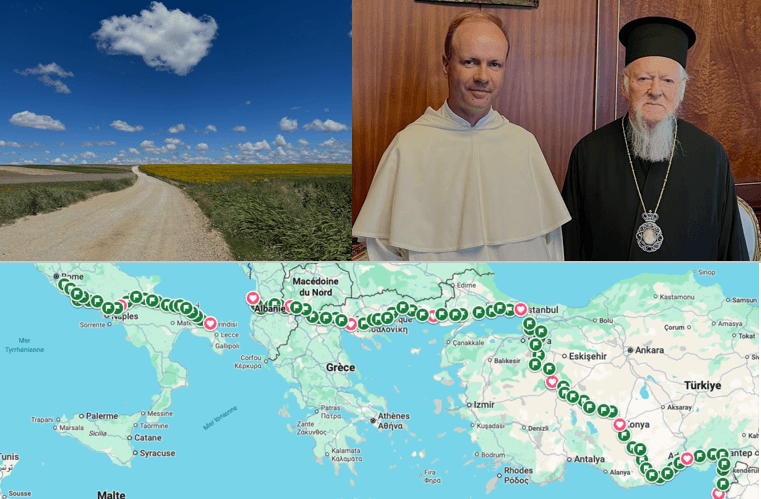
Rome (AsiaNews) – Step by step, walking amongst the people along the ancient pilgrims’ routes in the heart of the East, resuming each summer from where he left off the previous year: This is the experience that Fr Hyacinthe Destivelle, a French Dominican, director of the Institute of Ecumenical Studies (Œcumenicum) at the Pontifical University of St Thomas Aquinas (Angelicum) in Rome and an official of the Dicastery for Promoting Christian Unity, has been living for the past twelve years.
Fr Destivelle arrived in Rome from St Petersburg in 2013. “Among other things, when I was appointed, I wondered where I would go for my annual retreat.” The inspiration for the answer came through a saying of Jesus: “I am the way”, illuminated by the Dominican tradition of pilgrimage inaugurated by St Dominic himself.
Thus, in 2014, Fr Destivelle began his walking journey along the Via Francigena. The idea is to walk a section of the route every year during the summer break, strictly on foot (unless it is impossible, such as when crossing by sea), and then resume the following year from the same point to continue.
“It is not the destination that matters but the journey itself,” he says, and this is particularly evident in his experience. Initially, from 2014 to 2016, the destination was Rome. But, as often happens, once he arrived, the French pilgrim was captivated by the joy of the journey. So, in 2017, the plan became to continue along the Southern Francigena. “The route from the north to Rome is well organised in terms of accommodation; heading south was a bit more difficult because there aren’t any designated places. But as a priest in Italy, asking for accommodation in monasteries or parishes is straightforward, even without giving advance notice.”
In the footsteps of St Paul
On arriving in Ostuni, Fr Destivelle was welcomed by the monastic community of Bose and, during a meeting with Sabino Chialà, the community’s current prior, he learnt of the existence of the Via Egnazia, a Roman-era route that passed through Puglia to link Rome with what was then Byzantium. And there, the idea of a new destination and of continuing the journey took shape.
Since 2019, therefore, he has travelled through Albania, Macedonia and Greece: following in the footsteps of St Paul – who has become his travelling companion – and the communities he founded and visited. “Along the way, I was the only pilgrim, and the people I met didn’t quite understand what I was doing. At times I wondered if it wasn’t a bit reckless, especially on certain exposed stretches of the route through the mountains or when I came across stray dogs,” continues Fr Destivelle.
He also explains that he had not undertaken any specific preparation for the journey: he does not train physically throughout the year for this experience, so, he concludes, “every day, every year is a gift because I don’t know if I’ll manage to walk the distance I’ve set myself, and I’m getting on in years”.
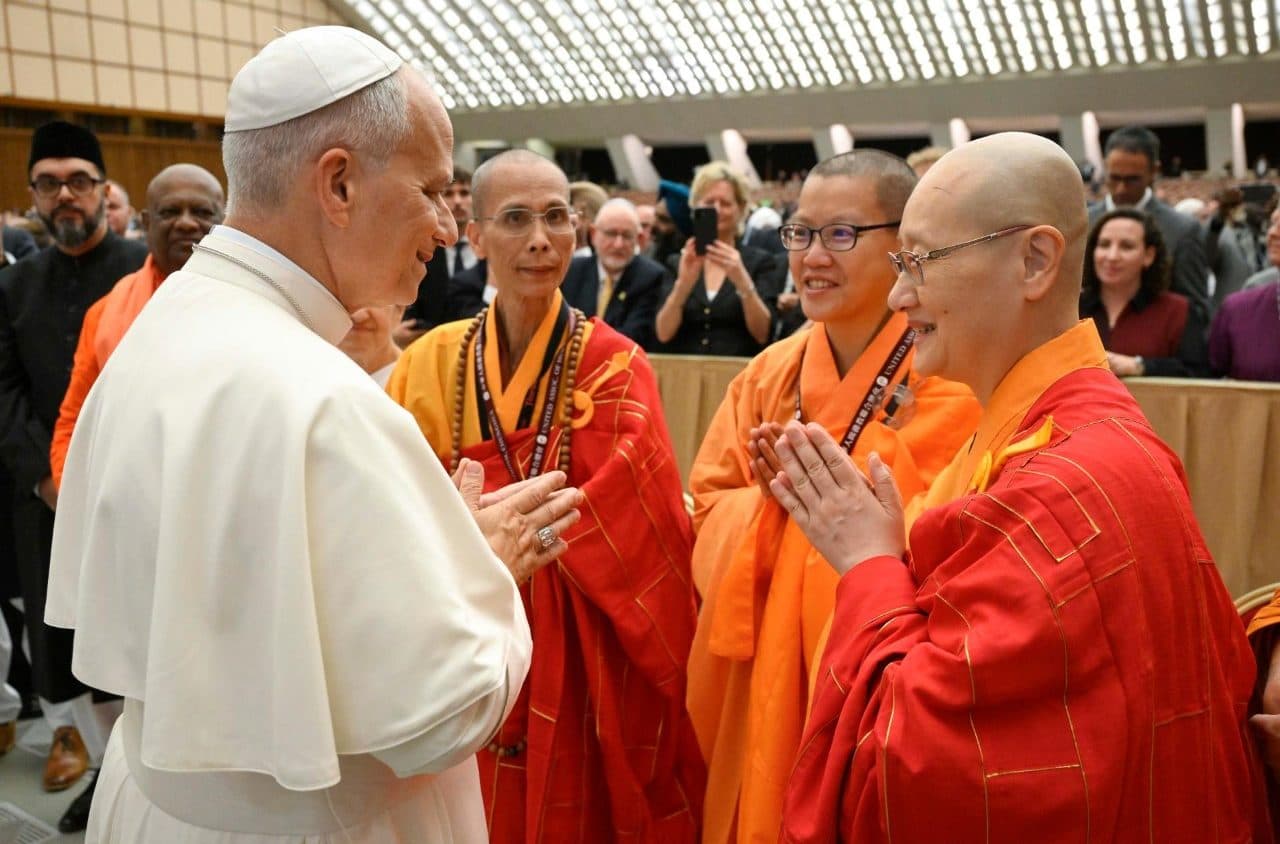
On arriving in Istanbul in 2022, Fr Destivelle requested an audience with Patriarch Bartholomew, whom he had already met on several occasions through his work with the Dicastery for Promoting Christian Unity. “For me, Istanbul was the end of my journey. But the Patriarch said to me: ‘Why not go all the way to Jerusalem?’” That question, and the richness of the journey itself, meant that the journey continued with a new destination. This year, therefore, when we meet Fr Destivelle after his summer journey, we find him back from Antakia, ancient Antioch, on the border with Syria.
We ask how he organises his accommodation along the way. “If there are Christian communities,” replies the French Dominican, “I ask them for hospitality, and sometimes I discover these places and people as I go along – as happened with the Indian Capuchin friars in Antakia, or with a Marist friar in Tarsus. Usually, however, I go to the village café where I arrive, where the men gather to drink tea and play games, and there I ask if there’s a chance I could stay for the night, and there’s always someone willing to help: it’s an experience of complete providence. They often want to offer me a chai [the local tea, ed.] and something to eat.”
Hospitality in mosques
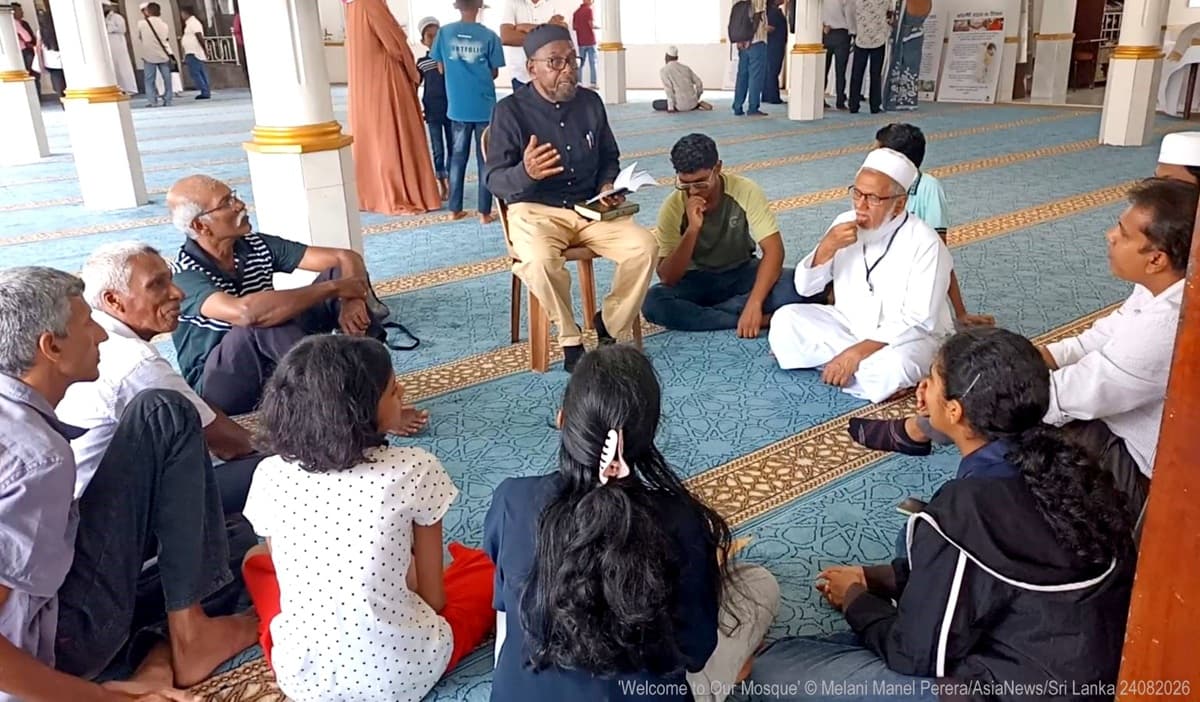
As he continued his journey through Turkey, the Christian presence was significantly smaller, and Fr Destivelle often sought hospitality in mosques. “One of the imams, welcoming me to sleep in the mosque, showed me the verse from the Qur’an which says that one must welcome the pilgrim. And I was very warmly welcomed.” Inside the mosque, so as not to disturb the prayers, Fr Destivelle went to the back of the hall and positioned himself respectfully in the direction of Mecca, like everyone else. “I prayed the Office of Readings,” he continues. “It was an experience that made me feel a certain sense of communion – I would say spiritual closeness – with the Muslims who were coming to the mosque to pray.”
The number of kilometres covered varies depending on the stage that Fr Destivelle organises each year; every day is a surprise experienced with an open mind, ready for the unexpected. “On the journey,” he comments, “I see the essence of my life: walking humbly with God. It is not the destination that matters, but the journey itself, the people you meet, the thoughts it inspires. In the morning I pray for the start of the day, for the arrival, for the people I will meet, and I ask God to keep my heart open to whatever may happen along the way.”
There are so many faces and stories along the way, and sometimes they leave an indelible mark through the simplicity of a brief exchange. “Two years ago, a Muslim man with his fruit and vegetable stall by the roadside was determined to speak to me and offer me some of his produce. He said something to me that has stayed with me: ‘If everything comes from God, the only thing that matters is sharing’.”
Another encounter took place on the road to Konya, home of the mystic Rumi. “Often, when people see me walking alone with a rucksack, they stop to ask if I need a lift, and I thank them and explain that the very point of my journey is to walk. But once, a gentleman even turned his car round to come and find me. When I explained this to him, he gave me his telephone number and told me to let him know in the evening when I arrived, as he wanted to invite me to dinner—and that’s exactly what happened.”
The journey is an experience of providence and a free gift, accompanied by intense physical exertion. “During my 10 hours of walking each day, I certainly pray for those who have asked me to pray for them and for my own conversion, but from the very beginning my main prayer intention has been for Christian unity”—a mission for which Fr Destivelle was appointed to the Vatican dicastery. “And in these places in particular, I feel in communion with these Churches. For example, when I walk through Cilicia, which was the kingdom of the Armenians”.
“Islam,” he adds, “is truly present everywhere in Turkey. Every small village has its own mosque, and there isn’t a single little restaurant that doesn’t have a place to pray. There is a certain disillusionment with the West, but as soon as people sense a spiritual quest, common ground is immediately established”. Fr Destivelle concludes by recounting his recent meeting with the Syriac Orthodox Metropolitan of Istanbul. “The only new church built in Turkey since the founding of the Republic was the Syriac Orthodox Church of Mor Efrem in 2023. Perhaps there is some hope that Christians will return.”
Next year, God willing, Fr Destivelle’s journey could take him as far as Jerusalem. A destination, certainly, but – ultimately, by now – one more point on a much longer journey.