Montevideo (AsiaNews) – The last time a pontiff set foot in Uruguay was almost 40 years ago when Pope John Paul II visited the South American country in 1987 and 1988.
Montevideo, the country’s capital, main port and most populous city is the first stage in Leo XIV’s apostolic journey, which began yesterday. The 12-day trip, from 6 November to 17 November, will include visits to Argentina and Peru.
The pontiff arrived after a flight of more than 13 hours, just 24 days after undergoing surgery at Rome’s Gemelli Hospital to remove a lung tumour. His departure was cleared by his medical team, given his excellent post-operative recovery.
Leo appeared to be in good form, greeting and talking with journalists on the ITA Airways flight that left from Rome.
The logo for the first leg of the papal journey features Christ, flanked by Leo XIV and the Virgen de los Treinta y Tres (Our Lady of the Thirty-Three), Uruguay’s patroness, as a reminder of the pope’s encounter with the Church and the people.
The motto for the visit echoes the angel’s announcement to the shepherds in Bethlehem: "I proclaim to you good news of great joy" (Luke 2:10). Words that express the fundamental significance of the visit: the presence of the Roman pontiff as an occasion for encounter and shared joy for the Church and for all the people of Uruguay.
The first address to the authorities
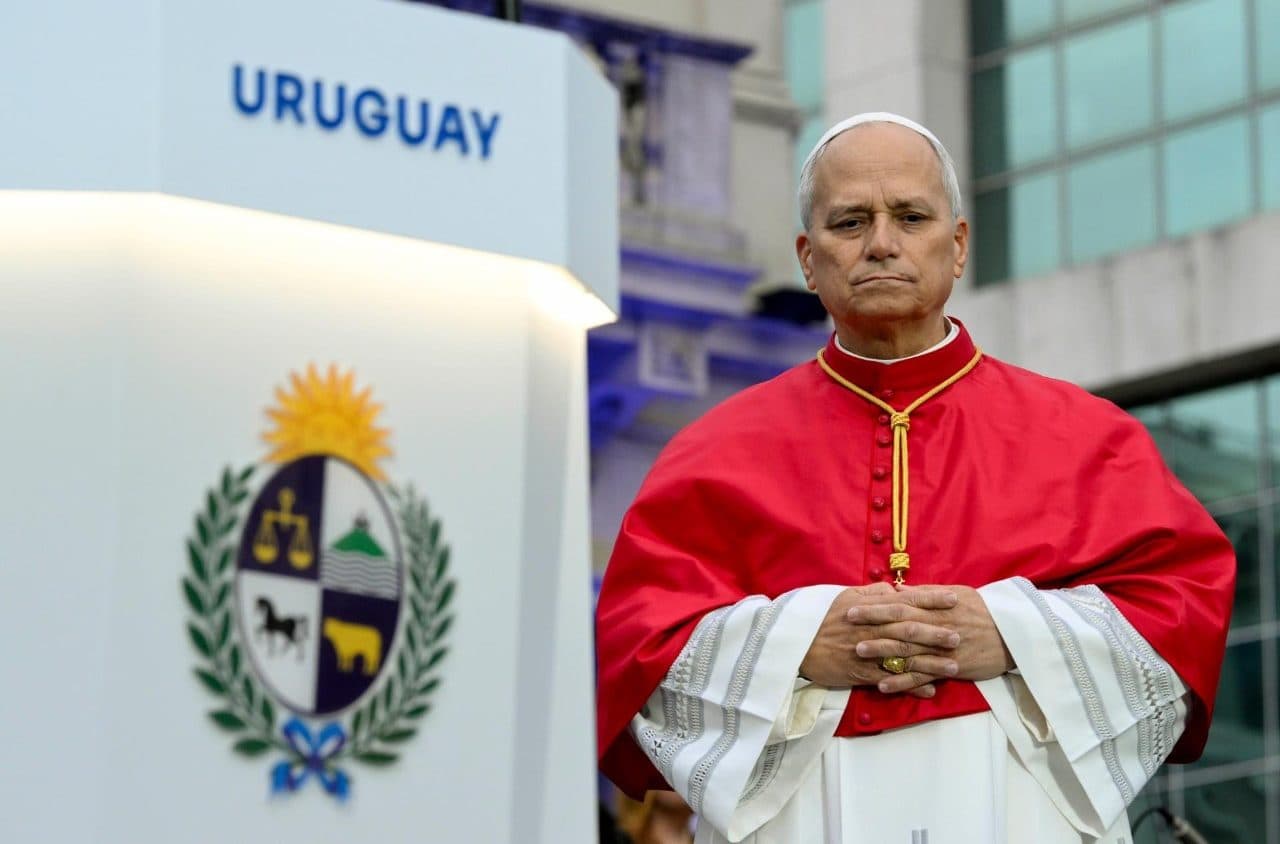
Leo XIV made his first address in Uruguay to the authorities, representatives of civil society, and the diplomatic corps. It followed remarks by Uruguayan President Yamandú Orsi, who has been in office since March 2025.
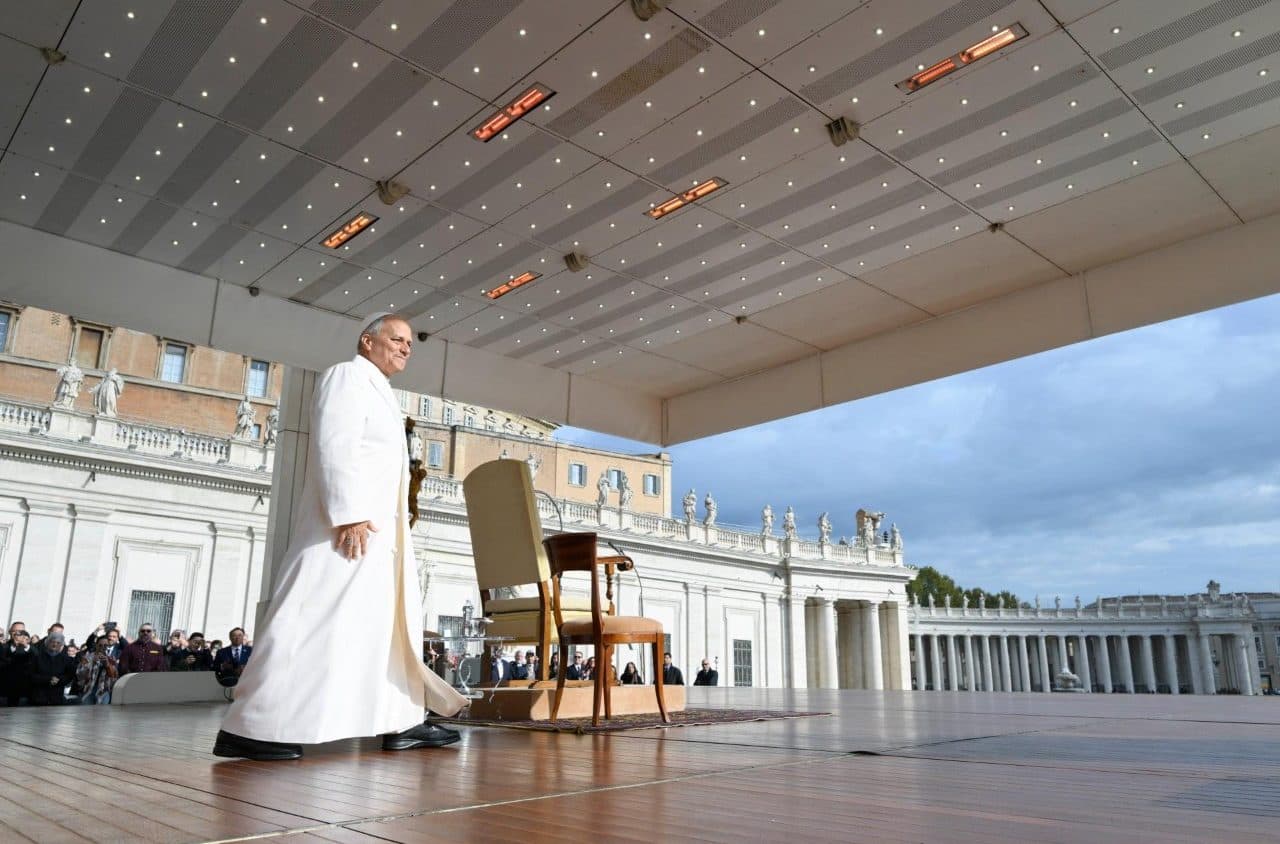
In Plaza Independencia, the pontiff walked alongside the president to the platform in front of the José Artigas Building, where he greeted the vice president, the president of the Supreme Court of Justice, and three former heads of state. Once on the stage, a youth choir sang the national anthems.
Welcomed by a crowd of more than 30,000 people, Leo XIV expressed his gratitude for the “kind invitation” and offered an initial greeting to “all Uruguayans, wherever they may be.”
Citing the Virgen de los Treinta y Tres, venerated in Florida, a destination on his itinerary tomorrow, he added: “I would like to place under her protection all those whom I will meet along the way. Her presence accompanied a decisive chapter in the history of the nation and continues to unite very different generations of Uruguayans.”
The pope also referred to the Exodus of the People of the East (Éxodo del Pueblo Oriental) in 1811, known as La Redota, foundational event for Uruguay, as a nation. The bronze frieze depicting this event serves as the central theme running through his address.
“Public authority finds its raison d’être in service to the common good and is called to exercise it within the framework of law, with respect for the freedom and responsibility of the citizenry.”
Leo stressed that caring for the common good includes “the duty to pass on to future generations the goods we ourselves have received.”
Presently, Uruguay generates almost all of its electricity from renewable sources, the pope noted. “Planning for the long term entails the ability to manage these resources without compromising future possibilities.”
“Welcoming a new life requires that fathers assume their responsibility alongside mothers, that the family offer its support, and that social conditions exist that allow both parents to raise and care for their children.”
Indeed, “The protection of the unborn and the support of those who welcome them are inseparable,” he said. “Caring for the youngest members of society necessarily includes ensuring they receive a suitable education.”
Work is ‘for man’ and not man ‘for work’
This background “must also provide concrete opportunities for entering the workforce,” since “Work is thus one of the structures that enables each person to develop his or her abilities and to contribute to the good of others.”
In this regard, Leo cited John Paul II, who said: “work is ‘for man’ and not man ‘for work’.” A principle that “remains as relevant as ever in the face of rapid changes in technology and artificial intelligence.”
The pope lamented that, “Loneliness, anxiety and the loss of hope can become so profound that a person no longer sees a reason to continue living.” No one “should ever feel like a stranger among their own or think that their absence matters less than their presence.”
The pontiff also mentioned that, “Other forms of suffering can be seen in illness or poor living conditions. Sickness, disability, physical pain, loss of autonomy, poverty, unemployment or social exclusion can make it especially necessary that others offer help.”
Healthcare within everyone's reach
Leo XIV talked about his own illness, and the “limitations” it imposed.
“That experience makes me think of the many men and women who lack the means to obtain a timely diagnosis or receive the treatments they need.”
“Ensuring that health care is accessible to everyone, regardless of their resources, is a duty that confronts every society. Those facing any of these situations do not cease to be full members of society”.
This is why, “it is everyone’s responsibility to ensure that each person can live with dignity, receive the care they need, and be accompanied until the natural end of his or her life.”
To this end, the Church works “with all those who work to alleviate suffering whenever possible, and to support the individual in cases when suffering cannot be eliminated. To this common effort, the Church contributes what is unique to her: a hope that does not fade when human resources reach their limits and which reminds those undergoing trials that their lives always retain meaning and value”.
Ensuring goods and opportunities reach everyone
Leo also said that those who belong to the same people “may come from very different backgrounds and have unequal resources.” In fact, “the way the economy is organized and directed has a direct impact on people’s living conditions and their ability to shape their future.”
The “benefits” as well as the “wealth, investment and economic initiative [. . .] must also translate into goods and opportunities that effectively reach everyone, for ‘it is individuals that matter, each and every person together with their families’,” said Leo citing the Encyclical Magnifica humanitas.
“To that Uruguay I have come as the Successor of Peter and as a shepherd, with the desire to meet the pilgrim Church in this land and to draw near, with affection, to all its people.”
“With her history of faith and service dating back centuries, the Church wishes to continue offering the Uruguayan people what she herself has received – Jesus Christ and the hope proclaimed by his Gospel – and to cooperate, through her own mission, with all those who work to promote the common good and the dignity of every person,” Leo said.
Promoting prayers for vocations worldwide
Yesterday afternoon, Leo XIV went to the Cathedral of the Immaculate Conception and Saints Philip and James in Montevideo, passing through the Citadel Gate and the Cabildo Historical Museum, to celebrate Vespers together with bishops, priests, deacons, men and women religious, and seminarians.
“Faithfulness to our vocation calls us to return again and again to Jesus Christ; to let him be our treasure, the one whom we wish to resemble,” the pope said, as he read his homily in Spanish.
“Dear brothers and sisters, one of the secrets of evangelization is to resemble the One whom we proclaim.”
“What a joy it is to know that generous responses to Christ’s love continue to come forth! I offer heartfelt thanks to those who have supported this initiative, and I encourage them to persevere,” he added.
“See in these fruits the proof that God hears the prayers of his people.”
In Montevideo Cathedral, Pope Leo XIV invited his “brother bishops throughout the world to promote days of prayer and fasting in their dioceses for an increase in vocations to the priesthood and to consecrated life.
“May parishes, families and religious communities unite in this prayer. May the example of this land inspire many others to pray with the same confidence.”
Finally, he urged seminarians, novices – both men and women – to look to those who, before them, have walked the “path of self-giving. See their worn hands, their persevering love and their way of relating to Jesus”.