Yerevan (AsiaNews) – A journey of just a few hours through Armenia is enough to discover traces of geological processes spanning millions of years: a lake formed in a volcanic crater, a gigantic stone ‘organ’ composed of basalt columns, a natural bridge, traces of an ancient sea and lava flows that now form part of mountains and gorges. What makes Armenia unique is that all these natural features are concentrated within a relatively small area.
The country’s landscape has been shaped by the combined influence of volcanic activity, tectonic movements, water, ice and erosion over millions of years. Consequently, Armenia can be thought of as an open-air geological museum, where the ‘exhibits’ are not displayed behind glass cases, but amongst mountains, cliffs, gorges and caves. To mark International Geodiversity Day, Novosti-Armenia has selected seven sites that particularly clearly demonstrate the country’s geological diversity.
1. ‘Symphony of Stones’: when lava turns into a stone ‘organ’
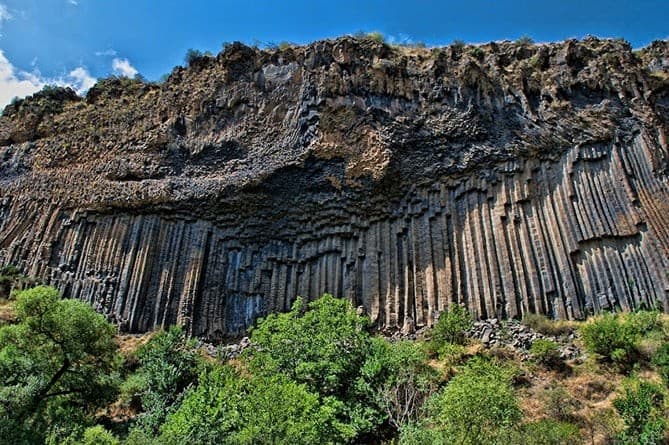
In the Garni Gorge, nature seems to have created a gigantic musical instrument out of stone. The basalt columns stretching along the Azat River gorge are almost perfectly pentagonal and hexagonal in shape, reminiscent of the pipes of an organ. These geological structures are formed by the cooling of volcanic lava: as the enormous mass of lava cools and contracts, cracks form within it which, under certain conditions, give rise to faceted columns.
2. Aragats: a giant volcano with four peaks
Armenia’s highest mountain is remarkable not only for its height: Aragats is an ancient volcanic massif, with a deep crater at its centre, surrounded by four main peaks. According to the Smithsonian Institution, numerous volcanic centres, craters and lava flows have played an important role in the geological history of Aragats and the surrounding areas. Subsequently, the mountain’s appearance was also shaped by glacial processes.
3. Aždakhak: a lake in a volcanic crater
At an altitude of 3,597 metres in the Geghama Mountains lies an unusual natural feature: a small lake formed within the crater of an extinct volcano. The shape of the crater has been preserved and water has accumulated at its base, creating a truly distinctive high-altitude mountain landscape. The volcanic history of the Geghama Mountains dates back to ancient times: volcanic activity in the region continued until relatively recent geological periods, and the last known eruption dates back to around 1900 BC.
4. The Devil’s Bridge: a bridge ‘built’ by water
In Syunik Province, on the River Vorotan, stands a bridge created not by man, but by nature. The Devil’s Bridge (Satani Kamurj) is a natural stone arch formed by the accumulation of travertine deposits carried by mineral waters.
Over time, natural processes have created a structure which, from a distance, truly resembles a man-made bridge. This site has another interesting feature: near the bridge, mineral springs feed into the Vorotan River. Consequently, the river downstream of the bridge appears fuller than upstream. Official descriptions attribute the name ‘Devil’s Bridge’ to this unusual phenomenon.
5. Areni-Gnišik Gorge: cliffs that preserve the memory of an ancient sea
The gorges of Vayots Dzor bear witness to Armenia’s distant geological past. Some of the rocks in this area were formed in the marine environment of the ancient Tethys Ocean. Subsequently, movements of the Earth’s crust altered the structure of the entire region: areas that were once seabeds have risen over time, becoming part of today’s mountainous landscape.
6. Šaki Waterfall: water cascading over volcanic rocks
The Šaki Waterfall, near Sisian, is another example of how various natural processes have combined to shape the Armenian landscape. The water plunges from a height of around 18–20 metres into a deep gorge surrounded by rocky walls and caves. The geological formation of this area consists mainly of relatively young basaltic, andesitic and dacitic lava flows.
7. Khrazdan Gorge: volcanic history in the heart of Yerevan
You don’t need to travel far from Yerevan to admire geological attractions: the Khrazdan Gorge, which runs through the capital, offers a glimpse into the region’s volcanic history. This area features columnar basalt formed as the lava cooled, and two distinct geological formations are included on Armenia’s list of national natural monuments.