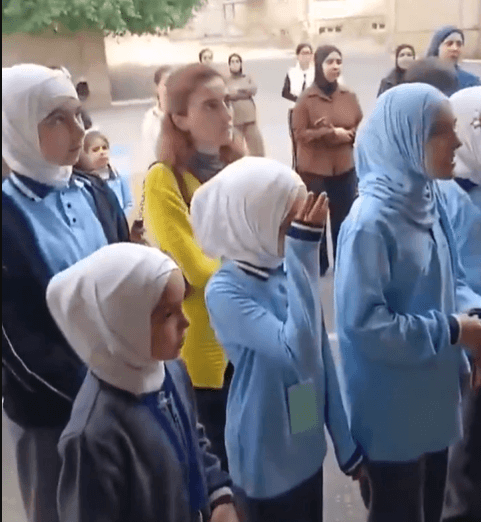
Baku (AsiaNews) – Protests are taking place in Baku and other cities across Azerbaijan against the new regulations on school uniforms, which ban the hijab, and the Azerbaijani Ministry of the Interior has reported the arrest of 37 people, according to Radio Svoboda’s Azerbaijani service. On 21 September, the Azerbaijani Council of Ministers officially amended the regulations governing school uniforms in state schools, banning “additional items of clothing that violate the requirements of the school uniform and contradict the principle of secular education”, without specifying to which items of clothing this applies.
In early October, residents of Baku and the surrounding regions began receiving complaints that some schools were refusing to admit female pupils and teachers wearing the hijab, the Islamic headscarf, into classrooms. Pupils and parents began protesting, with many boycotting lessons. Male students are expressing solidarity with their female classmates who wish to wear the hijab, and hundreds of people, including teachers, public figures and religious leaders, have taken part in the protests, arguing that barring female pupils wearing the hijab from attending lessons violates children’s right to education.
Protesters are smashing the windows of schools that ban religious clothing; according to the Telegram channel Minval Politika, protesters set fire to the car of a headteacher at a school in the Garadag district of Baku. In Yasamal province, protesters attempted to set fire to a school, but the flames were extinguished. Azerbaijani law enforcement agencies have opened criminal proceedings against those arrested for organised public disorder.
According to the constitution, Azerbaijan is a secular state, and Article 18 of the Constitution affirms the secular nature of public education. At the same time, according to the protesters, the ban on wearing the hijab at school also violates the constitutional right to religious freedom and the law on children’s rights. Azerbaijani schools have previously attempted to ban religious clothing and symbols, sparking protests; the most violent of these took place between 2010 and 2011, during which over 200 people were arrested in various cities, including religious figures from the opposition.
The September document provides for the possibility of “wearing traditional dress on occasions linked to the country’s history, culture and national and spiritual values”, subject to a decision by the teaching council. In July 2026, Azerbaijan’s law on general education was amended to enshrine the concepts of “nationality and secularism” as principles for the development of the school system, making it compulsory for pupils and teachers in state schools to wear school uniforms and placing the responsibility on parents to ensure their children wear them.
“When a general regulation concerns religious beliefs, it is important for government institutions to explain its meaning clearly enough,” says the journalist Agil Gakhramanov, so that parents, pupils and school heads do not have to interpret for themselves what is permitted and what is prohibited. The legal complexity lies in the fact that the Constitution of Azerbaijan enshrines several principles that cannot be considered in isolation: Article 18 establishes the separation of religion and state and the secular nature of the public education system; Article 42 guarantees every citizen the right to education and the right to free and compulsory general secondary education; whilst Article 48 enshrines freedom of conscience, including the right to profess any religion or none at all.
The secular nature of schools is a fundamental principle of the state structure, but the central issue is not only whether the state has the right to lay down rules on school uniforms, but also how clearly such rules are defined, what their legitimate aims are, and whether the consequences of breaching them are proportionate. These are a series of issues that have been causing considerable tension in Azerbaijan for years, against a backdrop of ambiguity regarding secularism and freedom of religious practice throughout Central Asia.