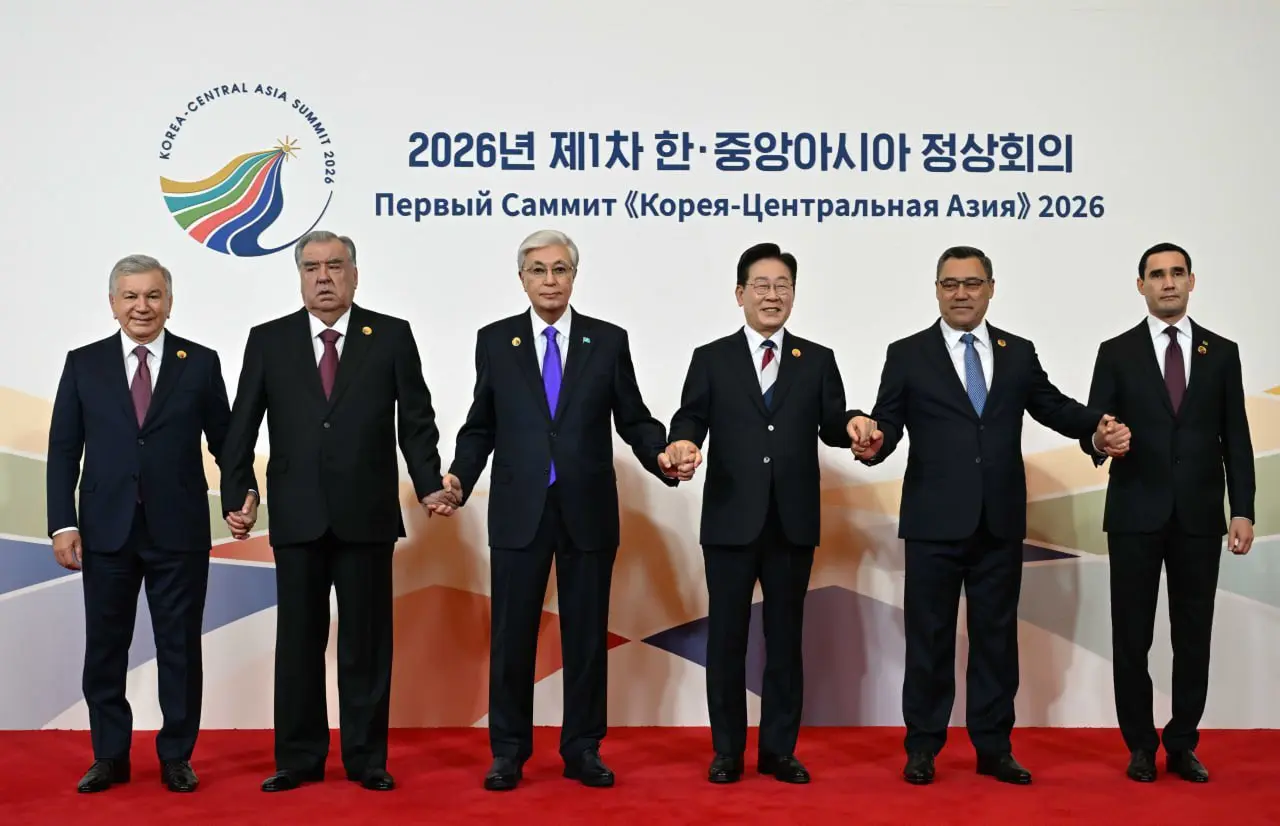
Astana (AsiaNews) – In Seoul over the past few days, leaders from the Central Asian states and South Korea discussed the nature of relations between the six countries and their vision for the future. Key topics included critical minerals (particularly rare earths) and their supply chains, the joint development of transport corridors, human capital and industrial cooperation.
The “5+1” dialogue format dates back to 2007, the year in which the Cooperation Forum was launched on the initiative of South Korea. In 2017, a permanent secretariat was established, and at the same time the status of the participants changed: until 2019, discussions took place at the level of deputy foreign ministers from the six countries. The September forum brought together, for the first time, the presidents of all six states: Kazakhstan, Kyrgyzstan, Tajikistan, Turkmenistan, Uzbekistan and South Korea. Presidential dialogue is also important because the influence of the head of state in Central Asian countries is traditionally high; they act not only as spokespeople for their countries’ interests on the international stage, but also as arbiters of domestic political issues, the nuances of which must be taken into account when implementing foreign policy initiatives.
For example, the President of the Republic of Kazakhstan, Kassym-Jomart Tokayev, embodies the multifaceted approach to foreign policy typical of Central Asian states, demonstrating his ability to build consensus. Specifically, during his visit to Seoul, Tokaev instructed Kazakhstan’s Minister of Culture and Information, Arman Kyrykbaev, to visit the Daejeon memorial complex in South Korea to honour the memory of General Hong Beom-do, a general revered in Korea and a symbol of the anti-Japanese resistance in the early 20th century.
At first glance, the recent summit might appear to be just another discussion forum, concluding with a token declaration – in this case, the Seoul Declaration – with few practical results. However, the ‘Central Asia–Republic of Korea’ format offers concrete prospects, and the interest between the countries is mutual. The Central Asian republics are interested not only in access to high-tech products, but also in the transfer of expertise in mechanical engineering and microelectronics, as well as in further localising production within their own territories. The authorities see this as a way to overcome the structural shortcomings of their economies and develop human capital. Furthermore, South Korea possesses efficient technologies for utilising limited water resources, which is extremely attractive to the Central Asian countries, where around 50 per cent of the water drawn for irrigation is lost due to inefficient use and deteriorating infrastructure.
South Korea’s interest, in turn, is driven by the search for additional reserves of critical minerals (lithium, uranium and rare-earth metals) and by the aim of integrating into the international Trans-Caspian transport route, to ensure reliable overland transit between Asia and Europe. And, of course, it is worth highlighting the desire to reduce China’s influence, as by 2026 China is set to become the main trading partner for each of the Central Asian countries.
The total volume of direct investment accumulated by South Korea in the Central Asian countries, according to some estimates, already amounts to around 20 billion dollars, of which over 95 per cent is accounted for by Kazakhstan and Uzbekistan. Kazakhstan accounts for around half of the total trade volume, with over 10 billion dollars. Against this backdrop, the trade agreements signed between Astana and Seoul, worth $19 billion, aim to provide fresh impetus for further deepening cooperation between the two countries. To this end, a ‘Comprehensive Programme for Trade, Economic and Investment Cooperation for the period 2027–2030’ will be drawn up.
The recent summit should therefore be seen as an opportunity for all Central Asian countries. Kyrgyzstan and Tajikistan must implement comprehensive reforms, reducing their economies’ dependence on remittances and agriculture and encouraging the development of a fully-fledged industrial sector. The countries of Central Asia are well placed to capitalise on their geographical position by pursuing a multifaceted approach to foreign policy; it is no coincidence that they are striving to attract foreign investment, without which it would be extremely difficult for them to modernise their economies. This is also because interest in the region could begin to wane should global conflicts de-escalate, particularly if many provisions were to remain in force only on paper.