Milan (AsiaNews) – A museum dedicated to the first patriotic bishop ordained autonomously by Beijing in 1953 has opened in Wuhan and been presented as one of the key venues today for showcasing that “Sinicisation of Catholicism” so dear to President Xi Jinping.
The Patriotic Association website, chinacatholic.cn, reports on the inauguration of the new “Exhibition Hall of Dong Guangqing’s Patriotic and Catholic Works”, which opened its doors on 18 August in the Hubei city made famous worldwide by the pandemic but which also has an important history for Chinese Catholicism.
In the nineteenth century, owing to its location on the banks of the Yangtze, the city of Hankou – the historic part of present-day Wuhan – was in fact the crossroads of evangelisation in inland China.
The very hospital that became famous during the Covid-19 pandemic had in fact been founded by the Franciscans. As is well known, however, with the victory of Mao’s Communists, all foreign missionaries were expelled.
In fact it was in Wuhan that, on 13 April 1958, the first ordination of two bishops took place without the approval of the Holy See: these were, in fact, Bishop Bernardino Dong Guangqing, himself a Franciscan and Bishop of Hankou, and Bishop Marco Yuan Wenhua, Bishop of Wuchang (another area in this part of Hubei now included within the metropolis).
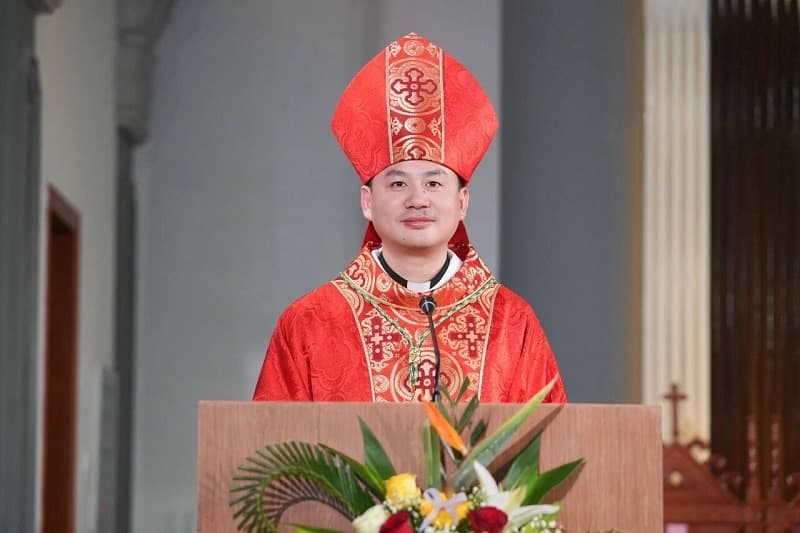
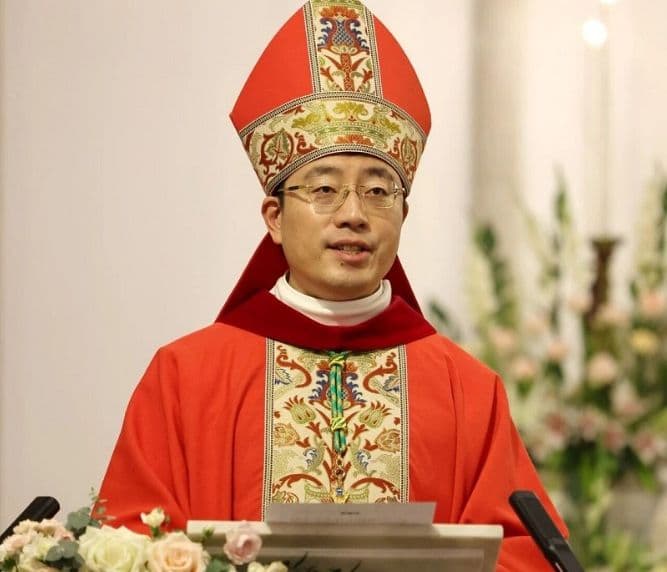
With the initial opening-up of the 1980s, Bishop Dong Guangqing had subsequently managed to re-establish contact with the Holy See, returning to communion with the Pope. Following his death in 2007 at the age of ninety, the diocese remained vacant until 8 September 2021, when – this time in accordance with the agreement between the Holy See and the People’s Republic of China – the current bishop, Bishop Giuseppe Cui Qingqi, was ordained.
It is hardly surprising that the Catholic community in Wuhan wishes to commemorate a figure as significant to its history as Bishop Dong Guangqing; yet one cannot fail to highlight the interpretation that the official bodies of the Church in China now seek to impose on the memory of this troubled history.
This absolute notion of continuity is conveyed between the dramatic rupture of 1953 (experienced with great pain by the protagonists themselves, as is now widely known) and the current propaganda on ‘Sinicisation’.
According to reports from chinacatholic.
cn, the opening ceremony with the local bishop, Monsignor Giuseppe Cui Qungqi, was attended by the leaders of the Patriotic Association and the Chinese Bishops’ Council (the collegial body not officially recognised by the Holy See – ed.), led respectively by the Bishop of Beijing, Monsignor Giuseppe Li Shan, and the Bishop of Shanghai, Monsignor Giuseppe Shen Bin – the two most prominent figures in the Church in China today.
During the ceremony, Bishop Dong Guanqing was praised as a “pioneer of the path of independence, autonomy and self-governance for the Church in China” and held up as a model for “telling the stories of love for the motherland and for the Church well”.
It should also be noted that the hall dedicated to the memory of Bishop Dong Guangqing is not an isolated initiative: museums on ‘Sinicisation’ are part of a specific ideological strategy by the Party to promote a reinterpretation of the history of the Catholic presence in China.
As we reported at the time on AsiaNews, a facility of this kind was opened in 2023 in Beijing, to coincide with the 15th anniversary of Bishop Li Shan’s episcopate. The Diocese of Shanghai, too, has for some time carried an invitation on its website’s homepage to contribute materials towards a project of this nature.
Meanwhile, however, rumours are circulating amongst Chinese Catholics of restrictions on pilgrimages to historic churches that have kept the faith alive in China even during the most difficult years.
In June this year, in particular, during a Mass at a Catholic church in Beijing, a priest reportedly informed the faithful that a pilgrimage to another city, scheduled for July, had been cancelled due to new regulations. Group trips to other cities organised by parishes now apparently require special authorisation; without this, they could be reported to the authorities. Consequently, parishioners are now reportedly organising visits only in small groups.