Beijing (AsiaNews) – Why are the Chinese authorities so determined today to prevent children from attending church and taking part in its activities? An AsiaNews source living in China answers this question through this account, which begins with an observation of everyday teaching practices in Chinese schools. These schools – alongside academic knowledge – impart a specific model of society.
The Chinese education system, in my view, is one of those key issues that can shed light on the mindset of society and, in particular, on the way in which the Party manages to be pervasive by creating ‘the masses’.
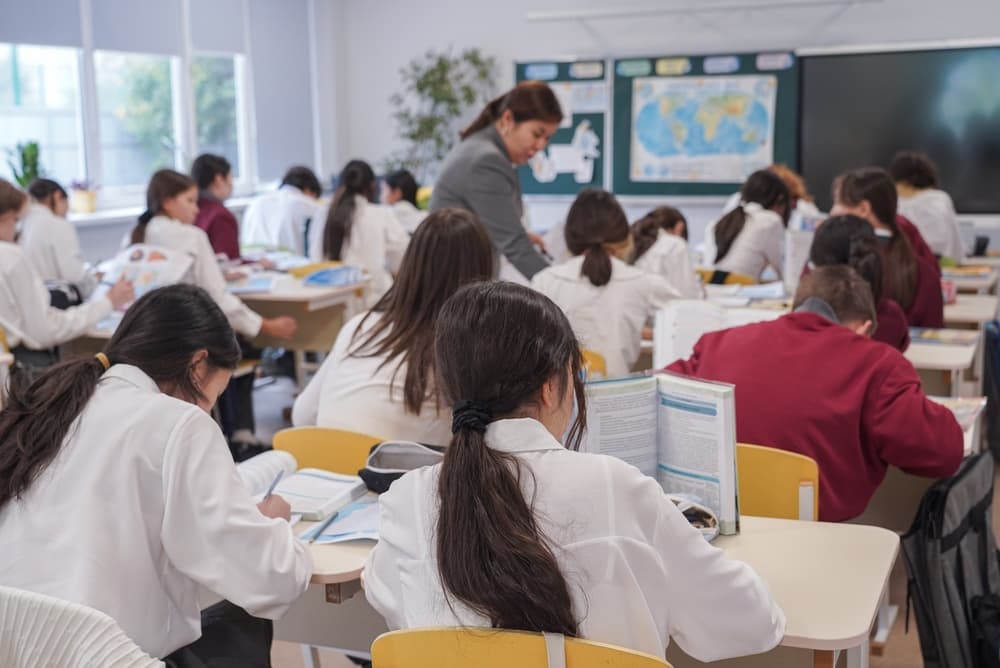
In China, school runs from eight in the morning until six in the evening (with slight variations from place to place and from school to school); after that, pupils do not go home but remain in the classroom to study.
On returning home, after dinner, pupils do their homework for about two hours. Sometimes they arrive at school even earlier, around seven, for a few extra hours of reading.
Similarly, in the evening, they may stay in class until nine or ten for extra exercises or tests. This is the routine from Monday to Friday; on Saturdays and Sundays, however, pupils attend ‘weekend schools’ where they practise English, music, IT, calligraphy…
The timetables alone would be enough to indicate the pressure pupils are under, but even more pressing and significant are the teaching methods and the classroom atmosphere.
Everything revolves around rote learning; every subject is learnt by heart and broken down into a series of exercises, which must also be learnt by heart. There are no oral assessments, no re-working of the material – in fact, re-working is considered wrong: a good student is one who memorises and passively knows the correct answers to the exercises, and is therefore able to recall them during a test.
Tests are, in fact, almost always exercises that have already been completed, and students must recall the answers; therefore, the more you repeat the same exercises, the better you are able to remember them – which is why there are so many hours of homework. Thus, every student is assessed on the basis of an objective score derived from their mnemonic ability.
“There is only one way to do things”
“In China, we don’t value diversity,” a Chinese friend told me, “there’s only one way to do things and that’s the one you must use; there’s no room for creativity. The Chinese are concerned with the result, not the process. This is what they teach us at school: there’s only one right answer and, above all, you mustn’t ask why.”
This is precisely the key factor driving standardisation: there is no ‘why’. Pupils hear this repeated to them from childhood, and it is the refrain of many conversations about the education system: ‘We were taught that there is no “why”.’ This assumption then comes to shape every aspect of life, every existential, cultural and political question: ‘There is no “why”; we are Chinese; this is how things are done in China.’
A woman who recently converted to Christianity told me that as a child she suffered greatly because “I had so many questions inside me and I asked my teachers and parents so many things, but the only answer I ever got was: there’s no reason.
It was only when I discovered the Gospel that I finally realised there actually was a reason’. Or again, ‘What matters to the government is that we don’t think; they want our children to be machines that do their homework and scroll through videos’. Or ‘Only results and outward appearances matter; you mustn’t think, you mustn’t understand the process – in fact, there is no reason’.
Having an opinion, being in some way different, or at any rate not conforming to the single model of a student, disqualifies you from the outset and makes you the target of criticism from teachers and parents.
Consequently, there is no room for the idea of ‘being more suited’ to one subject than another, or for individual inclinations, since there is only one correct way to be a good pupil and achieve results that will enable you, in the future, to gain entry to the best universities and thus hope for a good job. It is clear that in a system of this kind, disability or any other form of cognitive diversity is not taken into account.
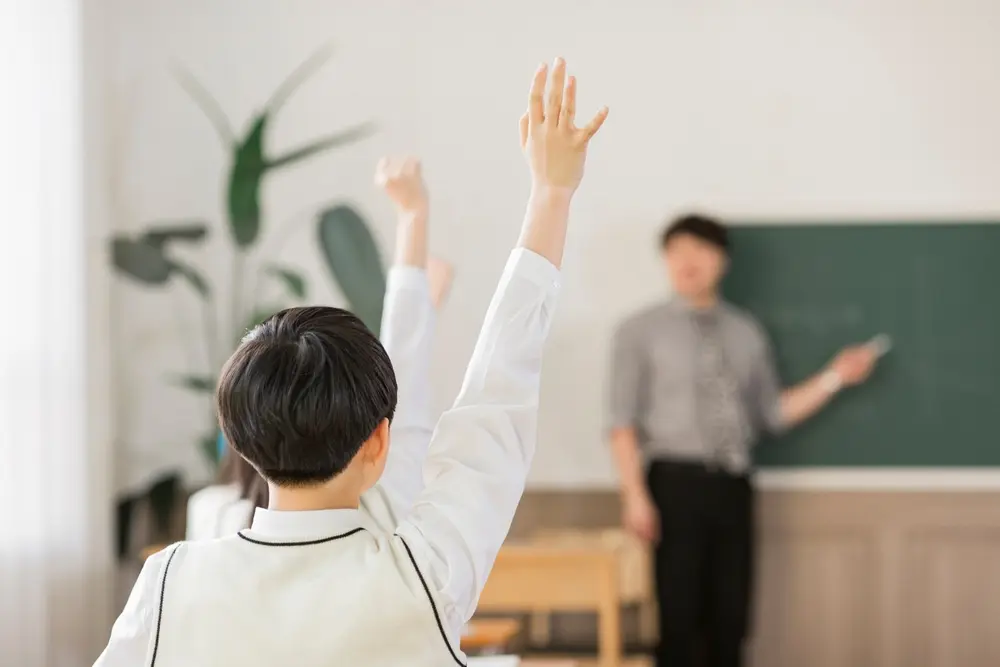
Furthermore, classes consist of around forty or fifty pupils each, and classmates are not regarded as ‘friends’ but as rivals to be beaten. The teacher, therefore, is not someone who builds a relationship with and gets to know their pupils, but a sort of uncritical assessor, who is themselves under pressure to deliver results.
The dilemma facing Christian parents
All this is largely accepted passively (partly because people are unaware of alternative systems), except by Christians, who often perceive the dangers and distortions of such a model.
Many parents have confided in me just how hard it is for them: they find themselves trapped in a straitjacket, caught between Scylla and Charybdis, aware of the system’s harmful nature yet unable to oppose it. And there is their ‘duty as parents’, which in Chinese society means putting pressure on their children to achieve results that meet society’s expectations.
It is truly a heart-wrenching dilemma: the harm they are inflicting on their children through an alienating system is right before their eyes, whilst at the same time they experience the pressure typical of parents who want the best for their children – a ‘best’ which, in Chinese society, translates into a life of homework, rote learning and tests ‘for no apparent reason’.
I believe that the recent regulations preventing minors from entering churches, or from receiving an education other than that imposed by the Party, must also be understood within this educational context. Educating in the faith opens the mind, liberates, fosters critical thinking, and transforms the masses into a people – in other words, it strikes at the very heart of what every oppressive system fears.
It is no coincidence that there is a sort of Chinese Catholic ‘public opinion’ which, behind closed doors, constantly repeats that ‘education is China’s real problem’.
What is being called into question is not so much the pressure, or the system of timetables and the sheer volume of tests – Christians are, after all, Chinese and, as such, almost never regard the heavy workload they are subjected to as a real problem – but rather the uncritical rote learning and, consequently, the failure to foster critical thinking.
Paradoxically, it is precisely the crackdown on children’s education that is helping to highlight with even greater clarity what the real problem is: the lack of freedom.
Having deprived families of the opportunity to educate their children in the faith – that is, having taken away that way out between the awareness of the system’s harmfulness and the social duty of a good parent – has brought out even more clearly that freedom is the crux of the matter.
And how freedom begins with being free to think.