Milan (AsiaNews) – For months, Russia has been intensifying its hostile actions towards Japan; in recent days, this pressure has escalated, to include Japan’s airspace.
On Tuesday, two Russian military aircraft spent several minutes flying over Japanese territorial waters off the coast of Fukuoka, near the island of Okinoshima.
Japan’s Air Self-Defence Force scrambled fighter jets, which shadowed the two aircraft through the Tsushima Strait and the island of Yonaguni and Taiwan, until they departed towards the Pacific.
A government spokesperson described the airspace violation as a serious threat to the nation’s security. The last such incursion occurred in September 2024.
That same morning, Russian military aircraft also approached South Korea and Taiwan.
Seoul scrambled its own fighter jets after several aircraft entered its Air Defence Identification Zone, an area where foreign military aircraft are expected to identify themselves.
Moscow does not recognise this zone, which has already been breached by about a dozen Chinese and Russian aircraft during a joint exercise in June.
A few hours later, Taiwan reported the presence of two Russian aircraft off its eastern coast, in all likelihood, the same ones intercepted by the Japanese. The incidents took place on the eve of Vladimir Putin’s arrival in Shenzhen for the APEC summit.
Putin started this period of tensions in August, becoming the first Russian president to visit Etorofu, the largest of the four islands northeast of Hokkaido occupied by the Soviet Union in the final days of the Second World War.
Moscow calls them the Southern Kurils, while Tokyo refers to them as the Northern Territories; the dispute over this archipelago has, to this day, prevented the two countries from signing a peace treaty.
In the weeks that followed, the Russian military conducted further military exercises involving missile launches in the waters surrounding the islands.
Administratively, the disputed islands are part of the Russian region of Sakhalin.
In October, security services arrested a correspondent for the Hokkaido Shimbun in its capital, Yuzhno-Sakhalinsk; the newspaper is based in the Japanese island of Hokkaido, which faces the Kurils.
The journalist, who was taken to a prison in Moscow, could get up to 20 years for espionage. According to Russian investigators, he was gathering information on the number of residents from the Kuril Islands involved in the fighting in Ukraine.
His arrest is part of a practice, frequently employed by Moscow, as well as Beijing and Pyongyang, of taking foreign nationals hostage to exert political pressure.
Last year, a Moscow court convicted in absentia Tomoko Akane, a Japanese national and president of the International Criminal Court in The Hague.
In 2023, the Court had issued an arrest warrant for Putin, holding him responsible for the deportation of Ukrainian children; last month, the Russian Prosecutor General’s Office requested that the Netherlands and other nations extradite Akane along with eight other officials.
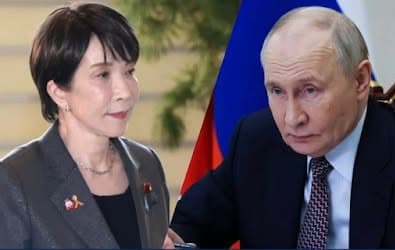
On this matter, Prime Minister Sanae Takaichi has effectively refrained from taking a firm stance, evidently hoping for a softening in Moscow’s position.
Moscow strikes at Japanese interests
At the end of October, while the prime minister avoided speaking out, her foreign minister, Toshimitsu Motegi, met with his Russian counterpart, Sergey Lavrov, marking the first such high-level diplomatic exchange between the two countries in five years.
Motegi requested the release of the journalist, and both governments agreed to keep channels of communication open, despite the strains in their bilateral relationship.
However, a further blow followed just days later when Vladimir Putin signed a decree placing four Japan Tobacco facilities in Russia under state-appointed management.
This is no minor development, given that Japan Tobacco holds approximately 37 per cent of the Russian cigarette market, a segment that generates a quarter of its operating profit, and possesses assets in the country valued at US$ 9.4 billion.
This move also carries implications for the Japanese state, as the Ministry of Finance is the group’s primary shareholder.
Dmitry Medvedev, Deputy Chairman of the Russian Security Council, sarcastically remarked that "smoking can kill”.
The Japanese government is now paying the price for its decision not to encourage Japanese companies to withdraw from Russia following the invasion of Ukraine, in stark contrast of the approach taken by European governments.
According to a survey, as of late 2025, three out of every four Japanese firms still operating in Russia had no intention of scaling back their activities; meanwhile, Japan has continued to import gas from Russia at pre-war volumes.
Moscow remains Japan’s third-largest supplier of liquefied natural gas (LNG), a resource that has grown even more critical following the closure of the Strait of Hormuz.
Back in 2022, three years before she became prime minister, Sanae Takaichi had addressed Japanese business leaders directly, labelling Moscow an "unreliable partner" and urging them to make difficult decisions.
Russia subsequently placed her on its sanctions list, but once in office, she adopted the cautious approach of her predecessors; following the journalist’s arrest, she merely offered assurances that the government would do “whatever is necessary” to see him free.
Even a half-hour conversation with Putin on the sidelines of the Shenzhen summit yielded no visible results, and Moscow did not even acknowledge that it had taken place.
Japan between Russia and China
Regarding China, Takaichi has taken a hardline stance from the outset. A year ago, she stated in parliament that a Chinese attack on Taiwan could pose a threat to Japan’s security, implying that Japan might intervene militarily.
Since then, Beijing has waged an intense campaign against her, involving both propaganda and diplomatic pressure.
According to US officials cited by The New York Times, Xi Jinping warned Donald Trump about Takaichi this autumn, labelling her a "militarist”.
At the APEC summit, Xi gave her an icy reception, offering nothing more than a handshake.
Takaichi has not retracted her statements on Taiwan, and media controlled by the Communist Party of China continue to slam Japan’s “remilitarisation”, citing the role of aggressor the country played over 80 years ago.
Japanese militarism has long been a recurring theme in North Korean propaganda as well, rhetoric often accompanied by missile launches into the Sea of Japan.
In such a climate, even seemingly minor events take on added significance, for instance, a visit by officials and business leaders from China’s Heilongjiang province to the island of Etorofu, the very same island visited by Putin in August.
Even more telling is the fact that this visit was only made public later, coinciding precisely with the day the Japanese journalist was arrested.
Beijing’s stance on the dispute between Tokyo and Moscow has not always been what it is today. In the 1960s, Mao Zedong supported Japan’s claims to the islands; and, to this day, maps published in China still designate them as Japanese territory currently occupied by Russia.
Yet today, Beijing obsessively slams the “Japanese threat”.
For its part, Moscow, aware that Tokyo has no intention of giving up either Russian gas or the investments its companies have made in Russia, is responding to Japanese overtures with new hostile actions, banking on the fact that the reaction will be limited to diplomatic protests.
However, this Russian pressure is helping to accelerate Japan’s rearmament, thereby providing Beijing and Pyongyang with further ammunition for their charges of militarism.
By the end of the year, the Japanese government will review its national security policies; the proposed changes include an exception to the “three non-nuclear principles”, under which Japan has pledged not to possess, produce, or introduce nuclear weapons onto its territory.
This amendment would allow US vessels carrying nuclear weapons to call at Japanese ports in the event of an emergency. Some argue that this represents first policy shift that could, over time, lead to the creation of a Japanese nuclear arsenal.