

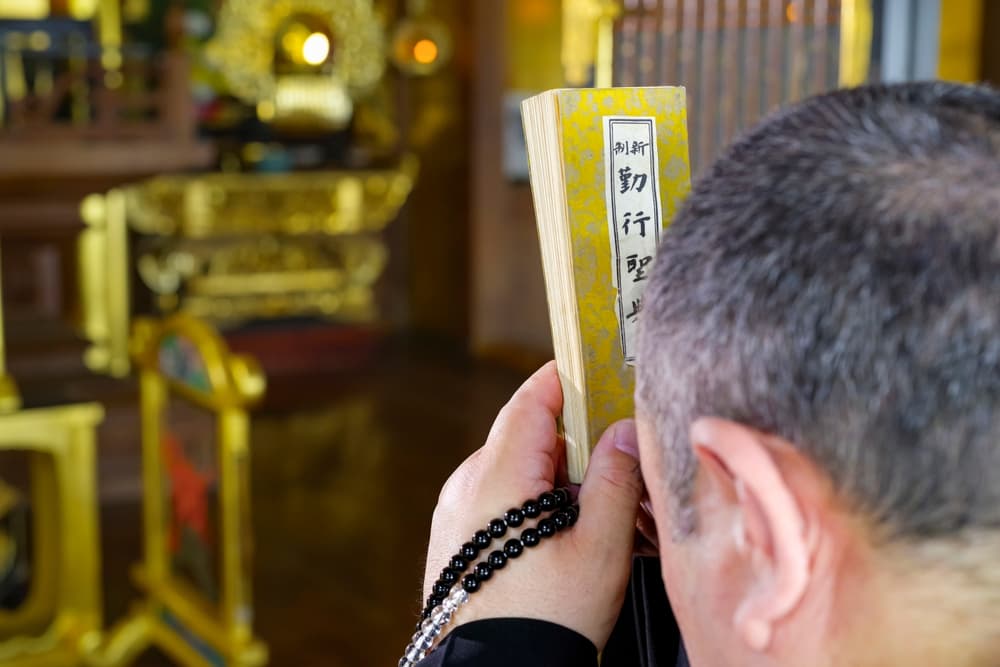
Nagoya (AsiaNews/Agencies) – At 87, Miruo Nakano, a Buddhist priest, has spent more than 25 years singing chansons, French songs, with Buddhist sutras to speak about peace and the value of life.
From Ichinomiya in Aichi Prefecture, the clergyman is known in Japan as the “chanson monk”. For years, his performances have conveyed a message shaped by his wartime memories and the pain of losing his son.
Now, as “a new pre-war era is approaching," Nakano frequently urges the younger generation not to take peace for granted, as something secured once and for all.
On 7 August, during an event in Yatomi (also in Aichi Prefecture) dedicated to preserving the memory of the war, he sang a song about peace before an audience of over 50 people, including children and adults.
"I know of children who have been robbed of even the hope of living by endless war,” he sang a cappella.
Nakano began singing French chansons as a hobby around the age of 60. Over time, he developed a unique style that pairs such songs with Buddhist sutras.
He has also taken his message to Paris.
At the conclusion of his performances, he typically recites sacred texts.
Wartime memories
Nakano was born in the Atsuta, a district of Nagoya, a city struck by 63 Allied air raids during World War II, attacks estimated to have claimed the lives of more than 7,000 people.
Due to asthma, he spent much of the war indoors. His family’s temple served as a makeshift morgue; following the bombings, coffins containing victims' bodies were brought there.
When coffins ran short, the dead were laid in wooden crates sourced from factories.
Thus, while still a child, Nakano grew accustomed to living surrounded by the dead.
Among the memories most deeply etched in his mind is that of a mother and her child: the infant had been brought to the temple missing their head and torso.
Nakano imagined that the pair had been caught in a bombing raid while the mother was fleeing with her child strapped to her back. It is an image that, more than 80 years later, continues to epitomise the brutality of war for him.
After the war, Nakano worked as a teacher and a Buddhist priest, consistently emphasising the importance of peace. For him, sharing his experiences became a “duty”.
Grief for his son
His commitment to the value of life was further strengthened by another tragedy, a personal one this time. In 1970, Nakano’s eldest son, then just three years old, drowned in a river.
Seeking to spare other families from the same grief, the priest appealed to the Ichinomiya city administration to install safety fences along the riverbanks.
War does not belong to the past
Eighty-one years after the end of World War II, Nakano views the unstable international situation with concern, fearful that the memory of that conflict is fading just as peace is once again being put to the test.
“We don't know when peace might come under threat,” he said. “Don't think of war as something that belongs to the past.”
His message, however, goes beyond mere warning. Nakano continues to believe that the actions of individuals can help change society.
For the “chanson monk”, “Even sighs, when brought together, can become a small voice, and small voices brought together can become a powerful one”.







.webp&w=3840&q=75)







