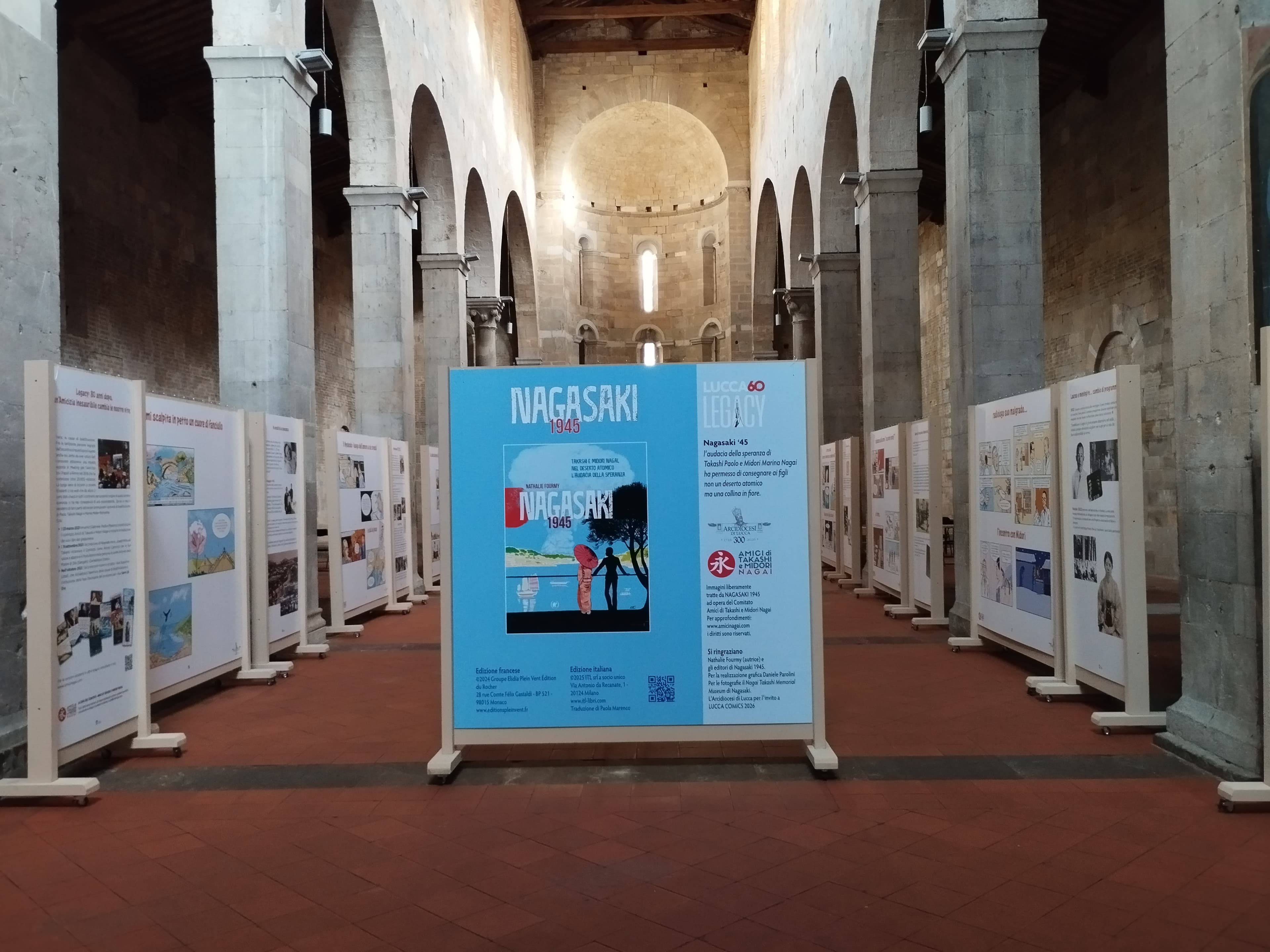
Lucca (AsiaNews) – ‘The Legacy of Takashi and Midori Nagai’ is a testimony to Christian faith in a world marked by the nuclear holocaust, a tragedy which, more than 80 years on, remains relevant given the many wars raging across the globe (from the Russia-Ukraine conflict to the situation in Iran) and the risk of nuclear escalation.
To mark the 60th anniversary of Lucca Comics&Games – whose 2026 edition, running from 28 October to 1 November, is dedicated to the theme of ‘Legacy’ – the ‘Nagasaki ’45’ pavilion will offer visitors the chance to retrace the story of Takashi Paolo Nagai, a radiologist who survived the bomb that killed his wife Midori, a descendant of the Hidden Christians.
In the aftermath of the nuclear explosion, he withdrew to live in a four-square-metre hut, the Nyokodo, and through his writings – which became bestsellers in Japan – he symbolically rebuilt the city and revitalised the nation. This work earned him the coveted title of ‘national hero’ from Emperor Hirohito, and led him to meet, over the years, ‘a flood of people’ to whom he never ceased to communicate and spread the values of peace and forgiveness until his death in 1951.
A bond that shaped their lives
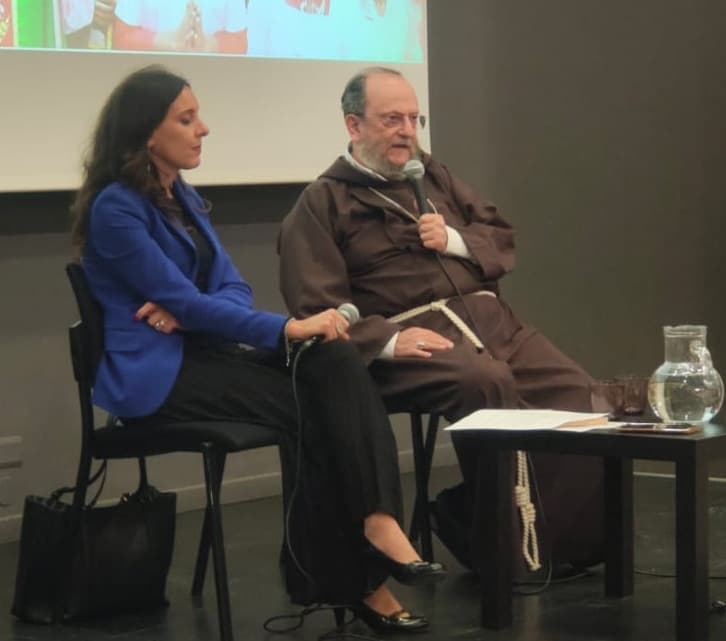
Speaking to AsiaNews, Paola Marenco, vice-president of the “Friends of Takashi and Midori Nagai” committee, describes the bond between the couple, which shaped their lives even after Midori’s death from leukaemia: “Without Midori, there would be no Takashi… We would not have had the Takashi we knew, neither as a doctor, nor as a man, nor as a saint,” emphasises the haematologist, a supporter of the cause for the beatification and canonisation of her Japanese colleague.
“Midori is a very interesting figure,” she continues, “despite being a quiet person. She is the daughter of a tradition of hidden Christians and is a woman of incredible faith. After more than two centuries without a priest, she kept alive an incredible faith, hope and charity. But above all, she is a woman who lives in the presence of God, always, in every decision she makes in her life, which are taken before the crucifix of the martyrs. Even when her husband told her he had leukaemia, she paused before this crucifix, then, smiling, turned and said: ‘Whether we live or die, it is for the glory of God’.”
Speaking of Takashi Paolo, she describes him as “an extraordinary man: he is a scientist, a pioneer of radiology, alongside Madame [Marie] Curie and the others. But he is also a person of open-minded reason – Paola Marenco emphasises – who allows life to pose questions to him.”
“He witnessed wars and diseases first-hand,” she continues, “he asked himself questions, but he also knew how to accept answers wherever they came from, even from those he did not, on the face of it, hold in high regard” – such as Christians, at first. “When he heard the bells ringing (from Christian churches), he would get irritated,” she explains, yet “he went to live alongside them to see how they lived, and allowed himself to be surprised”. His, she emphasises, was “a long journey, a journey of self-transformation”.
Today, the first day of Lucca Comics, the Church of San Cristoforo is hosting the opening of the ‘Nagasaki ’45’ pavilion, which begins with an interfaith prayer for peace in the presence of Archbishop Paolo Giulietti. The exhibition, open until 1 November to coincide with the international fair, centres on Nathalie Fourmy’s graphic novel, which tells the story of the Nagai couple, both before and after the atomic bomb. At the same time, the church of San Salvatore is hosting the ‘Faith and Comics’ initiative, featuring works by young participants in the competition, and the exhibition ‘Francigena. One Road, a Thousand Stories’ by Maria Pacini Fazzi Editore.
Nuclear Holocaust
On 6 and 9 August 1945, two of the most terrible events in human history took place, when the US Air Force dropped two atomic bombs: one on Hiroshima and one on Nagasaki, on the southern island of Kyushu, where at 11.02 the plutonium bomb known as ‘Fat Man’ exploded, three days after ‘Little Boy’ had destroyed Hiroshima.
Against this harrowing backdrop, in which ‘small but powerful lights’ shine, Nathalie Quinterie Fourmy – a French painter and illustrator with a passion for the Far East – embarks for the first time on the adventure of creating a comic to bring the life of Takashi Nagai to light. She recounts his conversion to Christianity and his story as a survivor of the atomic bombing. From a brilliant and ambitious medical student – a materialist and atheist – to a pioneer in radiology and atomic research, and the discoverer of the story of the people of Urakami (a tale of faith and martyrdom), he then met Midori, who would become his wife and accompany him on his journey to Christianity.
After the bomb exploded, Nagasaki was razed to the ground and Midori died, leaving him alone with their two young children. He would make his extraordinary resilience in the face of the atomic holocaust known to the world in 1949 with the book The Bell of Nagasaki, which enjoyed worldwide success. He died on 1 May 1951 and at his funeral, amidst the ruins of Nagasaki Cathedral, over 20,000 people attended; the city came to a standstill and Buddhist gongs, Christian bells and factory sirens all sounded.
The French artist’s work, which traces her journey through life and faith, earned her the ‘Christian comic’ award at the prestigious Festival International de la Bande Dessinée, and was subsequently translated into Italian in 2025 for ITL by Paola Marenco.
The ‘treasure’ of faith
The ‘Nagasaki ’45’ exhibition forms part of a wider international project entitled ‘Thesaurum Fidei’, centred on cultural and scientific research, launched in 2022 by the Church of Lucca. It was conceived and curated by Archbishop Giulietti himself, together with Professor Olimpia Niglio, a lecturer at the University of Pavia and chair of the ICOMOS Plesis of Religion and Rituals Commission.
One of the initiative’s objectives is the rediscovery and promotion of the history of Catholic missions in Japan from the mid-16th century onwards, exploring the link between the Tuscan city and the Land of the Rising Sun. This history begins with the work of the missionary and Blessed Angelo Orsucci, born in Lucca in 1573 and martyred in Nagasaki in 1622, who personally lived through what is known as the ‘Christian century’ from 1549 to 1638.
This work reconstructs the stories of the missionaries killed for their faith and of the Kakure Kirishitan (the hidden Christians), who for three centuries kept their faith in Christ secret whilst facing persecution by the shogunate.
Over time, this project has grown in significance and has established high-profile partnerships and patronage, such as that of the Vatican’s Dicastery for Evangelisation and the Archdiocese of Nagasaki.
It is precisely as part of the initiatives linked to “Thesaurum Fidei” that the Archdiocese of Lucca, together with the Friends of Takashi and Midori Nagai Committee, has sought to promote the “Nagasaki ‘45” initiative, highlighting the significance of “Legacy”, which is also the theme of Lucca Comics 2026. Their story shows how a “new beginning” is always possible, echoing the words of Pope Leo XIV in his message for the 59th World Day of Peace. In the face of war, the pontiff says, “we must encourage and support every spiritual, cultural and political initiative that keeps hope alive”.
“As we retrace this story through the exhibition,” Paola Marenco explains to AsiaNews, “the value of peace emerges, which is also the message that [Takashi] conveyed to all those who came to visit him in the hut. He explained that peace is not pacifism; it is not a slogan, but a long struggle against one’s own selfishness.”
It is also thanks to him that Nagasaki stands as a unique case in Japan’s history, despite having been struck by the atomic tragedy: “For the Japanese, forgiveness is unthinkable. They had never been defeated; there was a desire for revenge. Many people went to ask him, ‘But what do we do now?’ To everyone he replied that a greater sacrifice was needed to achieve peace, namely that of changing ourselves.”
The need and desire for conversion.
The events retracing the Nagai couple’s personal and faith-based journey do not end with the conclusion of the Lucca Comics festival. On 3 December, in fact, the play “Nagai – The Man Who Brought Peace to Nagasaki” will be staged at the Teatro Pime in Milan. A one-act play recounting the story of the Japanese doctor, the atomic bomb and the dialogue between two cultures: the millennia-old Shinto tradition, rooted in wisdom and care for creation, and the Western tradition, characterised by progress and a Christianity full of love for one’s neighbour.
The play – with a script by Romeo Pizzol based on Takashi’s writings, directed by Massimo Morelli and featuring original music by Marco Simoni – recounts his life and work, but above all his love, right to the very end, for his homeland and its people. The evening – on the day when the Church commemorates Saint Francis Xavier, the great evangeliser of Asia – will also be an opportunity to celebrate our agency’s 40th anniversary together.