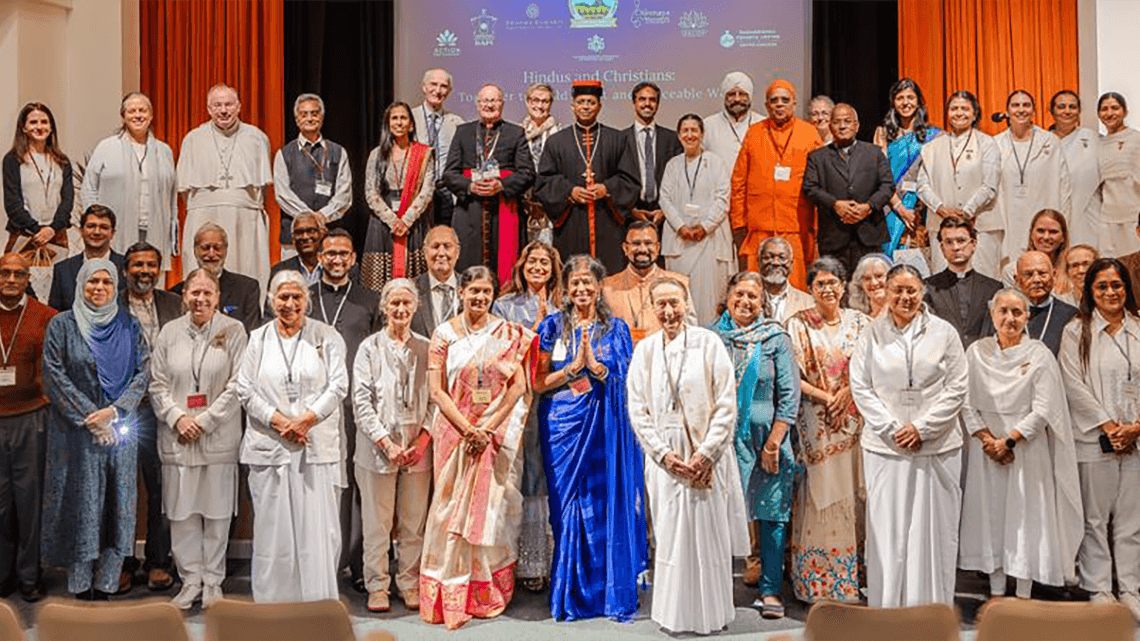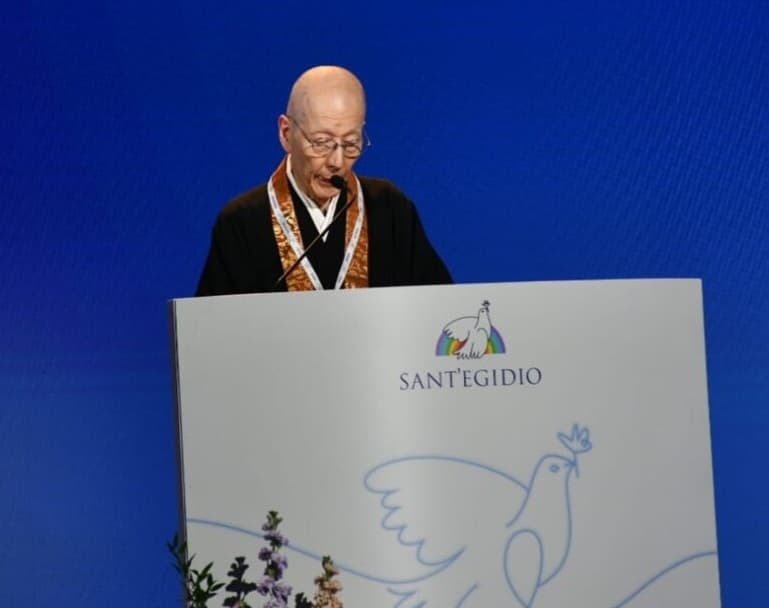
Assisi (AsiaNews) – The international meeting “Unarmed and Disarming Peace”, organised by the Community of Sant’Egidio and bringing together religious leaders from around the world to mark the 40th anniversary of the historic first interfaith gathering to pray for peace – held here at the behest of St John Paul II on 27 October 1986 – opened yesterday in Assisi, Italy. Today and tomorrow, in the city of St Francis, dozens of forums are being held on topics related to peace and the contribution of faiths to dialogue in today’s world. These events precede tomorrow afternoon’s gathering which – just as 40 years ago – will see each religious tradition pray according to its own rites in separate locations, before coming together for a shared symbolic gesture.
The meeting is also attended by many religious leaders from Asia, who are sharing their testimonies. Below we publish the address given yesterday afternoon during the opening ceremony by the Venerable Sugitani Gijun, High Priest of Tendai Buddhism in Japan, who spoke on how the ‘spirit of Assisi’ has given rise to significant experiences in the East in recent years.
It is with profound emotion that I take the floor before this assembly on the fortieth anniversary of the Meeting for Peace held on 27 October 1986, here in Assisi, at the invitation of His Holiness Pope John Paul II and with the wholehearted participation of so many representatives of different religions around the world.
“The Meeting for Peace in Assisi” was an event for peace at a time when the gravest threats posed by the Cold War seemed once again to be looming over the world. It was a moment of reconciliation among religions whose histories had, for so long, been marked by distance, misunderstanding and conflict. Moreover, it conveyed a powerful message: that people of different religious traditions wished to make clear to all that true religion never stands against humanity, but always stands on its side.
Indeed, as Andrea Riccardi the founder of the Community of Sant’Egidio, observed at the 2018 meeting in Bologna, religions are above all “sources of hope” — something of which we are all greatly in need today.
Since 1986, an extraordinary movement for peace has taken shape, and it continues to this day. Forty years ago, the Spirit of Assisi began to blow with great force, not only in the West but also in the East. The courageous initiative of His Holiness Pope John Paul II found a profound response among many religious leaders throughout Asia. From Japan came the Most Venerable Etai Yamada, the Supreme Priest of the Tendai Buddhist Denomination. On his return to Japan, the Most Venerable Yamada spoke of the deep impression made upon him by the Prayer Meeting for Peace in Assisi, and he had a remarkable foresighted intuition: to bring that “Spirit of Assisi for Peace” to Japan and to allow it to blow forth from Japan as well.
Since 1987, the Tendai Buddhist tradition has convened the “Gathering for World Peace through Prayer” every year on 4 August at the sacred Mount Hiei, inviting religious leaders from across Japan to gather in prayer for peace. Religious representatives from many parts of the world have often joined these gatherings, and representatives of the Community of Sant’Egidio have also participated on numerous occasions. I would not say that, over these forty years, the meetings organised by Sant’Egidio in Europe and those held on Mount Hiei have followed two parallel paths, because in reality there have been many points of contact between them, and their paths have often crossed and intertwined. Many friends have taken part in both initiatives. Among them, I would like to recall one person in particular: Mar Gregorios Yohanna Ibrahim, the Syriac Orthodox Metropolitan of Aleppo, who took part in several meetings both on Mount Hiei and with the Community of Sant’Egidio. He disappeared, most probably after being abducted, together with the Greek Orthodox Bishop Boulos Yazigi on 22 April 2013. Since then, we have had no further information about either of them.
I remember that Mar Gregorios was well aware of the dangers surrounding him. And yet, until the very end, he remained a great witness to peace. Today, he has become for us, almost a symbol of that people of peace to which all of us belong, and which over the years has grown ever larger.
The Most Venerable Etai Yamada, who brought the Spirit of Assisi to Japan and promoted the spirit of Mount Hiei, vividly remembered the tragic experience of the Second World War, including the atomic bombings of Hiroshima and Nagasaki. Wherever he went he bore a powerful witness to peace. He did so in Warsaw in 1989, at one of the meetings organised by the Community of Sant’Egidio in memory of the Assisi gathering. Before thousands of Polish people, who still carried with them the memory of the suffering caused by the Second World War, he delivered a powerful message of peace from Japan that moved them deeply.
The Most Venerable Yamada was convinced that globalisation, whose effects on politics and economics were already clearly visible, required religions too to develop closer relationships if they wished to continue to play a role in the contemporary world — a world that often rejects wisdom, spirituality and fraternity, while in truth being deeply in need of all three.
Today, that powerful movement towards political and economic globalisation appears to have lost much of its momentum, while strong winds are blowing throughout the world in the direction of conflict and war. Yet, The Spirit of Assisi and the spirit of Mount Hiei, continue to blow in the direction of peace. And we need these spirits now more than ever.
Our gathering here today, forty years later, to commemorate the 1986 Prayer Meeting for Peace was by no means inevitable. That event could have remained without consequences. Our shared journey could have end at any moment. The network of common commitment and fraternal friendship that binds us together could have dispersed. Yet this did not happen. And our gathering once again here in Assisi gives us the strength to continue along this path with renewed commitment — in the East as in the West.
Today, economic and political globalisation may seem to have lost the seemingly unstoppable momentum it displayed at the end of the last century, but we continue to believe in a “globalisation of peace”: in the possibility of bringing together the many acts of peace, great and small, that are carried out every day throughout the world.
This conviction to the possibility was born in Assisi forty years ago, and to find it reaffirmed here today, after all these years, is a joy beyond what I could have hoped for.
I would like to conclude by extending a special invitation to the younger generations to join us on this journey, to receive its legacy, and together to build a future of peace for our world.