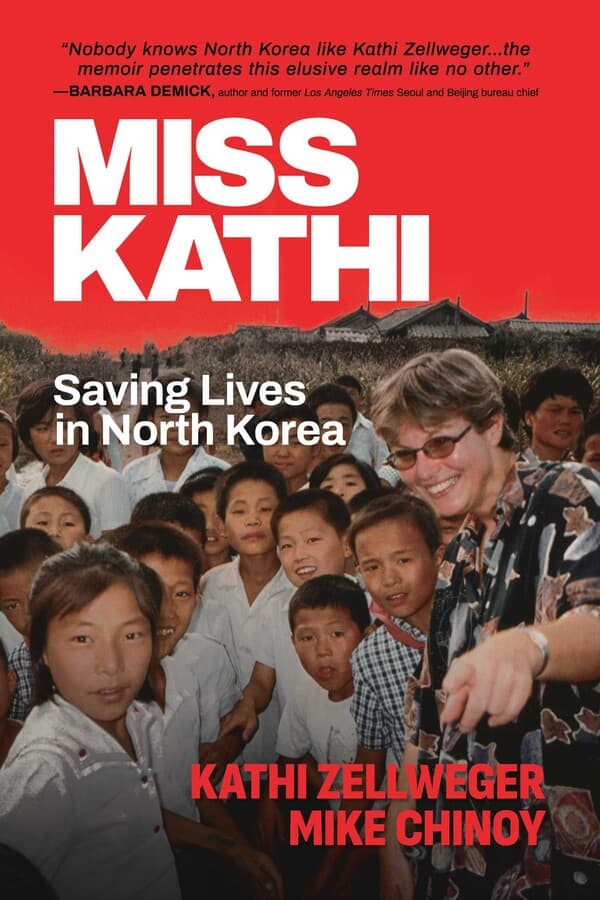
Milan (AsiaNews) – A 25-year diary, packed with encounters with those faces in North Korea that no one ever gets to see. An account of the daily lives of ordinary people, who never feature either in the Pyongyang regime’s ideological propaganda or in the stories of those who have managed to flee the country. The story of the practical aid that – during a favourable period in the troubled history of the Korean Peninsula – an aid worker managed to deliver. And of how much she herself received from these people.
This sums up the deeper meaning of the book “Miss Kathi. Saving Lives in North Korea”, in which Cathi Zellweger – a Swiss aid worker from a Lutheran family, who worked for Caritas Hong Kong for many years from 1978 onwards – together with a leading CNN journalist, Mike Chino, has documented her truly unique experience in North Korea.
The book – published earlier this month in the United States by Post Hill Press – chronicles 25 years of journeys and stays in Pyongyang. A journey that began quite unexpectedly when, whilst working on behalf of Caritas Hong Kong at the height of the famine that was bringing the country to its knees in the 1990s, she had the opportunity to enter South Korea to organise an initial shipment of tonnes of rice (whilst also having to contend with the misgivings of more than one Western government).
75 journeys and a wealth of faces
“Between 1995 and 2019,” recalls Kathi Zellweger in the Introduction, “I made 75 trips to North Korea and lived in Pyongyang for five years, working first for Caritas, then for the Swiss Government’s Agency for Development and Cooperation (SDC), and later running my own non-governmental organisation. My most recent visit to the country was in December 2019, shortly before the borders were closed due to COVID. As far as I know, no one else has such a long and continuous history of humanitarian engagement with North Korea. This book is an account of my experiences – of what I did, saw, thought and felt as I delved ever deeper into North Korea’s closed society, largely whilst the country was enduring one of the worst famines of modern times. It is a story of suffering and tragedy – but also of hope and extraordinary resilience in the most difficult of circumstances.”
Behind this account lies a clear desire to move beyond stereotypical views of Pyongyang: “Most North Koreans are neither involved in diplomacy nor trying to escape, however miserable their situation may be,” says Kathi Zellweger.
They are ordinary people whose fate was to be born in North Korea and who struggle to survive in whatever way they can. And amongst them are the most vulnerable – women, children, the poorest, the hungry and the disabled. These are the people who have been at the heart of my work and who feature prominently in this book.”
At 380 pages, the book is a treasure trove of their personal stories, but also of accounts of how she actually interacted with government officials to carry out cooperation projects, and of the life of the small community of foreign officials that had formed in Pyongyang during those years. It also contains an ‘insider’s’ account of historical events that took place during those years, such as the two visits made in 2000 and 2002 by Monsignor Celestino Migliore, the Holy See’s envoy, who was granted permission to celebrate Mass in Pyongyang’s only church, Changchung Cathedral.
North Korea today
Having lived through these extraordinary experiences, Kathi Zellweger is anything but naive. She is well aware that her time in North Korea coincided with one of the most favourable periods for cooperation. And she is well aware that this window of opportunity has now closed: following the failure of the 2019 Hanoi nuclear talks, Kim Jong Un has abandoned any hope of normalisation with the United States and has ruled out any progress even with South Korea, which he has declared to be an enemy state. He has steadily expanded his nuclear arsenal; he has aligned himself more closely with Moscow by sending thousands of North Korean soldiers to fight alongside Russian forces in Ukraine. From Kim’s perspective, even Donald Trump’s recent overtures towards a possible resumption of dialogue with Pyongyang are far less advantageous than they were a few years ago.
In the book, however, Kathi Zellweger recounts having learnt that, amongst North Koreans, pragmatism always prevails over ideological posturing. “Kim Jong Un himself,” she comments, “ultimately knows that he will have to do something for the North Korean people. If he really does feel more secure on the domestic front, it is possible that at some point he will also feel more confident about reopening the country to the international community, and in particular to UN agencies and NGOs. As time goes by, the belief that foreign aid is ‘poisoned sugar’, as a North Korean official once told me, may fade away.”
Kathi Zellweger’s confidence is also based on a simple fact: “A large number of North Koreans, including many who are now mid- or high-level officials, gained an understanding in the two decades prior to the COVID-19 pandemic of how education, healthcare, trade, markets, agriculture and diplomacy work in the rest of the world. This came about through programmes that I and many other humanitarian and development agencies helped to organise,” she recalls. This wealth of knowledge, which has been acquired but currently lies dormant for ideological reasons, could one day – “if the atmosphere changes – very well become a catalyst for renewed change”.
“Although North Korea often appears static and unchanging from the outside,” writes the Swiss aid worker in the Conclusions of the book, “one of the things I have learnt is that the reality on the ground is far more fluid than it might seem. For this reason, despite the current gloomy climate, I remain hopeful. In an incredibly rigid political system that is deeply suspicious of foreigners, it has been possible to achieve more than I ever imagined. The tens of thousands of North Koreans who survived the famine thanks to international aid, and the 30,000 people who have had their sight restored thanks to the help of KorAid (the NGO she founded, ed.), show that it is possible to achieve results and help those most in need, even in the most difficult circumstances’.