Milan (AsiaNews) – The reality of South Korea today is, in many respects, surprising, the more so when one considers the roots of the miracle that unfolded in the last half-century, and its relationship with democracy. This is an important chapter in the country’s history, one worth knowing, especially for those preparing to attend World Youth Day (WYD) next August. It is also the focus of today’s instalment in our series, Road to Seoul.
At the end of the devastating and brutal war with the North, which involved UN multinational contingents and US forces on the side of the South, and substantial forces from Mao’s China in support of the northern regime, the entire Korean Peninsula lay in ruins, reduced to a state of absolute poverty.
In contrast to the North, which retreated into an autarkic existence, effectively isolating itself from the world under the tyrannical Kim dynasty, now in its third generation, the South defied expectations.
General Douglas MacArthur, commander of US forces with great experience in the Asia-Pacific region, had once dismissed the South as having "no future", a country that "will not be restored even after one hundred years." Yet, the South showed such energy, capability, and determination that it achieved unprecedented development.
While US protection and support certainly played a role, the transformation was driven primarily by the vision of a succession of illiberal, if not outright dictatorial, administrations. Though these regimes failed miserably in terms of democracy and human rights, they succeeded in reviving national pride and unlocking the country’s potential.
Following the first president, Syngman Rhee, military strongmen, such as Park Chung-hee and Chun Doo-wan, established a highly repressive system that suppressed all opposition, while simultaneously placing a heavy emphasis on education.
The development of a highly trained and motivated workforce proved essential, and not just for the initial reconstruction. Beginning in the 1960s, the country transitioned from being one of the poorest in Asia to one of the wealthiest in the world, by creating a highly efficient and capable economic system.
The primary engine of this economic development was industrialisation, centred on a labour-intensive, export-oriented model. For decades, the South Korean economy grew at an average rate of 7 per cent per year, reaching 11th place in the world and 4th in Asia. And that is not all.
The country, with a population of 52 million living on a land area of just over 100,000 square kilometres, has transitioned from being a recipient of development aid to one of donor. It now serves as a key economic and infrastructure partner for dozens of countries across every continent.
Students and the path to democracy
Starting in the 1980s, the economic (and social) progress in the Republic of Korea saw the emergence of democracy. This transition was far from painless: various anti-authoritarian movements, most notably those led by students, paid a heavy price due to state repression. Yet, they were the driving force behind the establishment of a parliamentary democracy in 1987, after four decades of dictatorship.
Under the constitution adopted that year, South Korea is now a unitary presidential republic with a unicameral legislative body, the National Assembly, elected by universal suffrage.
According to the 2026 V-Dem democracy index, the country currently boasts the highest level of electoral and liberal democracy in Asia, tied with Japan, and is frequently cited as a model for its democratic transition, which occurred relatively peacefully and through internal initiative.
Today, under Lee Jae-myung’s presidency, the country is prosperous and proud of the many milestones achieved over the past few decades, most notably its full-fledged democracy, though one often marked by conflict or tarnished by scandals.
It is for this reason that, on the eve of the vote held on 3 June, the president of the Catholic Bishops' Conference of Korea, Bishop Mathias Ri Long-hoon of Suwon, emphasised that it is the duty of politicians “not to forget that they exist to serve the people and foster mutual respect and listening, with a focus on coexistence.”
Today’s polarisations
Lee Jae-myung’s victory marked the return of a progressive to the country’s highest office, along with his Democratic Party taking control of the National Assembly.
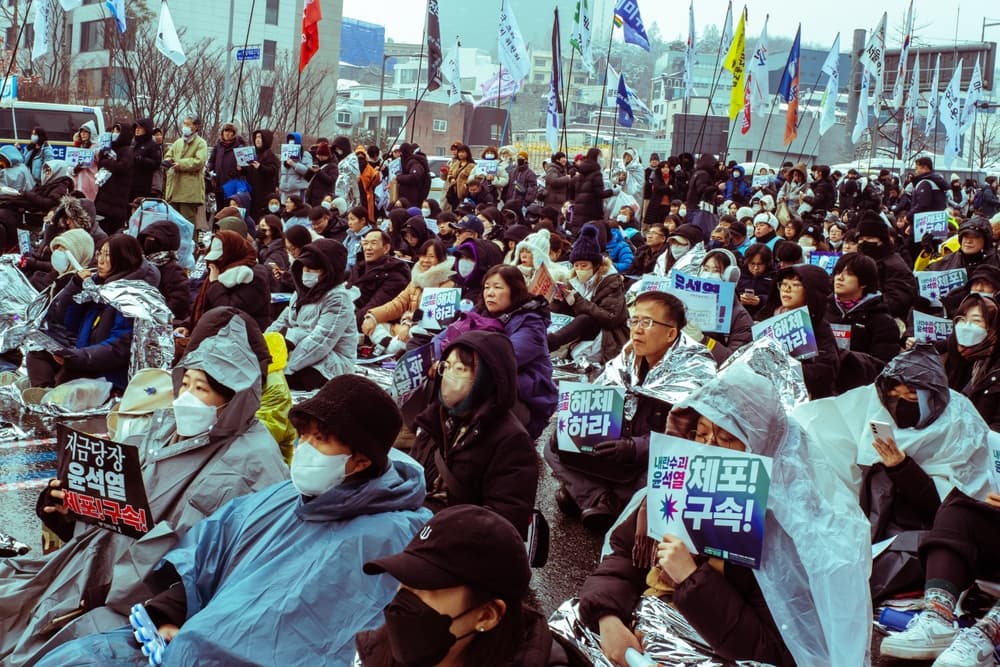
His presidency has proven politically robust, helping to restore confidence among social and economic stakeholders following a protracted conflict involving his predecessor, Yoon Suk-yeol (a non-practising Catholic). Yoon was forced to resign after imposing martial law on 3 December 2024, citing what he described as “hostile actions” by the political opposition.
That triggered a period of parliamentary tensions and bitter confrontation in the streets between the opposition and a significant segment of the population that had supported Yoon’s actions, at least until his removal from office by the Constitutional Court and his subsequent life sentence for insurrection.
These events plunged the country into its worst political crisis since the 1980s, leaving public opinion more deeply divided than ever.
While South Korea stands out in Asia as a mature democracy, it is still searching for a solid consensus, a shared understanding that transcends partisan or ideological interests, to address widespread demands, make crucial decisions, and prevent further social fractures.
Key issues on the agenda include a new income policy, support for the younger generation, and efforts to boost the fertility rate, which is currently the lowest in the world.
Also urgent is the protection of senior citizens, many of whom live in hardship or even poverty due to gaps in the welfare system and the erosion of traditional Confucian family values.
THIS ARTICLE IS PART OF ROAD TO SEOUL, ASIANEWS’ WEEKLY COLUMN LEADING UP TO WYD 2027. TO READ ALL THE ARTICLES IN THIS SECTION, CLICK HERE.