Milan (AsiaNews) – While the outgoing prime minister celebrates, justifiably so, despite losing 10 of his 64 seats and no longer holding a majority in the Knesset, his challengers, who had declared victory in the heat of the moment last night, are now unsure how to position themselves in the face of the strong performance (which had, in fact, been predicted) by Arab parties.
In Israel, it is always difficult to determine who truly wins an election. This is especially true this time, in such a unique round of voting, burdened by the deep wounds of 7 October 2023, the war in Gaza, the confrontation between secular and religious groups, and the violence perpetrated by settlers in the West Bank.
Within this complex political landscape, what is clear is who has been defeated: not so much an individual leader or a specific party, but rather an idea, the notion of a so-called Zionist alternative to Binyamin “Bibi” Netanyahu.
The Failure of the Zionist Alternative
Former general Gadi Eisenkot and his three allies in the anti-Netanyahu front - Naftali Bennett and Yair Lapid’s "Together" (Yachad/Yesh Atid-Yamina alliance), Yair Golan’s Democrats, and Avigdor Lieberman’s Yisrael Beitenu – had appealed exclusively to Israel’s Jewish electorate in their bid to defeat Netanyahu.
They largely and openly ruled out any alliance with political forces representing Palestinians with Israeli citizenship, descendants of the Arab population that remained in Israel in 1948, relying on the guarantees regarding citizenship rights enshrined in the Declaration of Independence proclaimed by Ben-Gurion.
The election results have demonstrated that, at present, no such alternative to the bloc of the Israeli nationalist right exists. Yet, this bloc does not actually command a majority in the country: Netanyahu, the religious parties, and the factions led by Smotrich and Ben-Gvir together garner roughly 40 per cent of the vote.
Consequently, 60 per cent wants change in Israel. To become a governing force, however, this segment must break a taboo: the tendency of many to view the Arab minority as an "alien body" within the country.
This minority not only makes up 20 per cent of the Israeli population, but it also plays a vital role in many sectors of the country’s life, one need only look at the doctors and nurses in Israeli hospitals to realise that.
Yesterday’s elections made one thing clear: one cannot offer an alternative to Netanyahu by dancing to his tune, playing on the same fears, and ignoring the fundamental question of what Israel truly wants to be today.
The signal from the two Arab parties
At the same time, by turning out in large numbers, voters from Israel’s Arab and Bedouin-majority areas sent a clear message. It was precisely the abuses and intimidation by the police, under the authority of Minister of National Security Itamar Ben-Gvir, the most extremist member of Netanyahu’s government, that convinced them to abandon their boycott of Israeli institutions.
They bet on democracy and the genuine possibility of a shared future. In doing so, they have also sent a powerful message to Palestine, where, Mahmoud Abbas (Abu Mazen) and other Palestinian factions (including Hamas) recently agreed to postpone elections until next year.
Those elections could have challenged the entrenched power structures and paved the way for a new generation of leaders, people in the West Bank and Gaza who have personally endured all the failures of recent years (not least the disastrous, point-of-no-return gamble of 7 October 2023).
The unprecedented success of the United Arab List, set to become the third-largest force in the incoming parliament, along with Ra’am, which together are poised to secure between 18 and 19 of the Knesset’s 120 seats, represents the truly new development that these elections have brought to Israeli politics.
These two “Arab” parties actually include Jews, drawing votes from people dissatisfied with the current direction of the Democrats, the political heirs to the old Labour Party of Rabin and Peres.
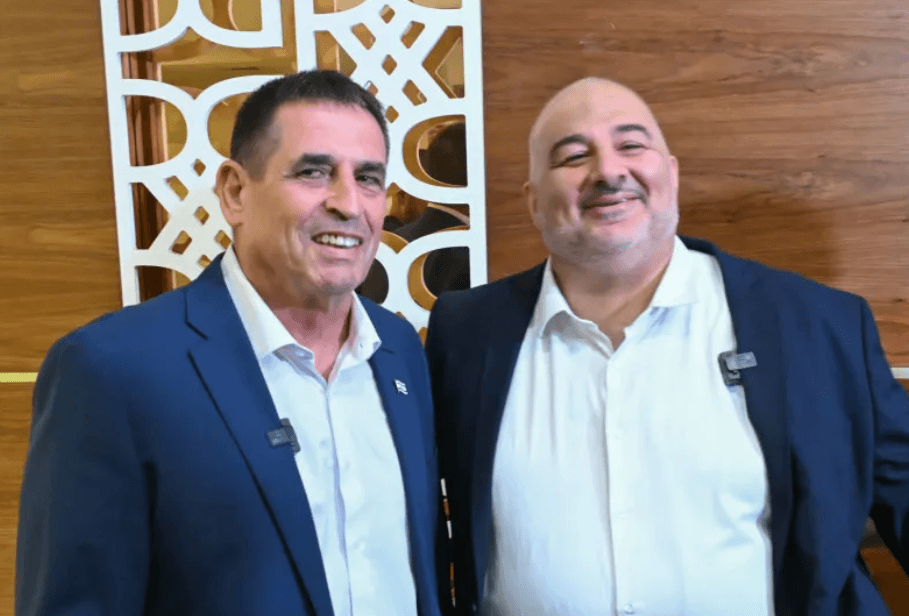
The most prominent figure is Ra’am’s number two, Yoav Segalovitz (pictured with Ra’am leader Mansour Abbas), a former Israeli police officer who began working alongside the Arab community to address the issue that affects them most directly, crime, which claims lives beyond just those lost in gang warfare.
This is an issue of no interest to Ben-Gvir, as it has nothing to do with his own political agenda, focused solely on stoking further tensions with the Arab population and expanding settlements in the West Bank.
Scenarios for the government
What, then, will happen now in Israel?
Netanyahu has 53 or 54 seats in the Knesset, and for his coalition this is the best possible outcome they could have imagined. Bibi will inevitably be asked first to form a new government, likely by bringing over some of the lawmakers elected with Eisenkot’s bloc, or at least securing their external support.
The prospect of a "national unity government" is far less plausible. The opposition saw what became of Benny Gantz when he agreed to such an arrangement. As he has done once again yesterday, Netanyahu has a knack for coopting everything and everyone.
Moreover, he is in no rush as the incumbent prime minister. With the very real possibility that, in a few days’ time (following the midterm elections), he might receive a green light from Trump for a new round of strikes against Iran that he has long been calling for.
While Netanyahu’s next moves are fairly predictable, the path to be taken by the Knesset members elected by the 60 per cent of Israelis who voted for change is much less certain.
An initial point of convergence will likely emerge in two weeks, when the Knesset elects its speaker, a process that will almost certainly involve an agreement on a joint candidate. They will likely vote to establish a commission of inquiry into the events of 7 October 2023, a step the outgoing prime minister has consistently blocked.
Will they stop there, resigning themselves to yet another Netanyahu-led government or to fresh elections in six months’ time? Or will they attempt a more ambitious, unified path, perhaps aiming for a minority government that includes Ra’am (as was the case under Bennett between 2021 and 2022), one that relies on the external support of the United Arab List?
Time will tell; in the meantime, the political contest in Israel remains wide open, and it is unlikely to be resolved anytime soon.