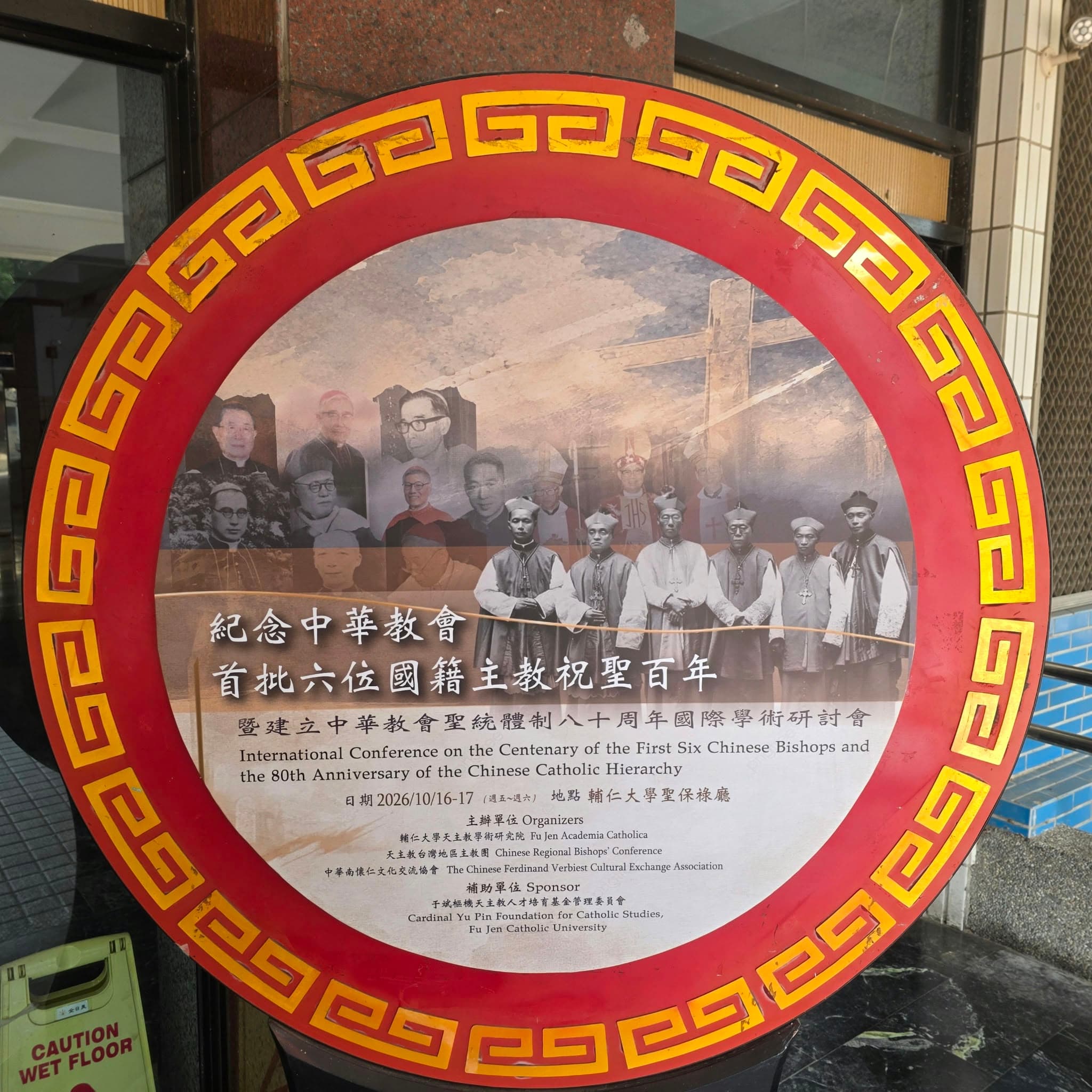
Taipei (AsiaNews) – An important centenary, not only for the Church in China. It is an opportunity to reflect on what the memory of this historic event still tells us today about the Church’s journey of inculturation within the Chinese context. In this spirit, experts from various parts of the Chinese-speaking world have gathered in recent days at Fu Jen Catholic University in Taipei to celebrate together the 100th anniversary of the ordination of China’s first six native-born bishops, which took place at the behest of Pope Pius XI on 28 October 1926 in Rome.
On the initiative of the Fu Jen Academia Catholica, the Regional Conference of Chinese Bishops and the Chinese Ferdinand Verbiest Cultural Exchange Association, an international conference was held on 16 and 17 October at the Catholic university in Taipei to reflect on the significance, in today’s context, not only of this anniversary but also of the eighty years that have passed since the subsequent establishment of the Chinese Catholic hierarchy in 1946.
Pius XI’s gesture in 1926
It was Fr Gianni Criveller, a PIME missionary and editorial director of AsiaNews, who, in his opening address, retraced the historical significance of the event of 28 October 1926, a date specifically chosen by Pius XI to coincide with the anniversary of his episcopal ordination. Fr Criveller traced the long and not uncontested path that characterised the inculturation of Catholicism in China, despite the fact that as early as the 17th century Pope Gregory XV had tasked Propaganda Fide with promoting the indigenisation of the clergy. And even after the crucial impetus in this direction provided in 1919 by Benedict XV’s apostolic letter Maximum Illud, the Apostolic Delegate to China, Monsignor Celso Costantini, had to overcome no small number of difficulties to arrive at the appointment of the first six Chinese bishops and the definition of the territories to be entrusted to their jurisdiction.
On 15 June 1926, however, Pius XI was able to announce, in a letter to the apostolic vicars of China, the names of the six bishops whom he would personally consecrate in Rome the following October: Joseph Hu Ruoshan (Vincentian, Vicariate of Taizhou, Zhejiang), Simon Zhu Kaimin (Jesuit, Vicariate of Haimen, Jiangsu), Philip Zhao Huayi (Vicariate of Xuanhua, Hebei), Melchior Sun Dezhen (Vincentian, Prefecture of Lixian, Hebei), Odoric Cheng Hede (Franciscan, Vicariate of Puqi, Hubei) and Aloysius Chen Guodi (Franciscan, Vicariate of Fenyang, Shanxi). Quoting from the writings of Monsignor Costantini, Fr Criveller recalled that – despite the difficulties and even the disagreements that had arisen – the missionaries obediently followed the Pope’s instructions.
“The younger missionaries,” the Apostolic Delegate noted at the time, “welcome the new directives with enthusiasm; the older ones – though with many significant exceptions – bow their heads in a sign of obedience. It is now universally recognised that the success and glory of a mission lie in the achievement of its ultimate goal: the building up of the Church through a native clergy. The rivalry that once caused serious damage to the missions is being transformed into a spirit of healthy emulation.”
Together with Monsignor Costantini, the six Chinese bishop candidates embarked on 10 September in Shanghai aboard the American ship President Adams (a vessel chosen to avoid using French or Italian ships, thereby reaffirming impartiality and independence from the European powers) and arrived in Naples on 16 October after a long voyage. And on 28 October, their ordination was celebrated in St Peter’s Basilica in Rome – an event which, as Fr Criveller emphasised, was “of extraordinary importance, not only for the Chinese Church but also for the universal Church”.
What happened next
The international conference in Taipei, however, did not stop at a commemoration of this great event from a hundred years ago: over the two days of proceedings, participants also discussed what happened afterwards and how that seed, courageously planted by Pius XI, had to face many other trials in the decades that followed, yet also bore further significant fruit.
In the conference’s second keynote address, Archbishop Savio Hon – former secretary of the Congregation for the Evangelisation of Peoples – explored the theme of the bishops’ communion with the Pope in China, beginning precisely with the sign offered by Pius XI in 1926 through their consecration in the Vatican Basilica. Reflection also focused on another fundamental development, which took place in 1946 under Pius XII: the establishment of the Catholic hierarchy in China, with the transformation of the apostolic vicariates into archdioceses, dioceses and apostolic prefectures. This represented a further show of confidence in the maturity of the local Church, undertaken at a time when the country was plunging into the conflict between Communists and Nationalists.
Mingfang Zhao, of the Pontifical Gregorian University, focused on the relationship between ‘diplomacy and resistance’ in the new situation that arose in 1949 with the establishment of Mao’s People’s Republic of China. Through an analysis of the work of key figures such as the internuncio, Monsignor Antonio Riberi, the secretary of the Nanjing Internunciature, Monsignor Martin Gilligan, and the Archbishop of Nanjing, Monsignor Yu Ping, she demonstrated how the Church’s relationship with the control measures imposed by the new Communist authorities should not be interpreted solely as a gradual separation of Beijing from Rome, but also as a period of profound redefinition of the identity, autonomy and structure of the Church in China.
For her part, Bibiana Wong, of Fu Jen University, focused on the break made by Beijing in 1958 – just 12 years after the establishment of the Catholic hierarchy in China – with the first episcopal ordinations without a papal mandate. By analysing official publications issued by the People’s Republic of China and the Patriotic Association, she demonstrated how this act represented not only a rupture in the traditional relationship between episcopal authority and the Holy See, but also the beginning of an alternative institutional framework for the governance of the Church in China. This remains an open issue even within the current framework provided by the Provisional Agreement between China and the Holy See on the appointment of bishops, signed in 2018.
Other presentations focused on further significant steps in the process of establishing Catholicism within the Chinese context in communion with the universal Church. Michael Chang, of National Chengchi University in Taipei, analysed the establishment in Taiwan in April 1967 of the Regional Conference of Chinese Bishops – spurred on by the Second Vatican Council – as a meeting point between the experience of exile, collegiality and the institutionalisation of collaboration between episcopal conferences. Anthony Lam, from Shue Yan University in Hong Kong, reflected instead on the contribution of the eight Chinese cardinals the Catholic Church has had to date: from the first, Thomas Tien, created a cardinal by Pius XII in December 1945, to the three cardinals still living in Hong Kong: Joseph Zen, John Tong and Stephen Chow.