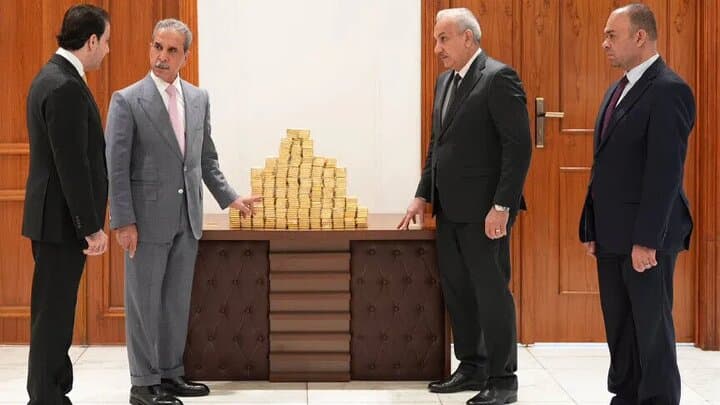
Milan (AsiaNews) – A veritable mountain of gold. 375 kg, to be precise. This is the haul recovered by the Iraqi authorities as part of one of the most extensive anti-corruption investigations in recent years, a case involving the former Deputy Minister of Oil for Refining Affairs, Adnan al-Jumaili, who was arrested in recent months on charges of running a complex system of bribery, embezzlement of public funds and illicit enrichment.
According to a statement from the Iraqi judiciary, 358 kg of the precious metal were recovered during an operation carried out in collaboration with the authorities of the Kurdistan Regional Government, whilst a further 17 kg were seized during a separate investigative operation. The entire quantity has been transferred to the Central Bank of Iraq, where it will be held as part of the legal proceedings.
The discovery is merely the latest chapter in an investigation that continues to reveal increasingly staggering proportions. In the preceding days, investigators had recovered around 14 billion Iraqi dinars – over 10 million dollars – hidden inside a rainwater drain. According to the government spokesperson, the assets seized so far in the case against al-Jumaili alone exceed 127 billion dinars, in addition to tens of millions of dollars, property, luxury cars and jewellery.
The images released by the authorities (which have been widely reported in the Arab media and on television) show dozens of gold bars neatly stacked. A ‘vivid’ illustration, more eloquent than a thousand words, of the wealth stolen from the state in a country which, despite possessing one of the largest oil reserves on the planet, continues to grapple with inadequate infrastructure, power cuts, youth unemployment and often substandard public services.
Operation Dawn
Corruption has for decades been one of the main obstacles to Iraq’s development. Following the fall of Saddam Hussein’s regime in 2003, the new political system built around the sharing of power between Shia, Sunni and Kurdish groups has gradually fostered the emergence of vast patronage networks. Ministries, state-owned enterprises and local authorities have become a battleground for the division of spoils among parties and political groups, which have often used public offices to consolidate their support through recruitment, public contracts and the distribution of resources. The oil sector, which accounts for almost all state revenue, has always been – quite literally – the ‘goose that lays the golden eggs’, the focal point of enormous economic interests. Control over refining, transport and supply contracts represents a formidable lever of power, capable of generating profits running into the billions.
The investigation into al-Jumaili forms part of the campaign known as ‘Operation Dawn’, launched by the new government of Prime Minister Ali al-Zaidi (in office since last May) with the stated aim of recovering funds siphoned off from the public purse and prosecuting officials accused of corruption. According to the authorities, numerous public executives and high-ranking officials have been arrested in recent weeks.
Some members of parliament have had their immunity lifted to allow the judiciary to bring criminal proceedings against them, whilst the Integrity Commission (the independent Iraqi state body responsible for preventing, investigating and combating corruption in public administration) is working to secure the extradition of hundreds of suspects who have fled abroad and to recover assets transferred out of the country. The government maintains that it intends to take action regardless of political affiliation, insisting that the law must be applied equally to all officials involved.
The political context
The anti-corruption campaign, however, is taking place against an extremely complex political backdrop. Iraq continues to be riven by deep-seated rivalries between the main Shia factions, by delicate relations with the Kurdistan Region, and by tensions between the various militias that exert significant influence over national security and the economy. The fight against corruption is therefore not merely a judicial matter, but also a tool of political competition. Every high-profile arrest shifts the balance of power between rival factions, inevitably fuelling the suspicion that some investigations may be used (if not fabricated) to weaken internal opponents. This dynamic has been a feature of Iraqi public life for years and makes it difficult to draw a clear distinction between the actions of the judiciary and the strategies of the various power coalitions.
At the same time, Baghdad is navigating the difficult balance between the influences of Iran and the United States, whilst seeking to preserve a fragile internal stability. Regional tensions and the role of the Popular Mobilisation Forces (in Arabic al-Hashd al-Shaabi, a collection of largely Shia Iraqi militias formed in 2014 to fight the Islamic State but which have now become one of the most influential players in Iraqi politics and security) continue to affect the structure of the state and the central government’s ability to fully exercise its authority.
In recent years, millions of Iraqis have taken to the streets demanding better services, employment and, above all, an end to systemic corruption. The protests, which intensified significantly in 2019, have denounced a model of governance perceived as incapable of transforming the country’s immense oil wealth into widespread prosperity. For this reason, the recovery of the gold bars carries strong symbolic significance. On the one hand, it demonstrates the state’s ability to identify hidden assets and seize illegally accumulated wealth; on the other, it highlights the scale of the corruption that continues to deprive a population still grappling with structural problems of its resources.
It now remains to be seen whether this operation will be merely a ‘one-off’ – destined to peter out once the most high-profile phase of the investigations is over – or whether it marks the beginning of a genuine era of reform. In a country where oil continues to generate enormous financial flows and where the political balance remains extremely fragile, the real challenge will be to transform these high-profile seizures into a strengthening of the rule of law.