New Delhi (AsiaNews) – More than 23,000 Central Armed Police Forces (CAPF) personnel have been deployed in support of Delhi police, with 37 checkpoints set up, detention centres prepared across the capital's districts, and potential restrictions on train and metro services.
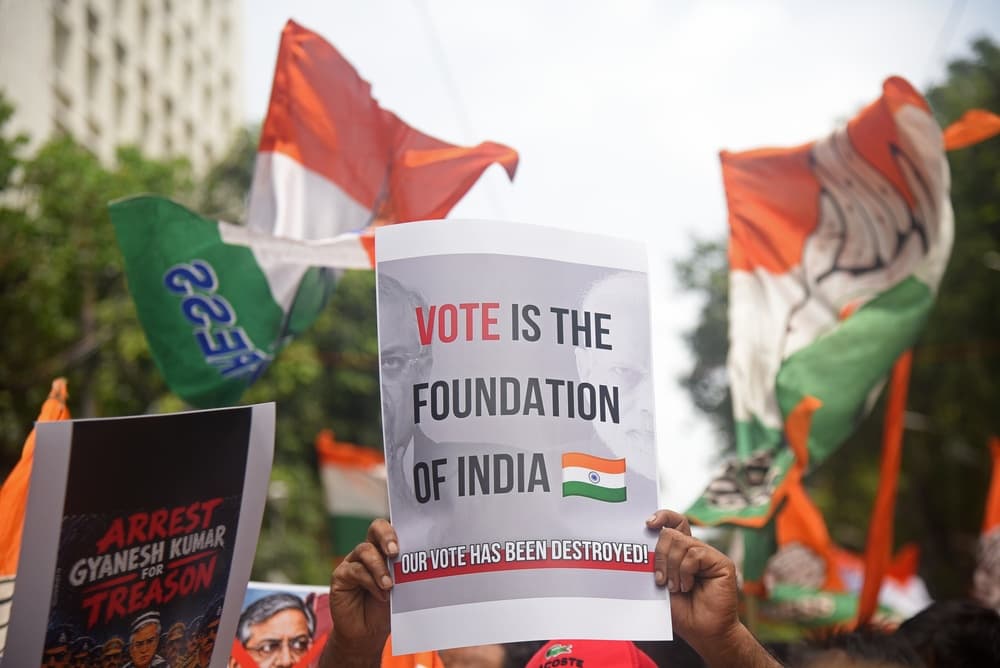
These measures have been put in place in Delhi ahead of protests announced for tomorrow, seeking the resignation of the Chief Election Commissioner of India Gyanesh Kumar.
However, police have denied the Cockroach Janta Party (CJP), a youth movement that has spearheaded recent street actions, permission to demonstrate at Jantar Mantar, the Indian capital's traditional protest site because the request submitted by CJP coordinators arrived too late.
Joint Commissioner of Police Nupur Prasad cited security, public order, and traffic management as the reasons. However, the CJP has reiterated its intention to be in the capital despite the ban.
The Ministry of Home Affairs, led by Amit Shah, is deploying 23,000 CAPF personnel to help Delhi police between 8 and 12 October. Five all-female paramilitary companies will be involved in the operation.
According to The Indian Express, officials anticipate that more than 50,000 people could arrive in the capital, including from neighbouring states. Authorities have set up checkpoints at the city's entry points.
The police have asked the Delhi Metro Rail Corporation to consider closing the entrances and exits of 57 metro stations, starting at 9 PM on October 9 and continuing until the situation returns to normal.
Indian Railways has also announced the cancellation of trains arriving at New Delhi and Hazrat Nizamuddin stations between 4 am and 2 pm on Saturday.
Furthermore, authorities have called on social media platforms to take action against content deemed related to the protests.
The Ministry of Electronics and Information Technology issued a statement expressing concern over online information deemed false, misleading, manipulated, or presented out of context.
Reacting on X, CJP founder Abhijeet Dipke, wrote: “Why not simply declare an emergency?” A movement spokesperson subsequently claimed that at least 10,000 people have been preventively detained across the country.
For several days, students and opposition parties have mobilised in Delhi and other Indian cities. Indian National Congress Party leader Rahul Gandhi, who joined young people in the streets, was detained on Wednesday.
Having successfully forced the Education Minister to resign over a scandal involving irregularities in university entrance exams, protesters are now demanding the resignation of the chief election commissioner. Some investigations suggest that the current office holder facilitated the removal of thousands of names during the Special Intensive Revision (SIR), the process by which authorities verify and update voter rolls.
Demonstrations demanding greater transparency from the Election Commission of India (ECI) have also taken place in other cities, such as Bengaluru and Mumbai.
The Conference of Religious India (CRI), a national body representing Catholic religious congregations, has issued an appeal urging Catholic men and women religious to defend the right to vote and to support the initiatives scheduled for 10 October.
The document, titled SIR and Disenfranchisement: CRI Standing Up for Truth and Justice, views the issue not merely as a political dispute but as a moral responsibility linked to upholding the dignity and rights of citizens.
In it, the organisation expresses concern over the situation. What is unfolding, the document states, should “touch the conscience and shock the sensitivities” of every citizen.
The “CRI cannot be silent spectators to what is unfolding in our country,” the appeal states, invoking the Christian vocation to defend truth, pursue justice, and bear witness to the life and teachings of Jesus Christ, especially when the rights and dignity of the most vulnerable are at stake.
The CRI has also welcomed the growing involvement of young people, including Generation Z, as well as opposition parties and various organisations in the debate over protecting the right to vote. Hence, it has called upon religious congregations to participate in national campaigns.
Communities are called upon to intervene “visibly and vocally, without fear or favour,” in defence of constitutional guarantees and the citizens' right to participate in free and fair elections.
The religious organisation further notes that the revision of electoral rolls cannot be viewed merely as an administrative matter or part of a political debate.
In fact, the revision of the electoral lists has resulted in the provisional exclusion of approximately 134 million names nationwide, out of an electorate of 954 million registered voters.
However, these figures do not necessarily equate to an equal number of citizens being deprived of the vote. The Commission has initiated a procedure allowing those omitted from the preliminary lists to request reinstatement.
Nevertheless, as various journalistic investigations have recently documented, red tape or other mechanisms have in many cases led to the permanent exclusion of individuals who were actually entitled to vote.
In Delhi, 32.78 per cent of voters were excluded from the preliminary lists. Conversely, in West Bengal, where the Bharatiya Janata Party (BJP), the party of Prime Minister Narendra Modi, recently won local elections, 91 per cent of the appeals examined so far have resulted in the reinstatement of previously excluded voters.
These figures have fuelled concerns over the past few months over the reliability of the revision process, thus sparking the ongoing protests.
INDIAN MANDALA IS THE ASIANEWS NEWSLETTER DEDICATED TO INDIA. WOULD YOU LIKE TO RECEIVE IT EVERY FRIDAY? TO SUBSCRIBE, CLICK HERE.