Baghdad (AsiaNews) – Extreme heat is still being felt in various parts of the country; logistical issues linked to the withdrawal of the US-led international coalition from the territory by the end of the month; the handover of all weapons still in the possession of militias and armed groups; security concerns linked to the conflict in the Gulf, which directly involves Iraq – a territory from which attacks directed at Saudi Arabia, carried out by factions linked to Tehran, have originated, including recently.
To date, the official reasons are still unknown, but the only certainty is that the government in Baghdad has ordered the postponement of the start of the 2026–27 school year, originally scheduled for 20 September. Initially, the date of 11 October had been proposed, representing a delay of more than three weeks compared with the calendar; however, in the last few hours the Ministry of Education has announced that the first bell will ring on 1 October.
Doubts over the postponement
The measure does not apply to the Iraqi Kurdistan region, where lessons are due to start as normal on 20 September, but to the rest of the country, affecting a total of over 12 million pupils. In recent days, various theories have been put forward and a heated debate has erupted regarding the postponement, whilst in Basra (in the south) the Ministry has issued a warning to private schools intending to start the academic year as normal, without waiting for the rest of the country. The original postponement to 11 October risked costing almost a month of the academic year, raising fears that the curriculum might not be completed, particularly for the final years of primary, lower secondary and upper secondary schools. Furthermore, experts believe that the nine-month academic year is increasingly at risk because the normal academic calendar is shortened by numerous public holidays and breaks associated with religious observances.
Rumours and speculation have linked the postponement to 30 September, the date set for the withdrawal of international coalition forces and the deadline for the transfer of weapons to state control, which could lead to clashes and tensions. The Ministry of Education, however, has cited four main reasons for the postponement, none of which relate to the withdrawal of foreign troops or disarmament. In a statement, Minister Abdul Karim Abtan al-Jubouri explained that the postponement will allow the second phase of examinations to be completed for pupils in year groups not sitting their A-levels, and will enable classrooms to be prepared for the new academic year. The statement goes on to say that this decision “also took into account the high temperatures recorded during this period and the need to meet educational, technical and administrative requirements before the start of term”. Faced with public criticism of the postponement, the ministry’s spokesperson, Karim al-Sayed, provided further justification, explaining that the previously announced start date, 20 September, had proved to be too early and that circumstances had changed.
Material from the Chaldean Patriarchate
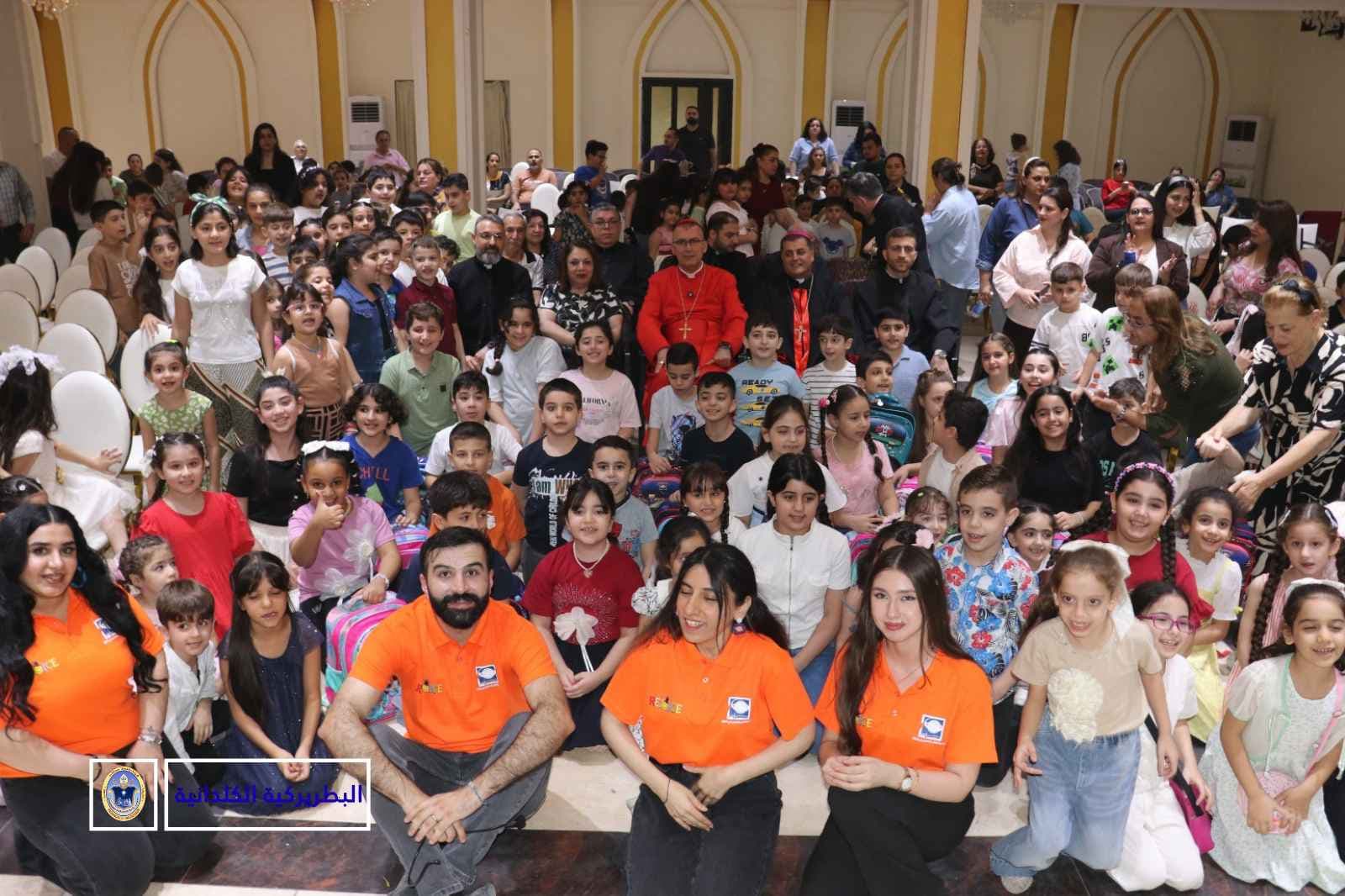
Meanwhile, in the run-up to the new school year, the Chaldean Patriarchate organised a celebration at the Indian Club Hall in Baghdad, during which rucksacks and school supplies were distributed to the 475 children in attendance. This initiative, strongly championed by Patriarch Paul III Nona, took place on 16 September and was attended by dozens of Iraqi Catholic families and pupils aged between six and 10, representing 15 Chaldean churches in the Iraqi capital. At the conclusion of the celebration – which included educational and entertainment activities organised by the Bible Society’s Rejoice programme, featuring theatre and specially designed games – a statement from the Patriarchate sent to AsiaNews explains that the Primate “distributed rucksacks containing school supplies and stationery”.
The event, the statement continues, took place in “an atmosphere of joy and interaction amongst the children”. Addressing the participants, Patriarch Nona “expressed his thanks and appreciation to all those who contributed to the organisation and support of this event, including priests, educators, philanthropists and volunteers”. He told the children to apply themselves to their studies, strongly emphasising that they “represent the future and the hope” of the country.
A shortfall of 10,000 schools
Finally, the controversy surrounding the reopening date has – at least for the time being – overshadowed another equally pressing issue concerning the country’s schools: overcrowded classrooms and the lack of a suitable learning environment. This is according to a report published in recent days by Eco Iraq Observatory, an independent research body which estimates that 10,000 new school buildings are needed to fill the gaps and effectively address the shortage of classrooms. Although the country has over 40,000 schools serving primary and secondary pupils nationwide, the observatory has emphasised that the existing facilities remain wholly inadequate to accommodate a growing student population.
Added to this are structural shortcomings that hamper day-to-day operations across the entire public education system; in particular, at least 8,000 new facilities would be essential to gradually phase out multi-shift schooling and move to a single-shift model, in which each school authority manages a separate building. The report by the Eco Iraq Observatory also drew attention to persistent disparities in building standards in rural and outlying regions, with around 200 mud-brick schools and some 800 temporary, caravan-style classrooms still in use. These makeshift structures are mainly concentrated in the governorates of Salah al-Din and Dhi Qar, in the north-central and southern parts of the country respectively. The organisation concludes by calling on the Ministry of Education to adopt capital allocation programmes, particularly in high-density population centres – Baghdad, Mosul, Basra and Dhi Qar – which are considered priorities in school reconstruction to address a lagging education system.