

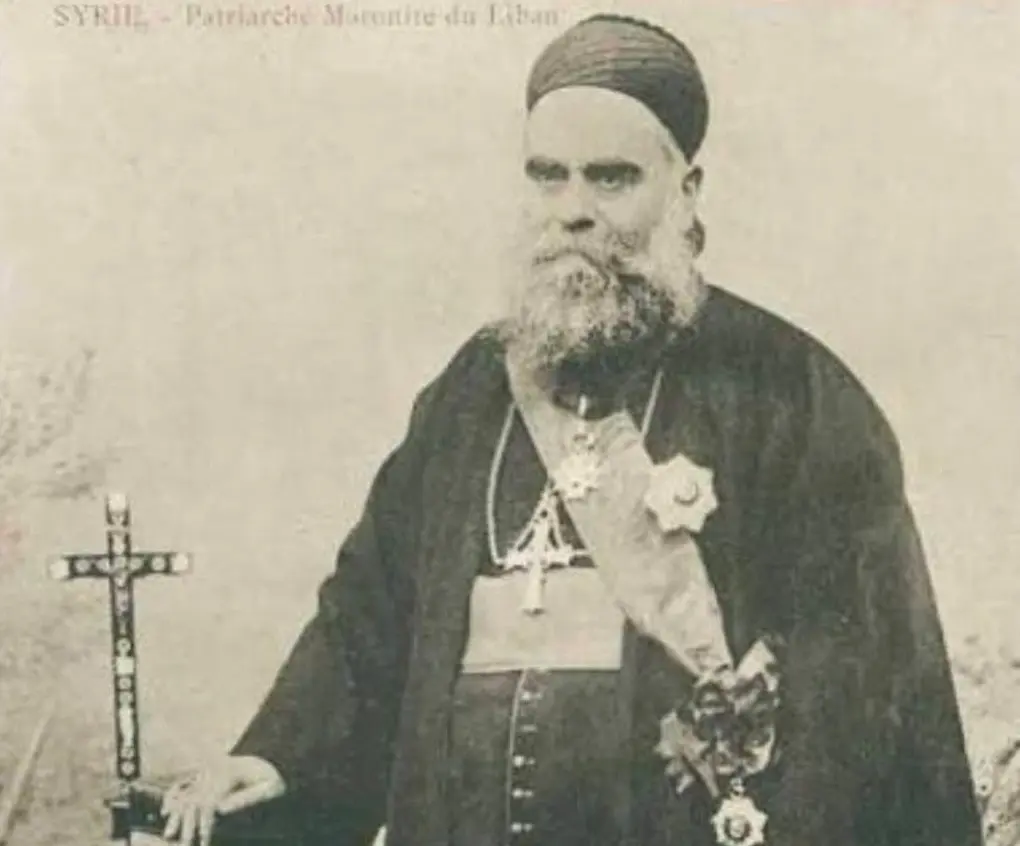
Beirut (AsiaNews) – “If there is one person who deserves to be called the patriarch of all Lebanese, it is Patriarch Hoyek.”
This is the view shared by many Lebanese regarding a man whom the turbulent events of history have not helped to be appreciated at his true worth, but whose beatification – scheduled for tomorrow in Dimane, the summer residence of the Maronite patriarchs – will place him on a pedestal of honour worthy of his mission. The ceremony will take place in the presence of Cardinal Marcello Semeraro, Prefect of the Congregation for the Causes of Saints.
History has preserved this emblematic phrase from Hoyek: “I am the Maronite Patriarch! My community is Lebanon. I belong to all Lebanese people.” This is no idle remark: it is to the miraculous healing of a high-ranking member of the Druze community that this man of prayer, who placed his trust solely in God, owes his beatification.
“Juvenis ad majora natus” – “Born for great things” – was the motto of Saint Stanislaus, prophetically noted in the margin of Elias Boutros Hoyek’s (1843–1931) school report at the end of his theological studies in Rome. He was then 27 years old and was in the Italian capital, sent by Patriarch Boulos Massaad to complete his theological studies at the Maronite College and prepare for the priesthood.
Distinguished by his keen intellect and meticulous adherence to the rules, this man destined for greatness was to become none other than the 72nd in a long line of holy Maronite patriarchs, of whom he is certainly one of the most eminent figures. His great achievement was the struggle for the creation of Greater Lebanon, proclaimed by General Gouraud, High Commissioner of the fledgling Republic, on 1 September 1920.
His vision for the country
Born in 1843 in Helta (Batroun), a tiny village in a remote corner of the Ottoman Empire, Elias Hoyek was, in fact, the man of Providence who would defend, first before the French Prime Minister Georges Clémenceau and then before the League of Nations at the end of the First World War, the idea of creating a Greater Lebanon, two months after the signing of the Treaty of Versailles (28 June 1919), which placed part of the Middle East under French mandate.
One might wonder to what extent Patriarch Hoyek’s choice in favour of a pluralist Lebanon constituted a sustainable historical gamble, whilst the dominant dynamics of the Arab world in the 20th century – decolonisation, the rise of nationalism, the development of political Islam and the challenge to Western modernity – were evolving in an often opposite direction. Was the pluralist project championed by the patriarch a visionary anticipation of the Middle East’s diversity, or a historical gamble rendered increasingly fragile by the major upheavals of the twentieth century?
Behind this decision, however – at the very least – lay a rare political, economic and ecclesiological foresight. First and foremost, Greater Lebanon shielded Lebanese Christians from the dhimmitude that would have been their lot in the Muslim-majority countries that were taking shape; furthermore, by integrating Beirut, Tripoli, the Bekaa and Jabal Amel into the ‘mountainous Lebanese’ core of the Mutasarrifiyya, it restored the country’s ‘breadbasket’ and protected it from a famine similar to the one that decimated its population in 1915; it also ensured abundant water resources and, finally, crowned the country with one of the most beautiful coastlines in the Mediterranean and, at the same time, a unique strategic promontory.
But whilst geographical Lebanon was a true jewel, its human and spiritual vocation was no less precious: in the spirit of its defender, it was to serve as a treasure-chest for living together, enabling ‘the wolf and the lamb’ to dwell together (as the prophet Isaiah wrote), a messianic biblical ideal that Lebanon would seek to embody and of which John Paul II would later say that it is ‘a model of freedom and pluralism for the East and the West’. A model that continues to elevate Lebanon, despite all the historical difficulties the country has faced.
Pluralism as a sacred right
Just over five years after the proclamation of the State of Greater Lebanon, on 1 September 1920, from the Residence of the Pines, the patriarch had the opportunity to set out his political position. In response to a key questionnaire addressed to the Maronite Patriarchate by the Mandate authorities regarding the nature of parliamentary representation, Patriarch Elias Hoyek and the Maronite bishops, on 8 January 1926, stated that it must be confessional, for the following reasons: “The country is composed of various religious communities. They differ not only in their dogmas, but also in their traditions, customs, ways of life and approach to social issues. Consequently, election on a confessional basis allows these communities to be represented within the assembly in accordance with a defined proportion. There, they learn to get to know one another and to reach agreement, each agreeing to sacrifice part of its own demands through a process of mutual concessions. This dynamic will gradually lead to a fusion and unification of political life.” (Archives of Patriarch Elias Hoyek).
“What strikes the reader in this masterful exposition,” comments Prof. Georges Hobeika, Vicar General of the Lebanese Maronite Order (OLM) and Rector Emeritus of the University of the Holy Spirit in Kaslik, “is that Patriarch Hoyek regards diversity, pluralism and differences within human societies as a natural given. He sees nothing abnormal in the heterogeneity of traditions, customs, ways of life and opinions stemming from religious beliefs. He respects the right to difference and firmly upholds it as a sacred, non-negotiable right. The opposite would have been surprising.”



.jpg&w=3840&q=75)







