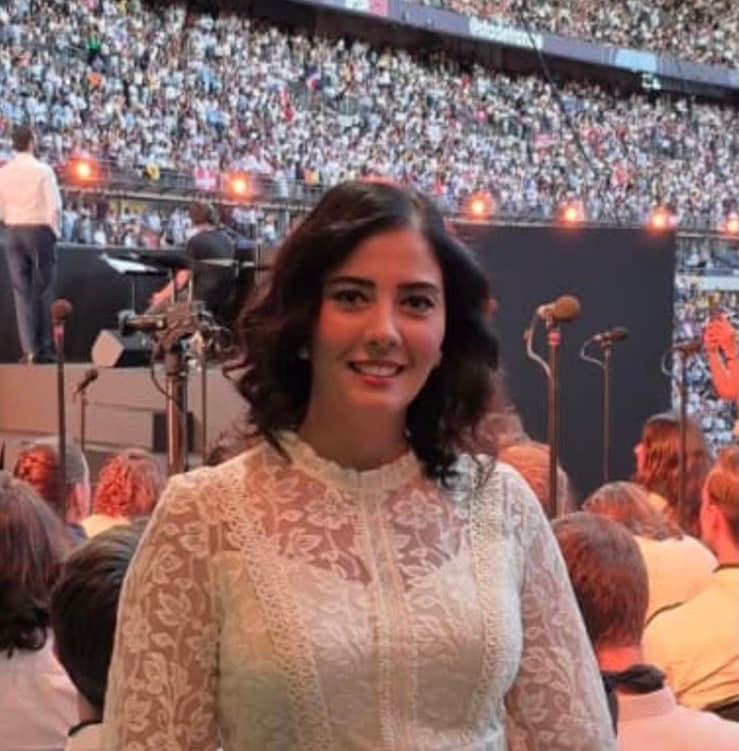
Beirut (AsiaNews) – Stade de France, on the outskirts of Paris. Pope Leo XIV has scheduled an evening meeting with young French people on the first day of his recent apostolic journey to France (25 September).
In a painting depicting a boat and a sail, a man and a woman can be glimpsed standing; superimposed over a 4th-century Aramaic hymn resounding through the stadium, a voice-over recites: “When France did not yet bear its name, Heaven was already preparing its plan. In the year 44 AD, on the shores of the Mediterranean, a fragile wooden boat drew up to the coast. Two disciples of Jesus Christ set foot for the first time on this land that would become Provence: Lazarus and Mary Magdalene. From the calanques of the coast to the cliffs of Sainte-Baume, their passage would be etched in stone, in hearts and in the memory of mankind as the very first page of the Christian phase of France’s history.”
“This is the cry of my whole life,” Mary Magdalene, the converted sinner, then exhorts, “Christ calls you by name. No one is too lost to be loved!”
Thus begins, with a meeting between East and West, the magnificent spectacle staged in honour of Pope Leo XIV on the occasion of his meeting with French youth. This culminating moment of the vigil centred on a great living fresco and a litany of the saints specially arranged for the occasion, combining traditional prayers with invocations to the saints and figures from French Christian history such as Joan of Arc, Vincent de Paul, Francis de Sales, Louise de Marillac, Thérèse of Lisieux, the Curé d’Ars and Charles de Foucauld.
The arrival, in the year 44, of a boat without sails, oars or a rudder, carrying a group of Christians who were companions of Jesus – including Lazarus and his two sisters, Martha and Mary Magdalene – abandoned at sea by their persecutors, is well attested in Provençal tradition. And the voice singing in Syriac is that of Héléna Alamil, a unique Lebanese talent, whose personal journey combines the world of advanced scientific research with that of ancient Eastern Christian liturgy.
A dual career
Far from being a travelling artist, Héléna Alamil is in fact a full-time researcher. She obtained a PhD in toxicology from the University of Paris-Saclay and has worked as a university assistant, postgraduate student and researcher in the field of mass spectrometry applied to the life sciences. Originally from Rmeich (southern Lebanon), a large Maronite border village, Héléna has been living in France for around 10 years.
In her adopted country, she is also known as the daughter of the village parish priest, Fr Nagib Alamil. The hymn she performed, ‘Abo Dqoushto’ (Father of Truth), is a profound 4th-century Syriac liturgical chant, addressed according to the Maronite liturgy to God the Father and centred on the sacrifice of Christ.
Héléna was chosen to represent the ‘Early Christians’ in the unveiling of the fresco ‘In the Footsteps of the Saints’, presented to the Pope. The performance is under the masterful direction of Alexis Duffaure, a conductor and choir director who is as ‘humble’ – to use Héléna’s words – as he is talented, with an orchestra and choir of 2,500 people coordinated by Ecclesia Cantic, a French ecclesiastical organisation dedicated to supporting liturgical chant. From a visual, vocal and musical perspective, the performance comprises around ten scenes summarising the history of holiness in France.
The evening’s big surprise: a carriage drawn by four horses that brought to life the narrative of the martyrdom of Saint Blandine in Lyon, and Joan of Arc with her comrades-in-arms galloping on proud steeds through the ranks of the spectators. Héléna’s performance formed part of the scene depicting the Eastern roots of Christianity in Provence. As the actors portraying Mary Magdalene and Lazarus entered the stadium standing on a boat, her soprano voice gave momentum to the performance, which moved Pope Leo XIV and the crowd of 80,000 spectators filling the stadium stands to tears.
“Honour and grace”
“It was an honour and a grace for me,” Héléna told AsiaNews, before adding, “and also a great responsibility.” “Must one succeed in life, or give it away?” asks the script for the evening, recited by André Dussolier. Héléna’s answer to this question is immediate: “ All I wish is to touch the hearts of the faithful, contribute to their conversion, and give glory to God and His Church.” At just over 30 years of age, the young woman, contacted by telephone, has no intention of burying “the talent” entrusted to her, but seeks to put it to good use primarily in public and private religious ceremonies, and on the rare occasion of an “honourary reception” as an exception.
She says she has never been happier than when some of her listeners in Europe confided to her that “they hadn’t understood a thing about the hymns” she had performed, adding, however: “Listening to you, it’s as if we’d understood everything”. This is a source of pride for this young woman who has sung ‘in every corner of France’, in Monaco, Luxembourg and Germany. And even in Rome, as a member of a choir, during the canonisation ceremony of the three Massabki brothers, Maronite laymen martyred during the Damascus massacres in the 19th century (1860), alongside thousands of other Christians from the Lebanese mountains.
Roots in Rmeich
It was from the village of Rmeich, where her family’s roots lie (now reduced to a residential enclave surrounded on all sides by the Israeli army, which can only be entered or left with prior authorisation), that she moved to Paris and answered the call to sing for the Pope. It is there that, at Christmas, Easter and in the summer, she is reunited with her father, her mother Violette, her married sister, her brother the priest and eight nieces and nephews. “I owe everything to my family,” says Héléna, who inherited her beautiful voice and love for her homeland from her parents. “In fact,” she adds candidly, “I learnt to sing even before I learnt to read.” Deeply attached to Lebanon, which she considers, along with many Lebanese, “part of the Holy Land, for it was trodden upon by the feet of Christ”, Héléna’s connection is “above all through her love for Rmeich, where, according to local traditions, certain places preserve traces of the passage of Christ and his disciples along the route to Sidon and Tyre”.
What made the greatest impression on her about the ceremony at the Stade de France? What touched her personally? Surprisingly, “it was the discipline, the peace and the respect for others” that struck her most. “You have to compare leaving the stadium that evening to leaving a football match to understand,” she explains. “A smooth, orderly exit. Not a single rubbish bin was knocked over!” But that’s not all. She also said she was moved to tears by the Pope’s message of hope: “You are the saints of France!” “What struck me, too, was the Pope’s emotion. He appreciated the vigil. After all, everyone was moved to tears, even the Pope,” adds Héléna. “I think this reawakening is profound and will stand the test of time. You only have to look at the reactions on social media. Young people are no longer ashamed to declare themselves Christians and to talk about it. The Pope’s visit has given them greater confidence. In France, a new generation of Christians is spreading – she concludes – its hope.” Let us leave the final word to the great Christian poet Jean-Pierre Lemaire: “We were on Mount Tabor… now we must come down from the mountain and root this renewed surge of faith in our daily lives.”