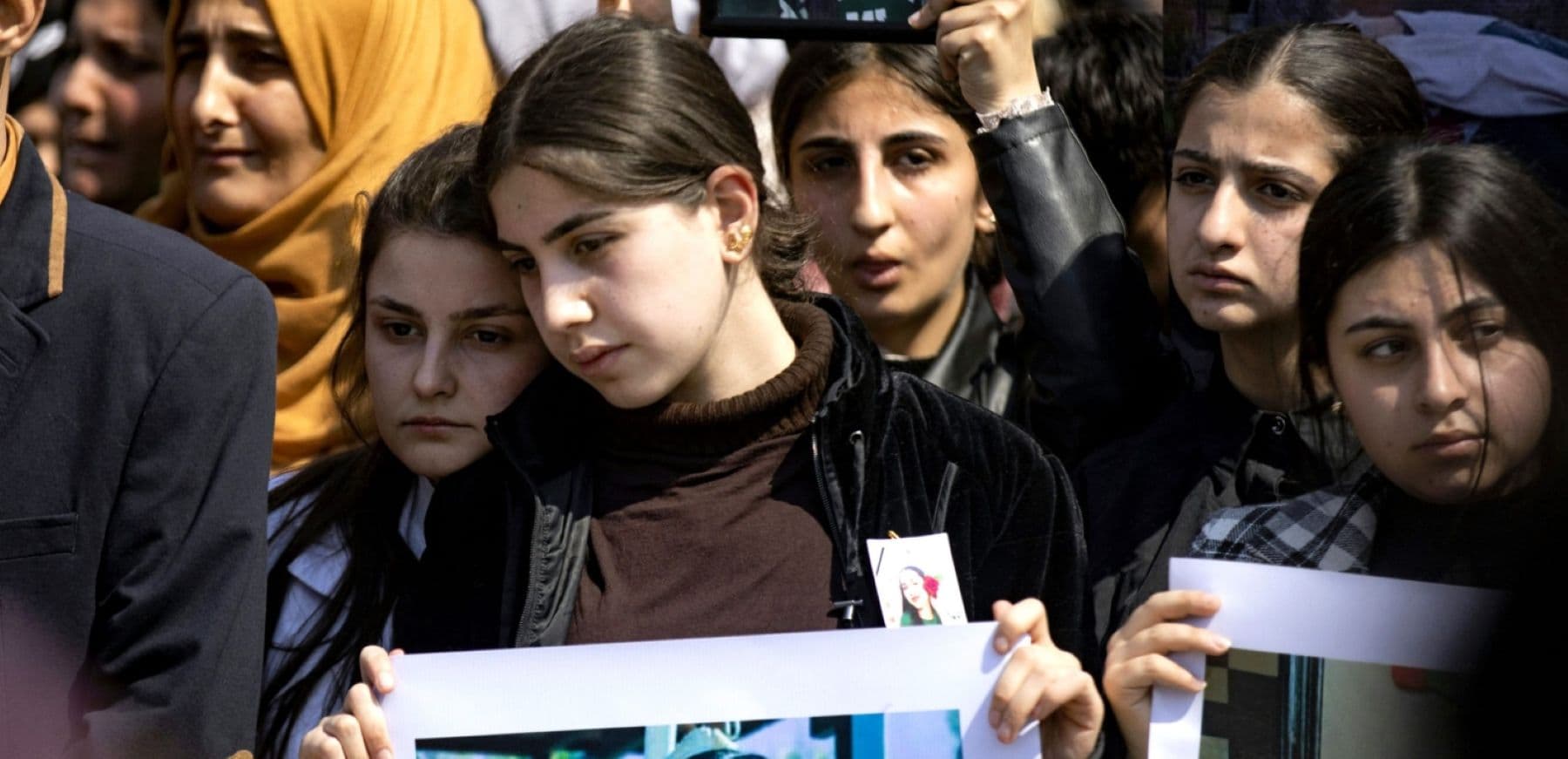
Damascus (AsiaNews) - From victim to accused, in a controversial and unresolved case with unclear aspects, which remains a mystery to this day. A case like so many others, concerning Alawite women who, since the fall of Bashar al-Assad’s regime, have been subjected to abuse and violence – a story we wish to recount today as we mark, as we do every year on 25 November, the UN International Day for the Elimination of Violence against Women.
Our story dates back to 11 May, at around half past two in the morning, when Batoul Alloush appeared in a live social media broadcast from the government complex in Jableh. Her family, who had not heard from her for twelve days, had issued appeals for her return, claiming she had been abducted from the university halls of residence in Latakia.
Batoul was seated in front of local officials, dignitaries and journalists. She was wearing a black niqab and said she had left of her own accord and was staying with a friend. In another video, she described her departure as a “journey for the love of God”. When the questions turned to her faith, she replied to one of those present: “What business is it of yours what lies between me and my Lord?”. Her reply went viral on social media and the debate over her faith has widened, whilst the circumstances of her disappearance remain controversial.
On 4 September, her father told Christian Solidarity International that he had met his daughter at the General Security headquarters, under the supervision of officers. Neither he nor his wife had been allowed to embrace her. During a subsequent phone call, he heard men’s voices around her. When the exchange continued via text messages, the family had doubts about who was writing.
In October, her mother renewed her appeal for her daughter to return home. Shortly afterwards, a Syrian newspaper published an image of what was claimed to be an extract from the Ministry of the Interior’s register: it lists Ahmad Ghazal as Batoul’s husband and a marriage dated 23 June 2026, a period falling between 29 April – when contact with her was lost – and the telephone call her parents mentioned in July. However, the document does not clarify the circumstances of the marriage, nor whether Batoul consented to it freely and without coercion.
Her parents accuse Haytham Ahmad Abbas, known as Sheikh Salah al-Din and described by her father as the local security chief, of being involved in their daughter’s detention and her forced marriage. In a separate account, reported by the Syrian National Observatory for Human Rights, Walaa al-Mahmoud accused him of detaining her in Jableh. The live broadcast left one question unanswered: was Batoul ever able to speak in private with someone independent of her family and the security apparatus?
Her mother said that Batoul was at the ‘House of Sisters’. Batoul denied this. On 18 May, the Ministry of Social Affairs and Labour stated that it had not accredited any organisations by that name. A local investigation subsequently gathered testimonies regarding proselytising and reception activities in Jableh and along the coast, with allegations that girls were isolated following a change of faith or a sudden marriage. The ministry did not clarify whether the reported locations had been inspected, who ran them, or whether there were any minors present.
A year earlier, contact had been lost with Mira Jalal Thabet, who had gone to a teacher-training college in Homs. She returned home with a security escort and the man she claimed to have married for love. A state television correspondent published the video: the focus shifted from the disappearance to the marriage and the family. In a context where marrying without family consent can expose a woman to violence, even fatal violence, the official defence of freedom of choice raises a question: would it also apply to those who choose an Alawite or Druze partner?
Beyond the footage
On 13 October 2026, local media reported the alleged abduction, two days earlier, of a 15-year-old girl in Tal Sikin al-Qaa’da, near Masyaf. They accused Youssef al-Hussein, from Halfaya, of assaulting her and abandoning her at the al-Humayri crossroads in a serious physical and psychological condition.
They identified him as a member of General Security and reported that pressure had been exerted on the family. The following day, a fact-checking platform quoted a local official as saying that the girl had been returned to her family. No judicial findings have been published to clarify the facts or the suspect’s position.
In March 2026, the UN Commission of Inquiry on Syria reported that it had documented the abduction of 21 women and four girls in 2025. At least eight suffered sexual violence, including gang rape and forced marriage, and three became pregnant. In one case, the Commission identified foreign fighters who were integrated into government forces in name only. It also documented the arrest of two survivors following their rescue, on charges relating to public morality.
In February, a survivor recounted that security personnel had asked her to claim she had gone out for a picnic. An anonymous source within the service acknowledged that some members had been involved in abductions and stated that they had been dismissed. It remains unclear whether any investigations or criminal proceedings followed, or what became of the files relating to the abducted women.
In a study published on 23 October by the International Institute for Religious Freedom, Jens Kreinath compared journalistic investigations, reports from the United Nations and human rights organisations, and testimonies from survivors. He found recurring instances of selection based on religious affiliation, forced video statements and obstacles to investigations. In his view, the convergence of sources points to organised networks and coordinated actions.
From reporting to denial
Abeer Suleiman, Zeinab Ghadir, Khuzama Nayef and Duaa Abbas are names that have emerged amid reports of disappearances, threats and ransom demands. Abeer’s family paid 15,000 dollars as instructed by the kidnappers, after which all contact ceased. In June 2025, an investigation examined telephone calls and receipts. Her family is still waiting for her.
In July 2025, Amnesty International documented eight cases. All the families had filed reports with the authorities. In four cases, the authorities either ignored new evidence or failed to acknowledge receipt of it. No family received any updates. In the case of a minor abducted for ransom, the General Security Directorate informed her family that the girl had been given in marriage. At the time of publication, Amnesty was not aware of any arrests or legal proceedings in the eight cases.
Two of the women were already married when they were abducted. Both rang their families asking for a divorce, saying that they were going to marry their abductors or that the new marriage had already taken place. In a voice message, one of the women said that the man had married her and would not allow her to return. Amnesty identified indications of forced marriage or coercion to seek a divorce.
Amnesty had raised the case with the Home Secretary in May and written to him in July, but had received no reply prior to publication. Also in July, the commission on violence along the coast stated that it had received no reports of abductions of women or girls. The Ministry of the Interior subsequently confirmed only one abduction out of 42 reports, citing voluntary departures, family disputes or other offences as the cause in the other cases. In April 2026, the Ministry of Information dismissed an investigation that had verified 13 abductions of Alawite women and girls, arguing that there was no evidence of a systematic pattern.
Reports of missing Alawite women and girls continue. When a case becomes public, however, the question of what happened to the young woman soon gives way to questions about whom she loved or what she chose to believe in. “She ran off with her lover” or “she converted to Islam”: these responses recur like ready-made formulas to close the case before any investigation takes place. Every video presented as the end of the story makes it easier to look away from the next disappearance.
The way these cases are reported has laid bare a moral divide in post-Assad Syria. Whether a woman’s safety and her family’s allegations are taken seriously may depend on her identity and that of the person suspected of having harmed her. The right to choose one’s partner or faith is fervently invoked when an Alawite woman goes missing, but is rarely defended with equal determination when she challenges the authority of her family or community. A woman’s freedom is safeguarded when she can speak and choose without pressure. Invoking it to silence questions about what has happened to her becomes a pretext for leaving her unprotected.