Beirut (AsiaNews) – “Lebanon is no longer the country we know.” This disillusioned observation is on the lips of many Lebanese Christians today, who are concerned at seeing too many foreigners on their territory and alarmed both by Hezbollah’s extremism and by the leniency shown towards it by institutions and government officials. Added to this are reports – which certainly do nothing to allay fears – of massive land sales in regions traditionally with a Christian majority.
These sales are, in fact, a highly sensitive issue, directly affecting the demographic fabric and the confessional balance of the ‘Land of the Cedars’. Between the economic and social necessity driving the seller to part with their land and the threat of a possible future numerical and demographic disadvantage, a subtle shift is taking place: the blame is shifting from the seller in financial difficulty to the Muslim buyer, who is suspected of enticing the seller with an offer they cannot refuse.
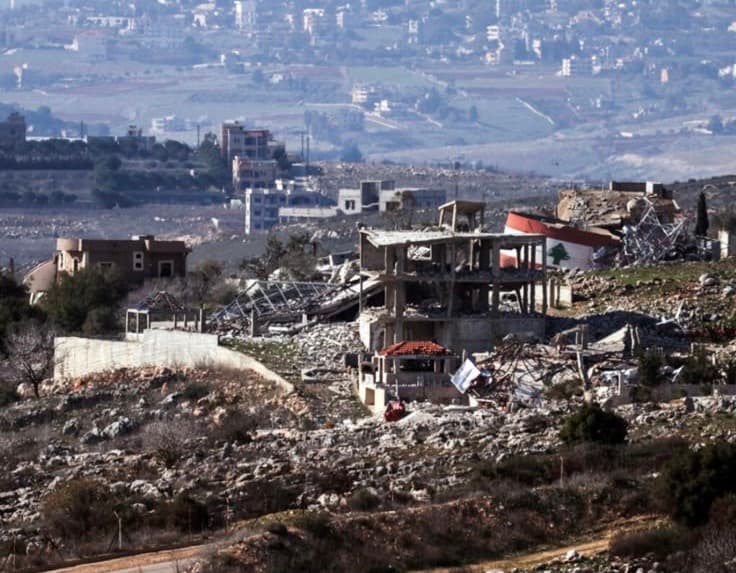
In this context, an accusing finger is pointed at Hezbollah. The displacement of the Shia population caused by the current Israeli invasion of the south has, in fact, heightened fears of a ‘coordinated resettlement’ of displaced families in Christian regions. As things stand, it is estimated that these internally displaced populations comprise thousands of families driven from their villages by the Israeli army, which is razing their homes to the ground along the entire border, over a width of approximately 10 km. And many of them continue to be housed in temporary reception centres.
Frozen bank assets
However, before succumbing to conspiracy theories, an objective observer must acknowledge that the majority of land and property sales by Christian owners can be explained by economic circumstances exacerbated by the country’s long-standing financial crisis. Since 2019, the depreciation of the Lebanese lira and the freezing of bank deposits have forced many families to sell their property to meet basic needs: healthcare, their children’s education and debt repayment.
Furthermore, the Christian population is experiencing a high rate of emigration, and those leaving often choose to sell their property in Lebanon to finance their resettlement abroad or because they no longer expect to return. Moreover, many of these departures are due to the chronic instability of the ‘Land of the Cedars’. “Those who leave are seeking stability above all else,” a single Christian lawyer told AsiaNews on condition of anonymity. That is to say, stability in employment, housing and social security.
Talal Doueyhi, president of the Haraket al-Ard (Earth Movement) association, speaking on the Christian television channel Télé-Lumière, emphasises that the issue of property sales is closely linked to the phenomenon of emigration. Migrants account for 40 per cent of land sales. In fact, a veritable demographic haemorrhage – not limited to Christians – has been affecting Lebanon since the start of the civil war (1975–1990). According to unofficial estimates, around 730,000 Lebanese have emigrated between 2020 and 2026 (equivalent to around 15 per cent of the national population), due to the cumulative effects of the economic collapse and the wars in support of Hamas and Iran in which Hezbollah has embroiled the country since 8 October 2023.
Perceived Intent
That said, it is precisely on the issue of the buyers’ motives that the debate is intensifying. In this regard, two interpretations regularly clash in the media and in political discourse: the theory of ‘malicious intent’ and demographic change, and the theory of supply and demand. Suspicions are currently directed at the pro-Iranian movement, which is accused of seeking to take advantage of the situation to ‘infiltrate’ certain Christian regions demographically – regions from which, it claims, it was driven out in the past in connection with the Maronite expansion of the 19th century.
According to several prominent figures within the Maronite Church, as well as in movements for the protection of the territory such as Harakat al-Ard, certain waves of property purchases are not simply the result of market forces, but of a deliberate strategy involving systematic purchases and inflated offers. The issue has been covered in recent news reports referring to the purchase of over 83 properties in the Metn (Baabdate, Mar Moussa, Douar, Qaaqour and Mhaydssé).
On 15 October, MP Razi al-Hajj (Lebanese Forces) submitted a report to the Public Prosecutor’s Office of the Court of Cassation to verify the source of the funds used, requesting that the legality of the transactions be ascertained. According to Talal Doueyhi, who criticises “the state’s apathy” in this regard, these large-scale purchases are the work of a Shia businessman named Réda Jaffal. The latter is said to have purchased 518,000 square metres in the Metn, including a plot of 125,000 square metres opposite a popular restaurant in Naas, in the hills above Bickfaya.
The great landlords
In his argument in favour of regulating these sales, Doueyhi questions both Hezbollah’s hidden intentions and the convergence of two unpredictable factors: the freezing of bank assets since 2019 and the upper middle class’s desire to own a flat in a European capital. In this regard, the French daily Le Figaro reported in an article published last October that Lebanese nationals are now the leading foreign buyers of flats in Paris’s 16th arrondissement, the French capital’s most exclusive neighbourhood. The trend, the newspaper notes, has accelerated since the 2019 financial crisis. “We have nothing against the poor, who sometimes find themselves in financial difficulty,” thunders the president of Haraket al-Ard, but rather against the “total lack of national sentiment on the part of certain major landowners and families whose fortunes date back to the era of the French Mandate or to the 19th-century Industrial Revolution in Europe and the first Lebanese silk mills”.
Aware of the danger, the government has just approved a bill which, on an exceptional basis, prohibits property sales and transactions in southern areas occupied by or affected by the Israeli army. It did so with the aim of protecting the social fabric and the rights of residents who can no longer access their own land or who are under pressure from speculators and war profiteers. Supporters of a freeze on property sales between different communities are calling for the bill drafted by former MP and minister Boutros Harb to come into force, arguing that the whole of Lebanon is, in various respects, in a state of emergency and should be subject to the same restrictions. In fact, as early as 2010–2011, Harb had drafted legislation prohibiting property sales between Lebanese of different religious denominations for a period of 15 years. However, this proposal was vigorously contested on the grounds of the principle of the right to private property, guaranteed by the Constitution.
Free market
This is why buyers and other analysts reject any accusations of bad faith or conspiracy theories and invoke the arguments of the free market, the need for housing and investment. The Shia community, for example, cites its own need for space due to strong population growth and the emergence of a prosperous entrepreneurial class – mainly from the diaspora – seeking to invest in the property sector or to settle in greener and safer areas of Mount Lebanon.
On the other hand, purely out of commercial opportunism, numerous investors are taking advantage of the general fall in prices on the Lebanese property market to purchase land with strong development potential. And they operate whilst firmly rejecting any accusation of ulterior political or security motives. Finally, it must be noted that Lebanese law guarantees private property rights; furthermore, the transfer of land between citizens of different communities does not in itself constitute evidence of demographic change. Nor does the transfer of property automatically imply a transfer of population or a change in the nature of their residence.