Abu Dhabi (AsiaNews) – The international community's attention remains focused on developments in the Strait of Hormuz where shipping has collapsed in the last 10 days, due to the US-Iran war, and their respective blockades.
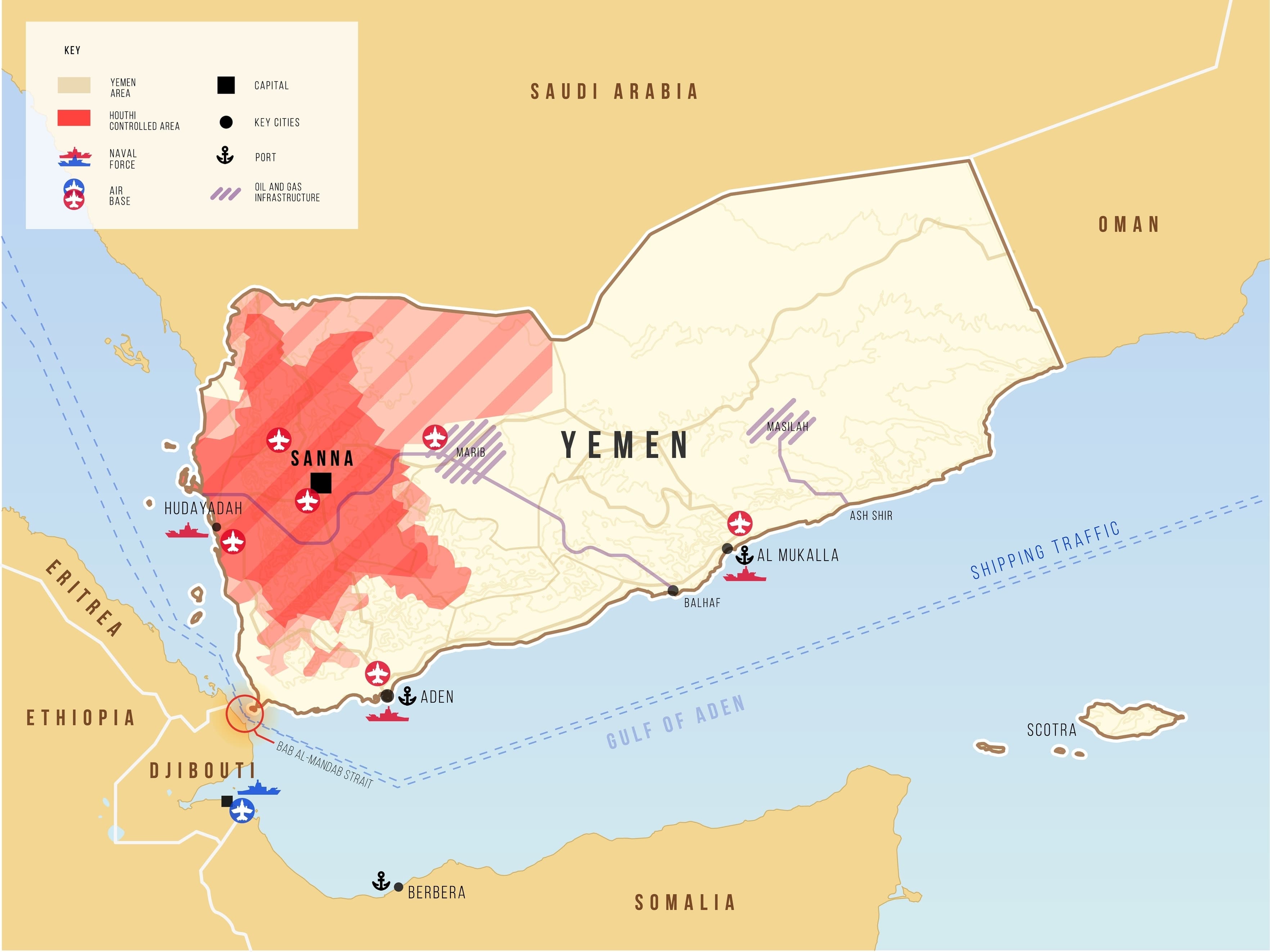
However, in recent hours, another front has opened up again in western Yemen, equally strategic and crucial for international trade since it represents the only alternative to the Persian Gulf.
Here, fighting is taking place between pro-Iranian Houthi rebels and the forces of the internationally recognised, Saudi-backed government, a serious escalation that risks blocking the southern access to the Red Sea. This has severe consequences for global trade since it involves the Red Sea route between the Bab el-Mandeb Strait in the south (Gulf of Aden) and the Suez Canal in the north (Mediterranean Sea).
Major escalation
The latest death toll from the fighting between Houthis and government forces is 81 dead: at least 39 among the regular army and 42 among the rebel militias backed by Iran. The Houthis are a key Iranian ally south of Saudi Arabia, playing a crucial in the Gulf of Aden.
The fighting broke out yesterday morning when Houthi forces launched a ground assault supported by missile and drone strikes near the Red Sea coast and in the Taiz area.
Government military sources, cited by AFP, say that the Houthis are trying to cut off the key port city of Mokha, under fire for weeks, from other government-administered areas.
Furthermore, the Houthis are reportedly moving towards the areas bordering the strategic Bab al-Mandab Strait, a sign that the rebel group's real objective, according to some experts, is to block access to the Red Sea, on Tehran's instructions.
In 2014 Yemen plunged into civil war between pro-Saudi government forces and pro-Iranian Shia Houthi rebels. It got worse in March 2015 when a Saudi-ed Arab coalition intervened, resulting in more than 10,000 deaths and 55,000 wounded. Independent sources put the death toll (between January 2016 and the end of July 2018) at approximately 57,000.
According to the United Nations, the war has caused the world's worst humanitarian crisis, made worse by COVID-19 and the concomitant food crisis, which have had devastating effects on the civilian population. Millions of people have been left on the brink of starvation, with children bound to suffer the consequences for decades.
Gateway to aid
Today, the country, home to one of the poorest populations on the planet, is still facing multiple humanitarian crises (health, educational, economic, and social).
In 2022, the two warring sides signed a truce in an attempt to respond to the various crises, but in July, fighting broke out again, more intense, linked to the broader Middle East conflict between Iran and the United States, and mediation attempts have been of little avail so far.
The latest clashes have been in areas near the Red Sea, a strategically important maritime route through which a significant portion of global trade passes.
According to some sources, the latest fighting is taking place along the axis connecting the city of Taiz to the port hub of Hodeidah, which has recently been the scene of heavy fighting for control of the area.
Last July, the southern area saw the deadliest attack in recent years, linked to the sudden Houthi offensive against government forces that resulted in the deaths of at least 16 soldiers and the wounding of 22 others.
The strategic importance of the port of Hodeidah is also confirmed by the fact that it is the gateway for approximately 80 per cent of food and humanitarian aid destined for Yemen; for this reason, seizing it is a crucial military objective. For several weeks, it has been the main battleground in the Arab country.
Attacks, ballistic missiles, and drones
Returning to the clashes of the last few hours, some sources say that Houthi fighters tried to advance towards Mount Dabbas, south of the city, which dominates the routes connecting Yemen's interior with the Red Sea.
The pro-Iranian rebels launched ground attacks as well as missiles and drones, targeting various parts of Taiz and Hodeidah provinces.
Government forces report at least 14 ballistic missiles and several drone strikes targeting populated areas and military forces along the western coast.
A statement by the National Resistance Forces adds that their units are combat-ready to repel the Houthi advance along the western front.
The latest escalation is significant because of its location: western Taiz links the mountainous interior to the coast, including the port of Mokha near the Bab al-Mandab Strait, one of the world's major maritime chokepoints.
Control of roads, mountainous positions, and coastal areas in the region can influence the movement of troops and supplies beyond the immediate battle lines.
In July, the Houthis announced a maritime blockade on Saudi Arabia, adding further challenges to the tense shipping landscape in the region and raising further concerns about the interplay between the conflict in Yemen and broader regional hostilities.
Mokha’s strategic location and the surrounding coast means that any escalation could have implications beyond Yemen, particularly if fighting threatens shipping through Bab al-Mandab.
The latest developments mark a sharp departure from the low-level fighting that followed the 2022 truce and come as Yemen remains without a comprehensive final political agreement capable of containing a major military showdown.
Experts warn that the roadmap for a nationwide ceasefire and negotiations on Yemen's political and economic future has yet to produce a final agreement, leaving the country vulnerable to renewed military escalation.