Riyadh (AsiaNews) – Fighting in Yemen has flared up again in recent hours, with intense combat between pro-Iranian Houthi rebels and the Saudi-backed government army; for its part, Riyadh has reported cross-border attacks in the vicinity of Madinah, Islam’s second-holiest city.
In a statement, the Yemeni military announced that, earlier in the day, it had struck various Houthi positions and targets in the rebel-held capital Sana’a, as well as in the northwestern province of Saada and the southwestern province of Taiz.
The latter are at the main battlegrounds of the escalating conflict, after the Houthis began gaining ground, threatening shipping and trade in the Red Sea while further worsening the humanitarian crisis.
Massive raids on the Houthis
In a post on X (formerly Twitter), army spokesman Majed al-Nuzaili reported that government forces had struck "high-value targets in the capital Sanaa," without providing further details.
The official added that government forces also targeted “11 high-value targets in the Saada province,” again without specifying the weaponry used.
In an earlier statement, al-Nuzaili had reported that air force had carried out 20 strikes over a three-hour period against Houthi movements, reinforcements, troop concentrations, fighters, vehicles, and military equipment in Taiz province.
The raids “scored direct hits on enemy targets and inflicted losses on the militia’s personnel, equipment, and military movements,” the spokesman added.
Conversely, the Houthis have not made any official statements regarding the attacks and the targets, at least according to government sources.
Meanwhile, yesterday, Saudi Arabia reported a Houthi attack on a power distribution station in Madinah, which supplies electricity to the Prophet's Mosque.
A Houthi military source, cited by the Houthi-run Saba news agency, denied the report, stating that the Saudi claim sought to mask what he described as Saudi Arabia's failure to substantiate a previous accusation, a reference to the controversial attack on Makkah in September, an incident Riyadh blamed on the Houthis, which the group denied.
In recent weeks, fighting has intensified as the pro-Iranian rebel militia seized control of several key locations in Al Hudaydah and Taiz provinces, including the strategic city of Mokha; furthermore, they reportedly extended their advance as far as Mayun Island, which overlooks the Bab el-Mandeb Strait.
Beijing’s (and Tehran’s) long reach
Recent press sources have reported that China is providing the Houthi forces with weapons and technological assistance. The group is already receiving assistance from Iran.
The Wall Street Journal notes that Iranian weapons and increasing supplies of Chinese dual-use components have helped the Houthis expand their territory and bolster their ability to threaten shipping in the Red Sea.
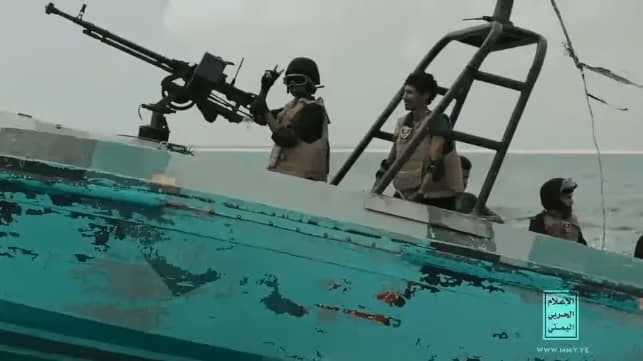
The Houthis do not possess a conventional navy, but are able to employ Iranian-designed missiles, explosive drones, naval mines, armed speedboats, and maritime drones to project power along the Yemeni coast.
According to the newspaper's investigation, their arsenal includes ballistic and cruise missiles, anti-ship weapons, and drones that rely heavily on Iranian technology and components.
In 2015, Iran’s Quds Force began shipping components for Iranian-designed missiles and drones, and sent instructors to assist the Houthis in manufacturing the weapons themselves.
This has helped turn the group into a force capable of striking Saudi oil infrastructure, disrupting shipping in the Red Sea, and threatening US forces.
In addition to Iran’s well-known contribution, aid from Beijing has also been forthcoming for some time, particularly regarding technology.
“The Houthis,” the Wall Street Journal writes, “now have a new source for the supplies they need to launch their attacks: China.”
Chinese companies are supplying dual-use goods, capable of both civilian and military application, including critical components for the Houthis' drone programs.
This revelation appears in United Nations documents and reports by arms experts cited by the US newspaper.
This shift comes at a time when traditional Iranian smuggling routes have faced increased disruptions.
For years, the Revolutionary Guard (IRGC) used small fishing vessels to transfer weapons, drone components, and missile parts to the Houthis, but many shipments were intercepted by US forces and Yemeni groups opposed to the Houthis.
Health crisis
Finally, one of the most tragic consequences of the conflict is the health (and humanitarian) situation, which is becoming increasingly dire. In fact, doctors are sounding the alarm about a system already weakened by cuts to international aid that now risks collapse due to the latest escalation.
Short on staff, medicines, and basic supplies, hospitals are struggling to cope with the massive influx of patients resulting from the intensified fighting between the Houthis and loyalist forces.
According to recent reports from the World Health Organisation (WHO), more than 800 people have been killed and 3,000 wounded, with approximately 130,000 displaced across seven governorates. Thousands more have fled across the Red Sea to Djibouti.
The resurgence of fighting has increased pressure on an already fragile healthcare system, with the wounded arriving at hospitals that are already at capacity.
A doctor in Aden, the seat of the internationally recognised government, described the situation as "miserable”.
Already devastated by over a decade of war, the country's healthcare system has suffered severe setbacks due to cuts in international aid from the United States, the United Kingdom, and other donors.
The humanitarian response in 2026 has suffered from a critical funding shortfall, receiving less than 20 per cent of the US$ 2.16 billion requested by the United Nations.
These shortages forced humanitarian organisations to scale back health services, leaving hospitals with fewer resources just as the US and Israel launched a war against Iran in February, a conflict that subsequently escalated into a broader regional war.






.jpeg&w=3840&q=75)