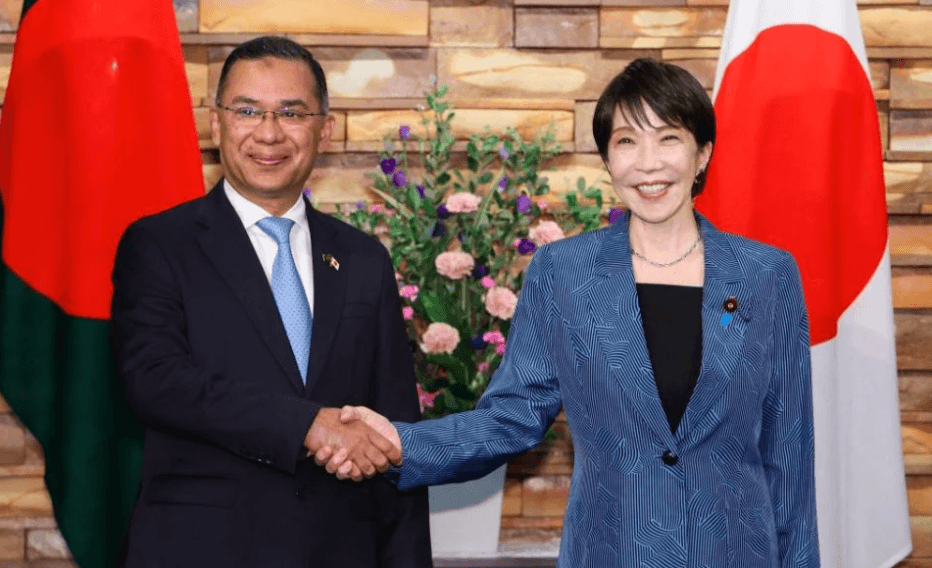
Dhaka (AsiaNews) - Not merely a “recipient of development aid”, but rather a “long-term economic partner” ready to support investment, the transfer of technology and industrial growth. This is how Bangladesh’s Prime Minister Tarq Rahman chose to present his country during his official visit to Japan last week, during which he met his Japanese counterpart and host, Sanae Takaichi, in Tokyo.
During the bilateral summit held on 28 October at the official residence of the Japanese Prime Minister (Kantei), Rahman urged companies, financial institutions and investors to play a more significant role in the next chapter of Bangladesh’s development. In this regard, the Prime Minister of the South Asian nation described the relationship between the two Asian nations as deeply rooted – and strengthened – by decades of friendship, trust and mutual respect.
“An opportunity has arisen to take this relationship to new heights,” said Rahman, who then invited Japanese businesses to explore investment opportunities in Bangladesh and to become partners in the country’s future economic expansion. For millions of Bangladeshi citizens, particularly the young people entering the labour market each year, foreign investment remains closely linked to hopes of stable employment and improved living standards. This is another reason why government officials regard Japanese investment as a key driver for the creation of skilled jobs and for accelerating industrial development in one of Asia’s fastest-growing economies.
Rahman went on to state that his government intends to strengthen cooperation with Japan in strategic sectors such as energy, information technology, railways, infrastructure and deep-sea ports. The Prime Minister then emphasised that productive investment, technology transfer and joint ventures could help unlock Bangladesh’s economic potential, whilst bringing benefits to both countries. “By working together, we can build a more resilient and prosperous future,” he said, “for both our great nations.”
Meanwhile, the visit has already yielded a whole series of significant results: Dhaka and Tokyo have, in fact, signed six cooperation agreements covering maritime security, economic relations, agriculture, fisheries and livestock farming, employment and climate change. Japan has also allocated approximately 295.5 million dollars in loans for two separate projects.
Among the agreements is a grant of up to 2.12 billion Japanese yen (approximately $13.44 million) for the supply of a patrol vessel to Bangladesh; this initiative is aimed at strengthening the country’s coastal security capabilities in the Bay of Bengal, a region of growing strategic and economic importance.
A separate memorandum between Japan’s Ministry of Economy, Trade and Industry and Bangladesh’s Economic Relations Division aims to improve the business environment and deepen economic cooperation. Further agreements were signed in the agricultural and fisheries sectors, areas that remain vital to the livelihoods of millions of people living in rural parts of the South Asian country.
Speaking following the Bangladesh-Japan Economic Forum at the JETRO Hall in Tokyo, Mr Rahman identified five sectors which, in his view, offer the greatest opportunities for future collaboration: automotive manufacturing, energy, technological and space cooperation, railways and logistics, as well as agricultural processing and production. “I invite Japanese companies to consider these five key sectors,” he said, “for future collaboration and commercial opportunities, based on mutual interests and benefits.”
Prime Minister Rahman noted that around 350 Japanese companies are currently operating in Bangladesh, but Tokyo’s foreign direct investment remains below $500 million – a figure that Dhaka hopes to increase substantially in the coming years. Trade between the two countries has also grown steadily and consistently: in the last financial year, Bangladesh exported goods worth 1.36 billion to Japan, whilst imports from Japan totalled 2.16 billion.
Rahman argued that bilateral ties should now move beyond traditional development cooperation towards a more comprehensive and effective economic partnership for both sides. Looking to the future, he urged the two nations to reflect strategically on their shared future. “Today I wish to discuss a partnership and cooperation,” concluded the Prime Minister, “that spans the next 30 to 50 years.”
The visit reflected Bangladesh’s broader commitment to attracting foreign investment, as part of its aim to diversify the economy and create more job opportunities for its ever-growing population. With this in mind, Mr Rahman concluded his four-day visit on 29 October, departing from Tokyo for Dhaka following a series of meetings focused on expanding trade, investment and long-term economic cooperation between the two countries.