.jpg&w=3840&q=75)
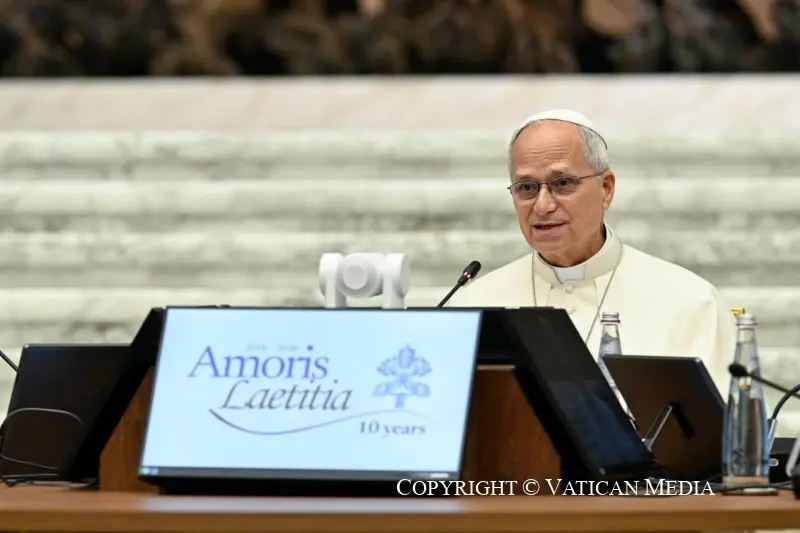
Bangkok (AsiaNews) – Cardinal Filipe Neri Ferrão, Archbishop of Goa and Daman, spoke today during the second day of the gathering convened at the Vatican to mark the tenth anniversary of the Apostolic Exhortation Amoris Laetitia.
In his address, the prelate, who chairs both the Conference of Catholic Bishops of India (CCBI) and the Federation of Asian Bishops' Conferences (FABC), looked at transformations affecting families in India and across Asia, saying that, “there is no single stereotype of an ideal family, but rather a challenging mosaic of diverse realities, marked by joys, hopes, struggles and wounds.”
Inspired by the day’s theme, “Families today: reality, beauty and challenges”, the cardinal urged the Church to begin by listening to the lived experiences of families, rather than offering ready-made answers.
The family remains where “life is received, relationships are formed, Gospel values are transmitted, and faith is lived through unique and personal histories.” At the same time, however, family life in Asia is undergoing “profound and radical transitions.”
Three changes underway in Asia
According to Ferrão, three changes are transforming the face of Asian families.
The first concerns their identity and composition: traditional extended and multigenerational families are increasingly giving way to smaller nuclear families, while new forms of cohabitation and relationships are emerging in urban areas.
Added to this is the rise in interfaith marriages, which raises new questions in Asian societies regarding the practice and transmission of faith within the family.
The second change is what the cardinal describes as the shift “from rootedness to mobility”. Urbanisation, economic growth, new development models, and greater access to education are driving more and more people to relocate, either within their own countries or across borders, in search of better opportunities.
“[M]any families entrusted to our pastoral care are no longer households connected to a single parish,” Cardinal Ferrão noted.
Then there is a third transformation, linked to material conditions, that makes building a family increasingly difficult. According to the cardinal, India and Asia share a paradox. “[G]rowth is rapid, but unequal; opportunities are expanding, but access to them remains discriminatory.”
Indeed, the dignity of life, the value of work, and the protection of rights are not experienced in the same way by everyone. “Economic insecurity, poverty, unemployment and uncertainty about the future weigh heavily on many families.”
For Christian families in various parts of India and Asia, there is the added challenge of growing religious polarisation, which makes it increasingly hard to publicly express and pass on one’s faith.
However, Ferrão emphasised that focusing on these difficulties does not mean ignoring the “beauty” that continues to manifest itself in daily life. It is, above all, the beauty of relationships, evident in the care shown to children, the elderly, the sick, and the most vulnerable.
“In such tender acts, our families lend visibility to God’s love shining through self-sacrifice, sustained by patience and sealed with fidelity,” he said.
There is also the capacity to persevere and to hope, even “amidst poverty, migration, and uncertainty,” with families continuing to create spaces of joy and hope.
Finally, there is the capacity for dialogue, particularly important on a continent marked by great religious and cultural diversity.
Let us learn from families how to change the Church
The situation has also led to a shift in the way the Church accompanies families.
Following the publication of Amoris Laetitia in 2016, Ferrão explained, Churches in India and Asia chose, first and foremost, to listen to families.
Marriage preparation was conceived as the beginning of a lifelong journey, while programmes for spiritual renewal and accompaniment for couples and children were developed, alongside the training of families and laypeople active in pastoral care.
“Pastoral work is itself a place of discernment,” the cardinal said. “We don't arrive with readymade answers. We discern together with families and, in doing so, we learn how the Church herself is being asked to change. For this reason, the Church must shift from a “mission to families” to a “mission among families.”
Indeed, “We can't guide people by standing far off and pointing at the destination. We need to be a lighthouse and a streetlight: one shows the horizon, the other lights the next step and walks alongside. Families are not just receivers of care. They are the Church's partners in mission.”
This approach also means viewing fragility differently. “Fragility is not the absence of grace,” the cardinal said. “If we listen well, we hear wisdom and faithfulness alongside pain. So, we ask not what families are missing, but what God is already doing in their midst.”
The cardinal cited the experience of a priest who, while visiting a young couple with two children, saw the difficulties hidden behind a seemingly normal family.
The husband worked long hours and the wife was torn between the children and managing the household; consequently, the parents had little time to talk to one other, and the children spent a great deal of time on their phones.
The priest listened and encouraged the husband and wife to speak openly with one another. The couple decided to make small changes: one evening a week without phones, a shared meal every day, and a few minutes of prayer together with their children.
“Their struggles remained, but they were facing them together,” Ferrão noted.
That experience also gave rise to a new form of parish pastoral care, featuring a commission dedicated to families, home visits, and the involvement of mature couples in accompanying younger ones.
“[T]he priest’s real family ministry began, not with a programme, but with a visit, a conversation and a willingness to listen,” the cardinal said.
He concluded by posing a question for the Church’s synodal journey: “What is the Holy Spirit asking the Church to change – not only in what we do for the families, but in how we understand, accompany and empower them as protagonists of the Gospel and as enduring loci of God’s revelation.”