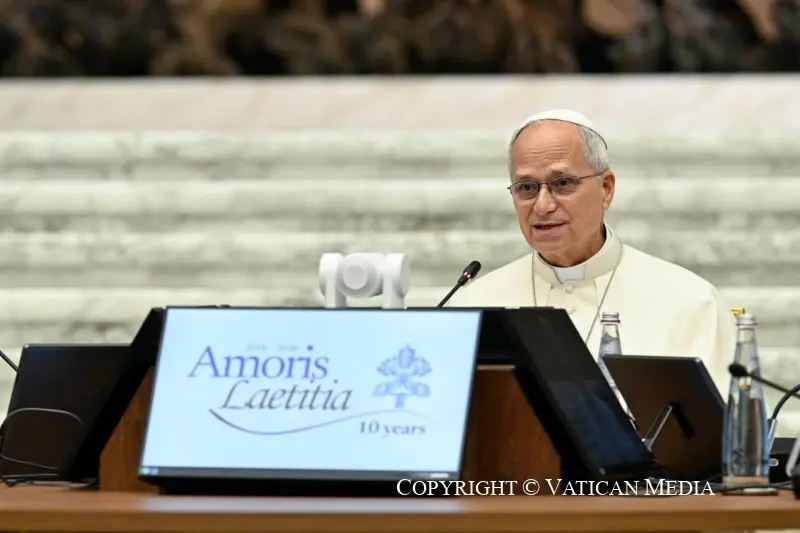
Vatican City (AsiaNews) – Pope Leo XIV opened this afternoon at the Vatican the proceedings of the meeting of the Heads of Eastern Churches and the Presidents of Episcopal Conferences on the occasion of the tenth anniversary of Amoris Laetitia, the apostolic exhortation issued by Pope Francis in 2016 following the Synod on the Family.
In his address, the pontiff said that, “we certainly have much to learn from families. Their lives also place before us questions that deserve to be faced with courage.” This is also true when it comes to the “growing distance [. . .] between the ways in which sex and intimacy are lived and the Christian vision of marriage,” as well as the relation to “Economic insecurity, migration, violence, loneliness and other forms of emotional fragility.”
For one week in Rome, 187 delegates from Churches worldwide will take stock of the journey travelled so far, while addressing the challenges that remain in an area so central to proclaiming the Gospel in people's daily lives.
Ten years of fruits, relationships, difficulties, and new questions
“[T]he Church has spent these ten years receiving Amoris Laetitia and walking with families in very different circumstances,” the pope said at the start of his address, which was characterised by the breadth of a theme that evidently cannot be reduced merely to a discussion of specific issues, such as the admission of divorced and remarried persons to the Eucharist.
“We too bring stories of what God has done among us. They are stories gathered along the path of mission: stories of conversion, of unexpected fruit, and of the relationships God has woven within families as our communities have sought to accompany them, together with the difficulties we have faced, the questions that have emerged, and what we have learned along the way,” Leo said.
“Let us place them before the Lord, share them with one another, seeking to recognize what God has been doing among us and where his Spirit is leading the Church today.”
“Families themselves participate in the Church’s mission in the ordinary fabric of their lives, through love and fidelity, care and forgiveness, the education of children, their efforts in transmitting faith, attention to the elderly and the vulnerable, and the many ways in which they serve their communities and society,” the pope said.
As bishops, he added, “we have received the responsibility, in season and out of season, of proclaiming the beauty of God’s plan for marriage and the family and his call for love and tenderness.”
What is more, “This ministry also places us in a school of listening. The wisdom of the People of God reaches us through our common faith, which enlightens all families, including situations marked by difficulties, loneliness and at times even apparent failure.”
The family and its responses to fragility
According to the pontiff, it is necessary today to know how to listen and discern even those things in contemporary culture, which, at first glance, appear distant from the way the Church proclaims God’s plan for man and woman.
“Young people continue to long for love, fidelity and belonging, yet many find it difficult to embrace how such a vision of love can take shape in their own lives or to believe that a lifelong commitment is the condition for reaching what they desire,” Leo noted.
“Economic insecurity, migration, violence, loneliness and other forms of emotional fragility also shape the choices people make and the possibilities they can imagine for their future.” Indeed, “These realities raise a number of questions that we must face with courage.”
“What are people truly seeking beneath these cultural changes? What do their joys and hopes, griefs and anxieties reveal to us? Where do our pastoral language and practices succeed in opening a path, and where do they fail to touch people’s hearts or assist their efforts to do what is good?”
Likewise, “What is the lived experience of families teaching us – an experience from which we have not yet fully learned? What can we offer as formation for healthy and holy family life? In particular, what can we learn from parents as they seek to accompany their children and young people in such contexts?”
Over the coming week, the bishops will address these questions, together with some couples, trying to heed the voice of the Spirit, without fear of confronting fragility. This, Leo noted, “raises the question of whether we are able to remain close to one another when life no longer corresponds to what had been hoped for, and whether we can recognize the work of grace even in situations marked by limits, wounds and apparent failure.”
“In this respect too, the experience of families has something to teach everyone, since fragility belongs to our common human condition and therefore also to the life of the Church.” Hence, “What kind of Church, then, do people encounter precisely when they are most fragile?” the pope asked.
“Do our communities help them discover that they still have a place, a responsibility and gifts to offer? Can the truth we proclaim be encountered through the patience, closeness and mercy of our pastoral presence? How can we announce to them the fullness of the Gospel’s teaching about the family? During these days, I invite you to give such questions their full weight.”
Two bishops from the People's Republic of China are present
The meeting that just got underway at the Vatican brought 15 heads of Eastern Catholic Churches and the presidents of 115 episcopal conferences from around the world. They include 22 bishops and cardinals invited directly by the Pope.
As was the case in recent synods, two bishops from mainland China are present: Bishop Jospeh Huang Bingzhang, 59, of Shantou (Guangdong province), and Bishop Matthew Zhen Xuebin, 56, who has served as coadjutor in Beijing since 2024.
The former is one of the bishops illicitly consecrated in 2011 whose excommunication Pope Francis lifted in 2018 upon the signing of the agreement between China and the Holy See regarding episcopal appointments. Bishop Huang Bingzhang currently also serves as vice-president of the Chinese Catholic Patriotic Association.
Pope Francis appointed Bishop Zhen Xuebin under the agreement and has been assisting Bishop Joseph Li Shan in managing the Diocese of Beijing for the past two years.
For both men, this marks their first participation in a collegial meeting of bishops at the Vatican.
Married couples are also present at the meeting to share their experiences. Two come from Asia: Charmaine Bernadette and Eren Lyle Villegas from the Philippines, and Claire Jiayann Yeh and Joseph Teyu Chou from Taiwan.
Following the pope’s address, the proceedings continued this evening with a spiritual meditation delivered by Sister Helen Alford, a British Dominican religious sister who chairs the Pontifical Academy of Social Sciences.
Over the coming days, sessions will be held on five topics: “Families today: reality, beauty and challenges”; “Young people and the discovery of the vocation to marriage”; “Married life. The first years of marriage: a decisive time”; “In the difficulties of life: accompanying and supporting”; and “Christian families as subjects of the Church’s mission”.