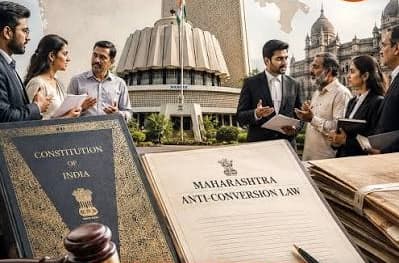
New Delhi (AsiaNews) – Archbishop Elias Joseph Gonsalves of Nagpur has expressed his concern about Indian President Droupadi Murmu's decision to sign the controversial Maharashtra Freedom of Religion Act, 2026, which has been criticised by Church leaders for potentially interfering in private’s lives.
“Even without any concrete evidence of wrongdoing, both state authorities and local groups could target interreligious couples and dedicated pastors,” the archbishop said speaking to AsiaNews.
“This distressing reality could quietly erode the sacred freedom of conscience guaranteed to every citizen,” he stressed. “It unhappily risks transforming a fundamental constitutional right, meant to protect the dignity of the human soul, into an overly regulated state concession/ privilege.”
The law, aimed at combating illegal conversions, received the presidential approval, overcoming the final constitutional hurdle. Its entry into force will occur after the Maharashtra government issues a decree specifying the date.
Approved by the state’s Legislative Assembly during the budget session, it seeks to regulate the change of faith and imposes severe penalties for conversion achieved through force, fraud, coercion, false statements, flattery, or undue influence.
“The Maharashtra Religious Freedom Bill,” an official source told AsiaNews, “has received the approval” of Droupadi Murmu, while the governor of Maharashtra has sent it to the state government for notification.
Under the law, offering money, gifts, employment, free education, promises of marriage, guarantees of a better lifestyle, or claims of divine healing to induce a person to change religion will be considered illegal.
Presenting one religion as superior to another with the intention of influencing conversion has also been included within the scope of the law.
Offences under the Act will be “cognisable and non-bailable”. Those convicted of illegal conversion can face a prison sentence of up to seven years and a fine of up to 100,000 rupees (about US$ 1,050). For repeat offenders, the penalty can rise to 10 years in prison and a fine of up to 700,000 rupees (over US$ 7,350).
The law also provides for rehabilitation of victims of illegal conversion.
It also gives blood relatives of a person alleged to have undergone illegal conversion the right to file a First Information Report (FIR), and the police will be required to register such reports.
Any police officer may also initiate an investigation suo motu cognisance, on his own initiative, if there are grounds to believe that a conversion has occurred or is being attempted in violation of the law.
Inquiries must be conducted by a police officer with the rank of sub-inspector or above, while cases registered under the law’s provisions will be adjudicated by a sessions court.
The law also goes after those who instigate, facilitate, or assist illegal conversion, including those who approve, draft, or authenticate documents related to such conversions.
A significant provision of the law places the “burden of proof on the person alleged to have caused or abetted the conversion”.
Speaking to AsiaNews about the new law, Archbishop Elias of Nagpur said: “Article 25 of the Indian Constitution explicitly guarantees every individual the fundamental right to freely choose, practise, and share their faith.” But now “India faces a direct contradiction between its federal constitution and state-level laws, leaving religious minorities deeply vulnerable.”
Regarding the Church’s position, the archbishop notes that, “The Church strictly adheres to the constitutional framework of our nation, observing rigorous and transparent canonical norms that completely forbid forced conversion or any form of material allurement.”
In fact, “Every baptism administered is entirely legitimate and voluntary, proceeding only from a true, uncoerced awakening of individual conscience.”
The prelate warns that there is a “deeply distressing” trend in which the state authorities try to regulate aspects of a person’s private life, like their religion, turning “a fundamental constitutional right, meant to shield the human soul, into an overly regulated state concession.”
Finally, Archbishop Gonsalves said: “As we approach Independence Day on August 15th, these restrictive measures and the potential misuse of [the] law directly contradict the very essence of freedom and independence envisioned by our founding fathers of our beloved motherland India”.