Faisalabad (AsiaNews) – Three years on from the violence that shook the Christian community of Jaranwala, in the district of Faisalabad, the survivors continue to demand justice, compensation and guarantees of protection.
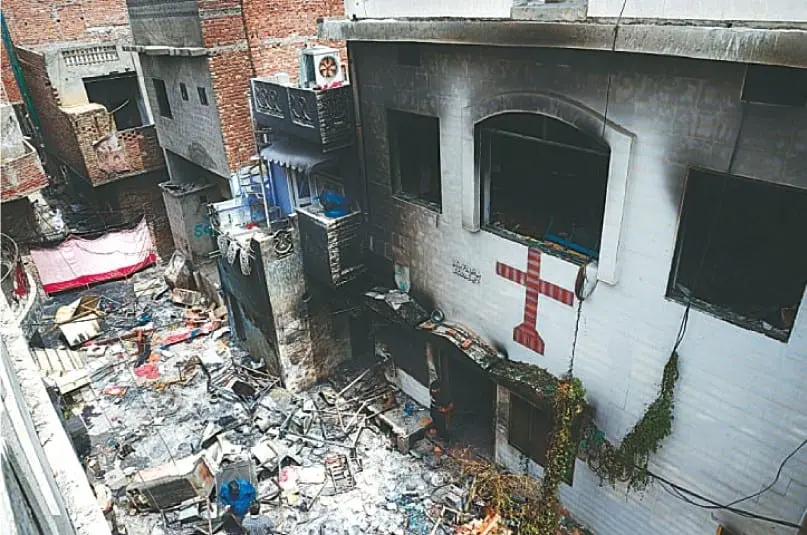
On 16 August 2023, allegations that two Christians had desecrated pages of the Qur’an sparked the most serious wave of violence against Christians in Pakistan in recent years. The allegations spread rapidly via mosque loudspeakers and social media, escalating into an attack on Christian neighbourhoods. As many as 26 churches were vandalised or set on fire, and dozens of homes were looted or destroyed.
On the third anniversary, the community of Jaranwala took to the streets once more. Local activist Samson Salamat, addressing the families of the victims, denounced the fact that, three years on, many survivors are still awaiting justice. He gave his assurance that he would continue to demand that those responsible for the violence in Jaranwala be held to account for these crimes.
Fr. Shakeel Gulzar, director of the Catholic Commission for Interreligious and Ecumenical Dialogue of the Archdiocese of Karachi, observed that material damage can be repaired, but rebuilding trust will be much more difficult. According to Gulzar, the incident demonstrates how an accusation can quickly escalate into collective violence and raises questions about the spread of disinformation and incitement to hatred, as well as the effectiveness of the response by the police.
On the judicial front, an initial sign came last month. An anti-terrorism court in Faisalabad sentenced Irfan Yousaf, a crane operator, to 10 years’ imprisonment for his involvement in the demolition of churches during the attacks. The prosecution also used video footage that had undergone forensic authentication. The verdict was welcomed by Christian leaders and human rights activists.
This conviction, however, highlights just how wide the gap still is between the scale of the violence and the accountability that has been established. Safina Javed, a human rights activist from Karachi, described the conviction as “a glimmer of hope”, but warned that trust can only be restored if the other cases are pursued fairly and if the victims are guaranteed the compensation and protection they have been promised.
Criticism of the slowness of the justice system had already emerged last year: Amnesty International had reported that over 90 per cent of suspects were still at large. In 2026, according to Christian leaders, doubts remain as to whether the police are implementing the Supreme Court’s guidelines on arrests.
Lala Robin Daniel, a human rights activist from Faisalabad, highlighted the severity of the consequences suffered by the survivors: the loss of homes, possessions, livelihoods and employment, but above all, a sense of security.
For Safina Javed, the case highlights wider problems facing the country: the misuse of blasphemy charges, the speed with which inflammatory information can spread, the protection of religious minorities, and the judiciary’s ability to prosecute those responsible. The July conviction therefore represents a step forward, but also confirms how much still remains to be done.