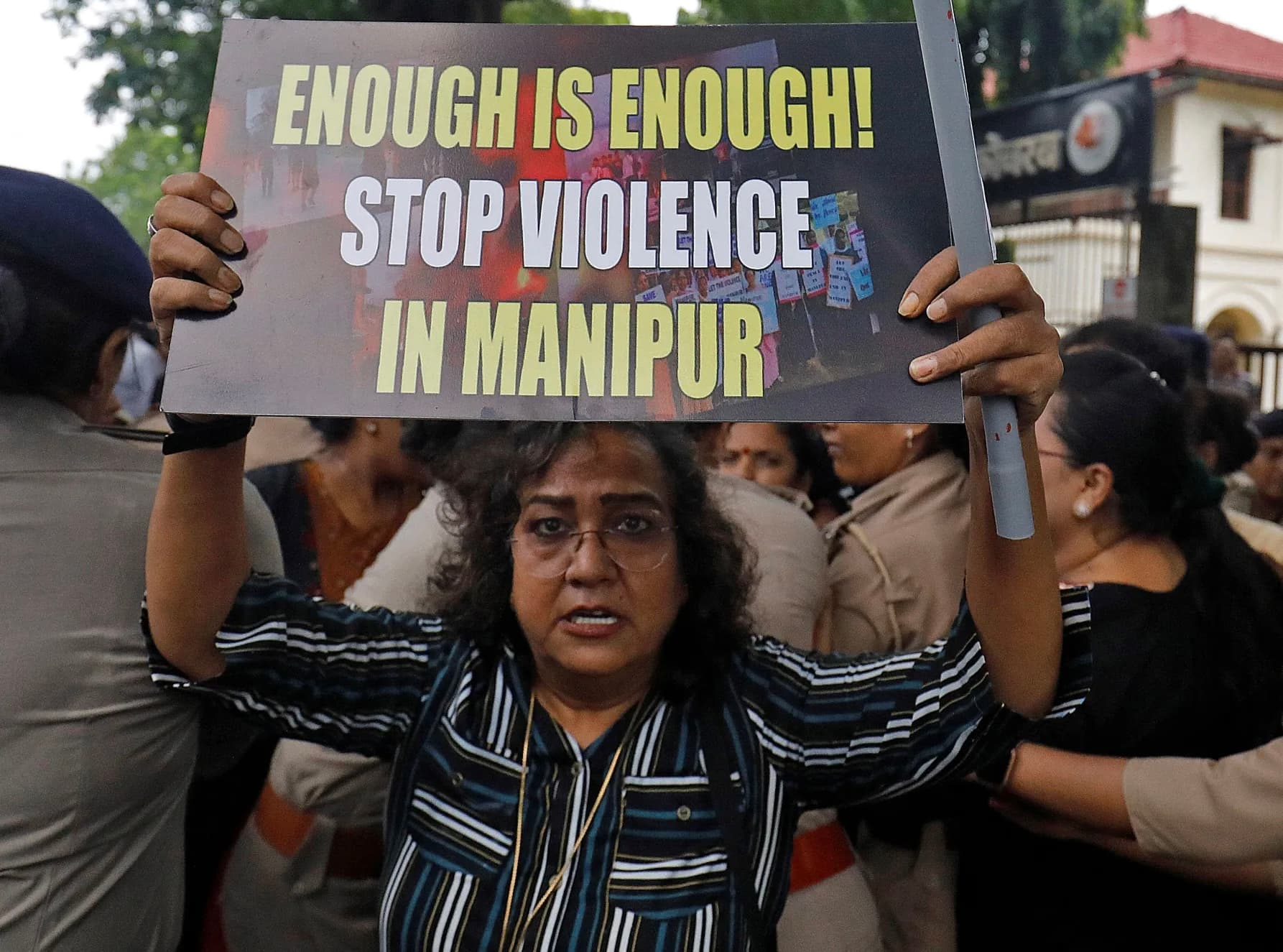
Delhi (AsiaNews) – Archbishop Victor Lyngdoh, Metropolitan of Shillong and president of the North East India Regional Bishops' Council (NEIRBC), has spoken with AsiaNews, sharing his deep anguish and concern about what is happening in Manipur.
"Our hearts,” he said, “remain deeply heavy as we witness the continuing violence, displacement, and pain afflicting our brothers and sisters” in the northeastern Indian state, which has long been the scene of ethnic and sectarian violence directly affecting the Christian population as well.
His lament addresses the unresolved crisis in the Indian state, where “Numerous lives have been lost,” and “thousands of families remain broken and displaced from their homes, and sacred places of worship have been reduced to ashes.”
At least 41 homes belonging to Naga residents, along with several community churches, were destroyed during an intense 12-hour wave of arson in Makui, a village in Kangpokpi district.
The violence broke out around 2:30 pm on Wednesday and continued through the night until 2:30 am, exacerbating tensions in the state, which has long been torn by conflict.
According to local representatives and village authorities, the destruction severely impacted three main areas in Makui, namely 17 houses completely razed to the ground in Makui Chamriupui, eight in Makui Thanamba, and 16 in Makui Thebram.
Similar incidents of arson and targeted vandalism were also reported in surrounding Naga villages, including Langka, Kapningching, and Tajeikaiphun.
Displaced residents and community leaders allege that the coordinated attacks were carried out by armed Kuki militants, who may have been acting under the Suspension of Operations (SoO) agreement established with the government.
Makui village authorities have strongly condemned the incident, describing it as a deliberate attempt to drive the indigenous Liangmai Naga community away from the vital Imphal-Tamenglong (IT) road corridor and to seize ancestral tribal lands.
This escalation occurred against a backdrop of ethnic tensions and instability in the region, which has also seen an ambush along the same corridor resulting in civilian casualties.
Although state security forces reported no deaths from arson, residents said that a massacre was averted thanks to timely warning, which allowed hundreds of families to flee into nearby forests just as the violent attack got underway.
However, a severe humanitarian crisis persists in makeshift camps, such as the one at Makui Khunjao, where hundreds of displaced women, children, and elderly people are struggling to access basic necessities, emergency shelter, and food supplies.
“The ongoing suffering of the people is a scar on our collective conscience,” Archbishop Victor Lyngdoh said, “and we cannot remain silent while hatred tears apart the social fabric of our region”.
The archbishop went on to issue an urgent appeal to all parties involved, community leaders, and both state and central governments to move beyond divisive rhetoric and actively pursue a peaceful solution.
“We unequivocally condemn violence in all its forms, regardless of who perpetrates it," the archbishop emphasised. “No grievance,” he added, “however legitimate or historical it may be, can ever be justly resolved through arson, retaliation, or the weaponisation of social media to spread malicious rumours and deep-seated hatred. Violence only breeds more violence, trapping communities in an endless cycle of retribution.”