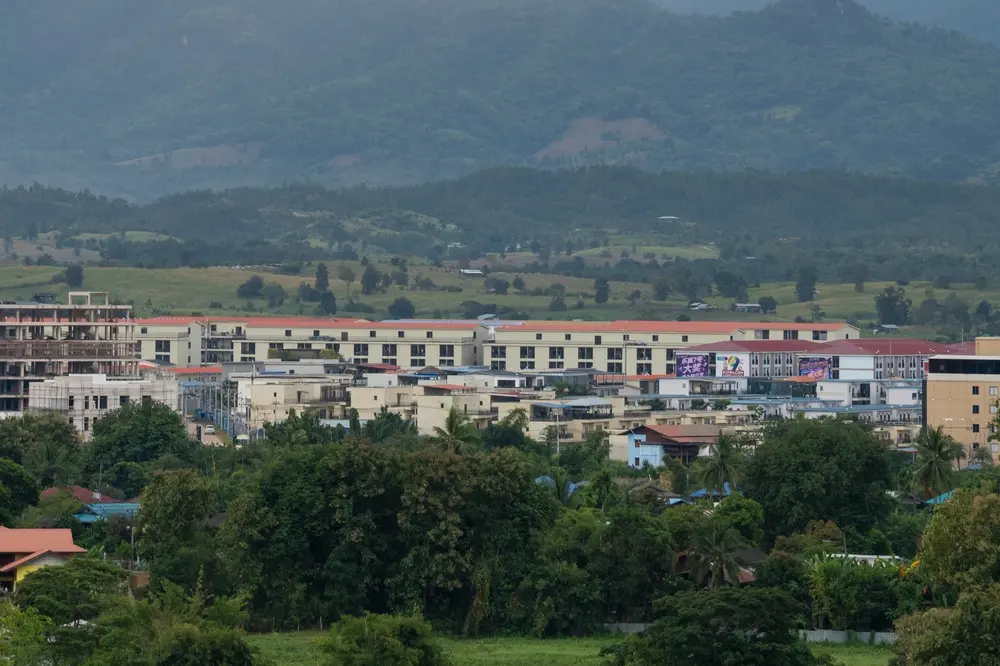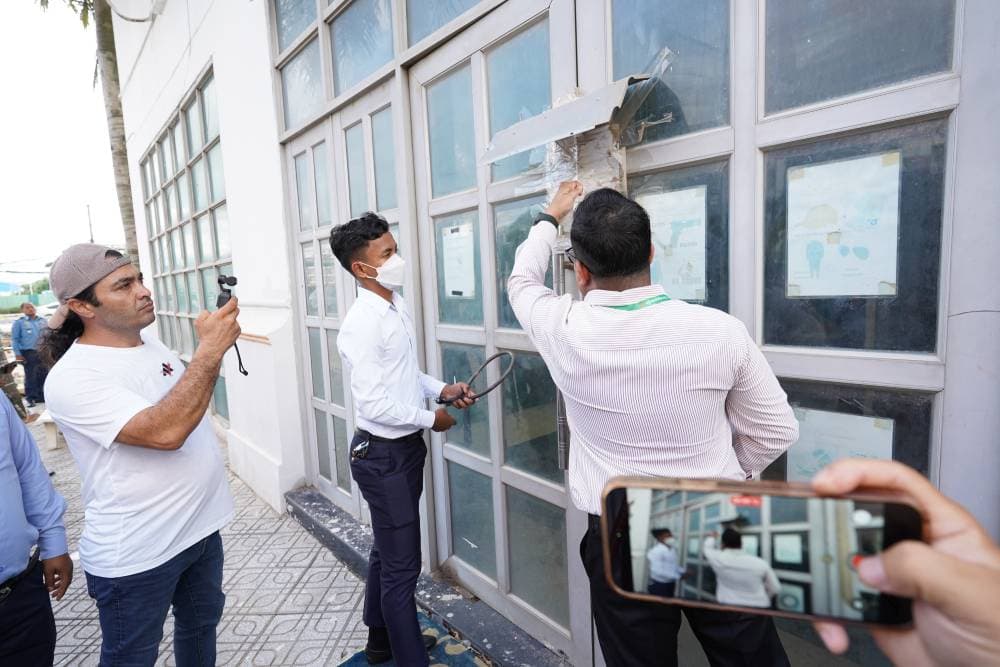
Phnom Penh (AsiaNews) – Dozens of journalists were taken on a tour in Cambodia to visit former online scam centres that authorities had shut down and turned into a sort of crime museum.
This initiative is part of a campaign by the Cambodian government to show to the world what it is doing ahead of the International Conference on Combating Online Scams, on 23–24 September in Phnom Penh, with the participation of some 20 countries, including the United States and China.
In recent years, both have stepped up pressure on Southeast Asian countries to put an end to scam centres, which involve hundreds of thousands of people, often trafficking victims, forced to engage in online phishing activities.
At the same time, links to other criminal activities proliferating in the region are becoming increasingly apparent.
The 79 reporters from various international media outlets taken to Bavet and Prey Veng reported seeing soundproof phone booths and counterfeit US$ 100 bills scattered on the floor, while motivational slogans in Chinese, such as "Give it your all" and "Getting rich overnight", were posted on the walls.
Inside the compound, which Cambodian authorities say housed up to 20,000 people last year, there was even a fake police station, used to lend credibility to scam operations conducted via video calls.
“The perpetrators impersonated officials corresponding to their target countries,” Cambodian authorities explained during the visit. "If targeting China, they posed as Chinese authorities; if targeting Vietnam, they posed as Vietnamese officials. While based in Cambodia, their operations extended internationally through affiliated branches."
The message is clear: Cambodia is committed to fighting a criminal industry that, in recent years, has turned the country, alongside Myanmar, Laos, Vietnam, and Thailand, into one of the region's main hubs for online scams.
Hay Makara, an official with the Cambodian anti-scam commission, told reporters yesterday that authorities had shut down 663 sites, including 86 large compounds, and frozen over US$ 300 million in fraud-related accounts.
The government also claims to have arrested nearly 30,000 people and deported just as many. An estimated 210,000 reportedly left Cambodia voluntarily following the crackdown.
However, the Cambodian government’s claims are not fully borne out by independent investigations; on the contrary, the latter have pointed to links between the proliferation of scam centres and a network of financial firms, casinos, and various real estate ventures that are, in turn, connected to Cambodia’s political and economic elite.
Back in June, Amnesty International had questioned the scope of the campaign launched by the Cambodian government in 2025.
Of the 86 compounds identified by the organisation, there was evidence of state intervention in only 24 cases; mass escapes or releases were documented in another seven.
Furthermore, according to the organisation, some interventions were compromised by collusion between compound administrators and the police. Crucially, none of the 73 survivors interviewed by Amnesty had been identified by the authorities as trafficking victims.
Conversely, cases were documented of foreign nationals who, upon escaping or being freed, were left without assistance, stranded on the streets or in immigration centres, while other victims were transferred to different facilities to evade closer scrutiny.
A 2024 US State Department report on human trafficking in Cambodia had documented a similar picture.
That document accused high-ranking officials, relatives of government figures, and prominent businesspeople of involvement in or profiting from scam centre operations, including through the ownership of buildings and facilities used by criminal networks.
The report also noted that some compounds received advance warning of raids, or that local police required authorisation from high-ranking officials before intervening, thereby giving operators time to relocate people and activities.
More recently, a Reuters investigation published in July details business ties between the Cambodian Lim Heng Group and buildings located just metres from the Royal Hill Resort and Casino in O’Smach, near the Thai border.
These properties, leased by the group to a Chinese national in March 2024, were used for large-scale illegal operations and housed human trafficking victims.
In this case, too, some rooms had been converted into mock police stations and foreign bank branches, serving as backdrops for video calls.
Reuters notes that it found no evidence of Lim Heng Group’s direct involvement in the scams or human trafficking. At the same time, its investigation highlights the difficulty of separating the scam centre economy from Cambodia’s business and political systems.
Lim Heng has been photographed at public events alongside high-ranking Cambodian generals and was awarded a noble title by the king. According to Reuters, he also donated US$ 20,000 to the Cambodian armed forces in 2025.
His case is not isolated; ties between the scam industry and the ruling elite have long been documented.
Cambodian senator and businessman Ly Yong Phat, for instance, was targeted by US sanctions in September 2024 due to his alleged involvement in serious human rights violations.
Facilities linked to his business interests included the O’Smach Resort, located in the same border area as the Royal Hill complex.
In 2025, the United States designated the Prince Group, a Cambodia-based conglomerate led by Chen Zhi, as a transnational criminal organisation; Washington accused the group of building an empire on operations that include scam centres, human trafficking, and money laundering.
Chen Zhi was arrested and extradited to China in January of that year, after Cambodian authorities revoked his citizenship in December 2025. Around the same time, China executed 11 members of criminal organisations that had been active in northern Myanmar.
Born in China, Chen Zhi became a Cambodian citizen and built ties with the country’s establishment over the years, even serving as an advisor to Prime Minister Hun Manet and, previously, to his father, Hun Sen, who remains the de facto architect of Cambodia’s policies.
This trail leads all the way to the highest levels of the state. Consequently, on 15 September, US lawmakers Brian Mast and John Moolenaar called on the State and Treasury Departments to investigate dozens of individuals and consider imposing sanctions over possible links to scam centres.
The list includes prominent figures within the Cambodian establishment, such as Deputy Prime Minister and former police chief Neth Savoeun, and Interior Minister Sar Sokha.
According to US estimates, in 2025 alone, transnational criminal organisations in Southeast Asia defrauded US citizens of at least US$ 18.2 billion via the Internet.
Meanwhile, Neth Savoeun himself was invited to deliver the closing remarks at the Phnom Penh conference.
While the government has showcased the emptied compounds as proof of its crackdown's success, the issue of the victims remains unresolved.
The individuals who were freed or escaped from such centres had been lured to Cambodia with false job offers and then forced, under threat of violence, to scam others.
Amnesty International has documented cases of torture, rape, forced labour, and other forms of abuse, and has criticised the failure to identify numerous victims.
Dismantling operations conducted so far have shown that physically closing a compound does not actually curb the spread of online fraud.
Cambodian officials themselves have admitted that criminal groups adapt by shifting from large facilities to rental houses and rooms, hotels, and even cars. At the conference, they will likely insist that they are close to resolving the matter.
Yet for years, human rights organisations have explained what is needed to combat these scam centres, i.e. targeting owners, financiers, and officials who enable the networks to keep operating, while simultaneously protecting trafficked individuals rather than treating them as illegal immigrants or criminals.